What angle for sliding dovetail?

smorgasbord

Member
Joined
Jan 7, 2022
Messages
1,551
Location
NorCal
I'm making a throat plate for my tablesaw, and it's going to have replaceable inserts that slide into the throat plate. I made a prototype and used the ubiquitous 14º dovetail bit, and I don't think that's enough since the insert is only about 4mm thick. Since then I've acquired 45º and 30º (from horizontal) dovetail bits. Both will flare out more than the 14º bit, but I'm wondering if the 45º will be too much and that the 30º will be better?

Any suggestions - at least for which to try first? The inserts themselves will be made on the tablesaw, so I can set the blade to either angle. My instinct says the 30º bit, but...
 
Use the 14º bit. Less is more when it comes to holding power. Too much angle, and the edges become fragile. In fact, you could easily get away with 9.5º, which equates to a 6:1 ratio. This is what I use for sliding dovetails with hand tools.


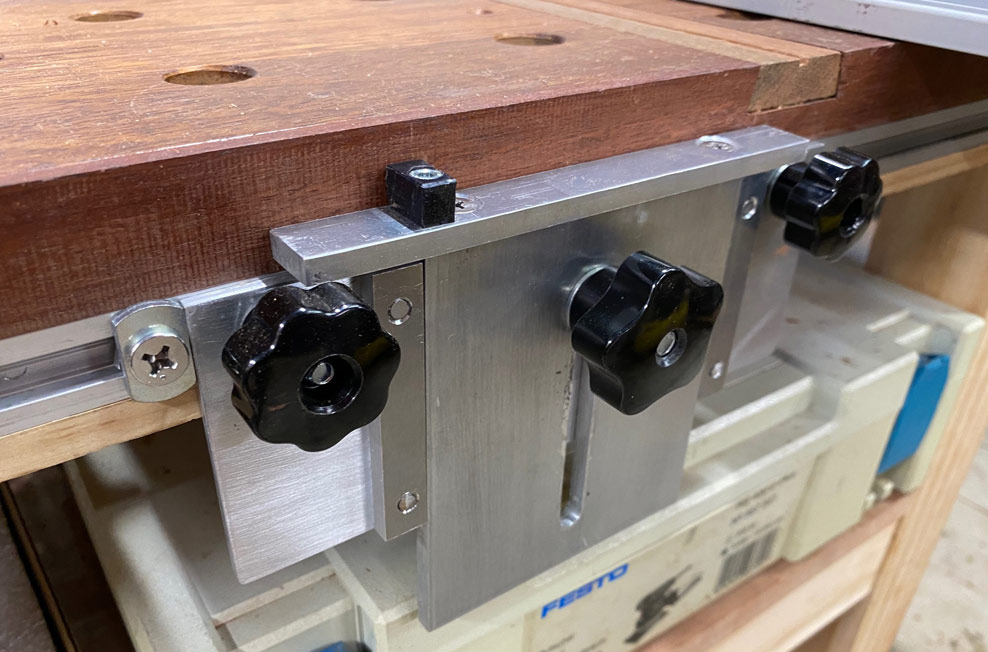
Tapered sliding dovetail insert in my MFT ...

MFT4_html_m14dfdb65.jpg


MFT4_html_m54f88292.jpg


MFT4_html_meb0621a.jpg


Regards from Perth

Derek
 
I made 2 sliding dovetail joints in my life. It was time consuming and would only be admired by experienced woodworkers (but in many instances it would be in an area where it would not be seen).

As a shelf support joint, it would not be as strong as a dado due to the removal of material at the joint. It offers some pull out mechanical advantage, but it squeezes out almost all of the glue in the joint during assembly, so I suspect a well-glued dado would equal or exceed the the tight sliding dovetail joint.

Dado joints offer almost no racking strength absent of the glue. With the glue it offers some racking strength.

I have seen no data on racking strength for sliding dovetails.

Sometimes listed is the ability to break down the assembly with a sliding dovetail. But I suspect that is wishful thinking in the warmer months due to seasonal wood expansion, and questionable in the winter too.

I made back room equipment for my picture framing shop and that included racks for holding mat boards. I put slots on 2” centers top and bottom to allow Masonite to slide in or out according to the amount of space I needed per slot. After a couple of months the Masonite or the particle board expanded enough so that the easily slid in boards were permanently affixed.

I suspect the same will occur with most sliding dovetails.

In any case, there are stronger joints that are created more easily. I have avoided them ever since.

But to answer your question, I used the same dovetail router bit that came with my Porter Cable dovetail joint jig. You can probably find that information online.
 
I tried the 14º and it really wasn't enough for the thin insert after the saw blade made its kerf.
I just checked by Colliflower miter saw insert and it's at 30º
Milling on a CNC, btw.

I really need to take a course on toolpaths in Fusion 360 - I'm wasting too much time hacking away until something works.
 
Responses to these comments ..

As a shelf support joint, it would not be as strong as a dado due to the removal of material at the joint.

The depth of the housing for both a sliding dovetail and a dado should not exceed more than 1/4 to 1/3 of the thickness of a panel. A sliding dovetail is far stronger than a dado. The sliding dovetail is a mechanical joint and does not rely on glue, where as a dado does.

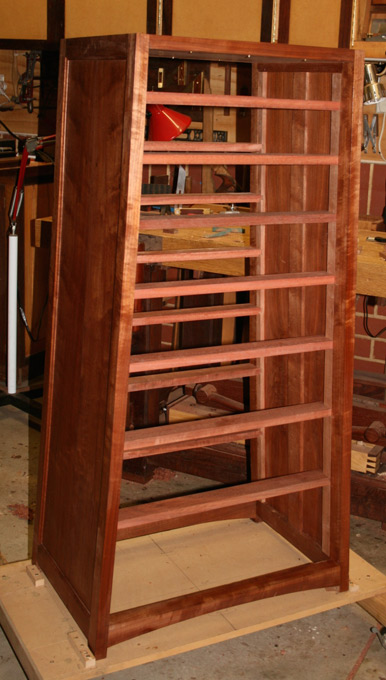
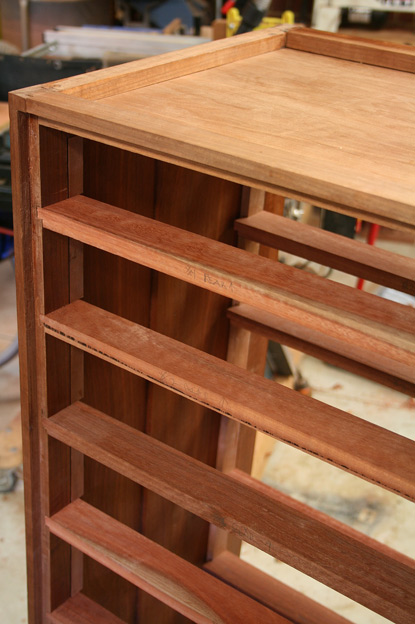
This case is held together with sliding dovetails via the drawer blades ...


I tried the 14º and it really wasn't enough for the thin insert after the saw blade made its kerf.

Do you mean that the insert was too flexible to be captured by this?

Regards from Perth

Derek
 
Last edited:
Do you man that the insert was too flexible to be captured by this?
Yes. I'll see if I can grab a photo tomorrow. I'm going to beef the insert from 3.15mm to 4.0mm, but that's as thick as I can go without compromising the throat plate, which itself is pretty thin. Depth of cut on this saw is 4" (12" blade), and I want every mm of it. The original throat plate is aluminum, mine is Delrin. Probably will use UHMW or HDPE for the inserts.
 
I would make it from aluminium. It is easy to shape with woodworking tools, such as a circular saw or router.

I made this that way ...


Regards from Perth

Derek
 
  • Like
Reactions: rst
Back
Top