Would I clog a CT 26 / MIDI with layers of paint from kitchen cabinets

pinky

Member
Joined
Nov 30, 2025
Messages
4
Hi there,

I’m restoring our 75-year-old oak kitchen cabinets that have three layers of paint (lab-tested, lead-free). I tried removing the paint with a heat gun, and managed to lift some of the paint off in sheets, but the fumes were bad, the process was slow, and the results were inconsistent (sometimes only the top layers come off, sometimes it goes all the way to bare wood).

I'm considering buying a RO 90 with either a CT 26 or CT MIDI. My concern: I’ve read that sanding paint can generate much finer dust than sanding wood. If I sand through all three paint layers on these old cabinets, would I clog the CT?

Any input welcome. Thanks!
 
Tangent: I am also puzzled by the manual filter cleaning feature on the MIDI. If you agitate the filter, won't the dust fall from the filter to the *exterior* of the bag, hence get sucked right back into the filter once the airflow is resumed?
 
Yes and no. The dust that is caked to the top of the inside of the bag also falls down to the bottom of the bag. And what was on the filter also moved sideways.

In my experience the MIDI clogs sooner than the 26 but that manual cleaning thing really does work.

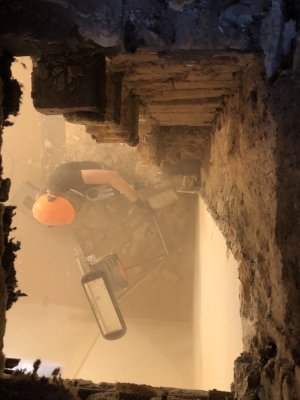
Here is my Midi-I btw, on the left of side of the picture.
It did need some cleaning afterwards. This was a brick chimney, so plenty of fine dust available.

signal-2023-07-03-21-20-09-970-6.jpg
 
Well, our flooring installer had a Fein (I think) vacuum with the automatic thumper technology. This was about 12 years ago. But that thing did a great job with keeping the filter clear/clean.
Anyway, have you considered a cyclone-style separator?
BTW - what you are doing is a pretty nasty (i.e. dusty and grungy) job. So thanks for letting some of us learn from your struggles.
 
This is the FOG, so of course you need a Festool sander and dust extractor.

But for stripping paint you need a serious infrared paint remover.
The heat gun demonstrates proof of concept but it’s too puny for a large project.

To get the best results out of an infrared source you have to find the right combination of distance to heat source and speed of movement.
For stripping cabinet doors I’d hang the infrared tool from an overarm (like a raised 2x4) set up over a table. Then slide the door under the lamp at the appropriate speed.

On the other hand, if the doors are just flat panels doing some hand scraping (not so difficult after you learn how to keep the blade sharp) to get most of the abrasive clogging paint off will then allow you to start sanding and as soon as you get down to bare wood it’s off to the races.

On the other other hand, if these are raised panel doors you’ll need to also use the heat gun and variously shaped steel implements to get paint out of the profile.
And then you sand with variously shaped sanding implements by hand. (Definitely worth trying the new Festool sponge profile sanding pads here)
And once you are about halfway through this job, while taking a much needed break, you’ll tally up all the money you’ve invested in restoring the doors, and all the hours you’ve devoted and realize you’ve got that many more hours to go, and you’ll wish you just bit the bullet and ordered new doors, ready to finish or maybe even pre-finished.
 
A lot of the technique required to strip paint has to do with heat generation. It globs and sticks back to itself and to your sandpaper. The trick to it is using a very coarse grit but not going hog wild with it. There is potential for damaging the wood underneath it, from being too aggressive.
While you are still in the considering stage, an RO125 is probably a better choice, at least for this project. Not only is the larger disc size less likely to make gouges in the substrate, and generate less heat, you can get Saphir paper for it.
Depending on how thick this paint really is, you might want to go as low as 24 grit. If it's not that bad, go for 36. The 36 might be better for wood, especially if you have concerns about technique. 24 is safer with metal, where it wouldn't gouge as deep. Either way, be prepared to move up the grit pretty quickly, so you don't cause yourself more work smoothing afterward.
Assuming re-painting, priming heavily will fill scratches better than rounding over the edges, by over doing the sanding. There is no need to go any finer than 120, for priming.
 
And once you are about halfway through this job, while taking a much needed break, you’ll tally up all the money you’ve invested in restoring the doors, and all the hours you’ve devoted and realize you’ve got that many more hours to go, and you’ll wish you just bit the bullet and ordered new doors, ready to finish or maybe even pre-finished.
Agreed 100%, except I would evaluate before getting halfway...... ;)
It is so hard to evaluate the scope of the job, from such a minimal description.
 
Thanks all for the input so far. Some more info about the project. The doors are flat with no raised panels. They taper at the edges like a quarter round would. So I believe an RO sander would be sufficient. I was inclined towards RO 90 because it has a triangle configuration that would allow me to get to corners.

My hope was to put in an hour or two everyday and then go back to cook in the same kitchen later in the day, and repeat this for about a month or so. Is this realistic or would it be a dusty mess every time I hit it even with Festool?

Even if I get the doors stripped in a shop (which would cost me the price of a CT plus RO), I would still have to contend with the frames which have the same problem with 3 layers of peeling paint. When I scrape it with a heat gun it comes out like a laminated sheet of paper, but only sometimes. Most of the time I am just wasting time creating fumes.

I plan to prime and repaint after done.

Any input welcome.
 
This the kind of project that builds character.

With sufficient ventilation you can work, vac, ventilate, and return later to a safe kitchen for meal prep.

The doors can be removed individually and scraped/stripped/sanded elsewhere but the face frames probably have to stay put.
You haven’t said anything about the sides of the cabinets. If they will be redone as well you probably can knock off the face frames and reattach later, especially if they were nailed on originally. Pull the nails out the back (inside) of the face frames and when installing new nails they should force the frame back into the original position. Use a little glue after thoroughly clearing the mating surfaces of loose fibers and bent splinters that would prevent the re-mating of the frame on the cabinet. Then patch any gaps, sand, and paint.
 
[...] heat gun [...]
Oh btw; are you in the USA? Are those heat guns as lame as your electric kettles? Yeah then it takes forever. I have one that is 2 kW, but even then... On 230V there are also some that run at 3 kW

You could also do a propane burner. That can go a bit faster too. If your burner is the type that doesn't throttle when you turn the gas tank upside down it also works to burn away wasps that harass you during the work. Won't help with the fumes though.
A lot of the technique required to strip paint has to do with heat generation. It globs and sticks back to itself and to your sandpaper. The trick to it is using a very coarse grit but not going hog wild with it. There is potential for damaging the wood underneath it, from being too aggressive.
While you are still in the considering stage, an RO125 is probably a better choice, at least for this project. Not only is the larger disc size less likely to make gouges in the substrate, and generate less heat, you can get Saphir paper for it.
Depending on how thick this paint really is, you might want to go as low as 24 grit. If it's not that bad, go for 36. The 36 might be better for wood, especially if you have concerns about technique. 24 is safer with metal, where it wouldn't gouge as deep. Either way, be prepared to move up the grit pretty quickly, so you don't cause yourself more work smoothing afterward.
Assuming re-painting, priming heavily will fill scratches better than rounding over the edges, by over doing the sanding. There is no need to go any finer than 120, for priming.
Maybe he has small recessed panels where the RO125 won't fit. Otherwise; agree. The RO90 is hard to keep flat.
EDIT: I should read better


Cool photo @Coen ...nicely done. (y) :cool:(y)

I wish I'd have thought of that when I removed our chimney.
Thanks. I didn't know the photo was taken until later. It's a Bosch GBH 5-40 DCE (probably sold under different name in the USA) with a the GDE Max (the previous version; 1600A001G9) dust extraction thingy. The two floors above this had clear air immediately after chiseling. Extracting the fine dust right near the tip of the chisel really works wonders.
This photo is looking down to ground level. Because I let too much debris fall down into the channel, combined with the 3.5m (11'6") ceiling height the ground level definitely did not have clear air after...
You removed a chimney without dust extraction? Yeah that sucks. Previously I also did it without and also with just a basic mask. Now I have the proper stuff;

Dunlop Purofort+ S5 boots (steel sole, steel nose); very comfortable
3M 6800 full-face mask; also very comfortable. Way less resistance than the covid face diapers
3M G3000 helmet
3M Optime III ear protection

And I would never go it again without.

The use of a 5 kg class hammer with the vibration reduction in the grip was also sooo much better than the 2 kg class (Bosch GBH 2-28) that I used on previous chimney take downs. No numbness in the hands. Also; the 3.2J hammer energy of the 2-28 with an SDS+ chisel easily gets the chisel buried in the wall and then getting stuck. With the 8.8J and SDS Max chisel of the 5-40 the wall just cracks open half a meter away instead of the chisel getting stuck.

If I did this more often I would definitely get an extractor with AC. Something like a Festool CTL 36 E AC or Nilfisk Attix 33 ... (forgot about the other letters). The smooth Festool hoses are superior however.
 
Thanks all for the input so far. Some more info about the project. The doors are flat with no raised panels. They taper at the edges like a quarter round would. So I believe an RO sander would be sufficient. I was inclined towards RO 90 because it has a triangle configuration that would allow me to get to corners.

My hope was to put in an hour or two everyday and then go back to cook in the same kitchen later in the day, and repeat this for about a month or so. Is this realistic or would it be a dusty mess every time I hit it even with Festool?

Even if I get the doors stripped in a shop (which would cost me the price of a CT plus RO), I would still have to contend with the frames which have the same problem with 3 layers of peeling paint. When I scrape it with a heat gun it comes out like a laminated sheet of paper, but only sometimes. Most of the time I am just wasting time creating fumes.

I plan to prime and repaint after done.

Any input welcome.
I would rather forget about using the kitchen for 3 days and do it in one go. Otherwise you would have do clean up every time too. Fine dust goes everywhere.
 
  • Like
Reactions: P_K
Did you try manual scraping without heat or chemicals yet? You might get lucky with a simple carbide scraper particularly if the paint is hard and the wood has shrunk.

Personally I wouldn’t be doing any sort of paint removal in a kitchen if I could possibly avoid it even if tested for lead. Can you move the cabinet to another area?
 
I would rather forget about using the kitchen for 3 days and do it in one go. Otherwise you would have do clean up every time too. Fine dust goes everywhere.
I agreed with @Coen. Even with a good sander and dust extractor, dust will be hard to clean on a daily basis.
 
I just bought a carbide scraper off Amazon. I am feeling lucky that I will be able to shave off the top two layers of paint as they are unsound. But the bottom layer of paint looks robust, with good bond to the wood (and is oil based I believe).

If any of your inputs above would change if using Festool on only one layer of paint (oil based) pls let me know.

Would there be a big difference between the dust captured by the CT MIDI vs 26 in my application?

Thanks all. BTW, I am in the US, and these are 75 yr old solid oak cabinets that cannot be moved or taken apart (with my skillset that is, which is non-existent).

Edit: My heatgun is a mere DeWalt cordless. I cannot conceive of using a more powerful one as the fumes would put me out.
 
You need a corded heat gun for anything more than a few minutes work. They’re cheap. This work puts too much stress on a battery.
You need better ventilation even though winter says keep the windows closed. But since the doors are flat if you can scrape off the softer paint you should be able to do this project without using the heat gun.

Try the carbide scraper but I’ve never been satisfied with the way they work.
They just aren’t sharp enough to begin with so you need to apply a lot more downward pressure to move any paint.
A thin sharp edge on a steel scraper penetrates the paint with just a little pressure and then you just have to pull.
A few strokes with a fine file every few long scrapes will keep the edge sharp. Just have to maintain the curve of the blade to avoid letting the corners of the blade get too long and making groves in the work.

The CT MIDI moves a slightly less volume of air per minute but it won’t matter much in this case. You can probably use the same bag for all the doors for the first abrasive and maybe some of the next grit. You’ll want to install a new bag for the middle grits and probably for the final grit, even thought the bag feels like there isn’t much in there it’s the surface of bag that gets full of fine debris and reduces it’s ability to allow air through, so more dust is left behind on the work and in the room. The benefit of the larger CT is the much greater bag surface area so one CT 26 bag will probably get you through to the fine grit stage, as long as you pause to open the vac and thump the bag to knock some of the dust off the surface and make room for more dust.

You’ll probably start with 40 grit after successfully scraping off the newer paint layers and you’ll run the vac at full speed. Next you can use 60 grit and maybe slow the vac down a little. From there 80 grit and if you find the sander is getting sucked down to the surface of the door too much you can slow the vac down more. Finally 120 grit with the vac running at around middle speed. You should be able to slide the sander around with the sander off and the vac on. If it’s too hard to slide the suction is still too strong. This applies to when the sander is fully in the field of the door. That is, the sander disk is not overlapping the edges of the door. When it does that some of the dust extraction holes in the pad will be sucking free air so the overall effectiveness of the dust extraction will be reduced. If you can coordinate that you should crank the vac suction back up when sanding the perimeter and turn it back down (to avoid making deeper scratches) when the sander is back inside the field.

For the doors a 5 or 6 inch sander will be good. 125 or 150 in Festool nomenclature. For the frame a Festool DTS or RTS will be better and easier to use than the larger sander, which will be more likely to round over the edges just because they overlap so much. If you want to just buy one sander for now get a 5 inch sander and just be more careful on the frames. If there is the option, get a harder sanding pad to help preserve the flatness of the frames.

I agree that doing this work for a few hours and then cleaning to do food preparation will get old fast. I’d move all the kitchen stuff out to another room for the week, after making a bunch of stuff that can simply be reheated to serve. And/or get some lightweight “Painters plastic” and sub-divide the room. This plastic is easy to use since it has some static cling to hold it to surfaces while you arrange it and it takes tape well so you can secure it to the ceiling and walls to keep the stuff behind it clean.

You’ll need a better brush for the vac to get ready to paint. I like this Miele Universal Brush because it has fine bristles that get down into the pores of the wood to knock dust out. I like this Norton Micro Fiber Cloth for final cleaning because it doesn’t get hung up on surface fibers as much as the hairy micro fiber cloths and it doesn’t leave any of it’s own fibers behind.

 
Maybe he has small recessed panels where the RO125 won't fit. Otherwise; agree. The RO90 is hard to keep flat.
EDIT: I should read better

Thanks. I didn't know the photo was taken until later. It's a Bosch GBH 5-40 DCE (probably sold under different name in the USA) with a the GDE Max (the previous version; 1600A001G9) dust extraction thingy.
That one made me literally laugh.

You're right about the item name. Many of the Bosch tools are sold as some kind of name, that you can pronounce, rather than a list of numbers/letters. Those numbers probably mean something (as far as a descriptive code) but you would have to be familiar with the lingo.
Sadly, many things are "dumbed down" (I wanted to say "for Americans", but that is probably too harsh, maybe just a more modern thing?)(In the western world anyway)

@pinky The information provided does help. As the others have said, take the doors off and set them aside somewhere for now. They are the easiest to deal with in an alternate way, if needed. Concentrate on the face frames. Since you mentioned a 75 year old house, they are very likely "built ins" meaning built on-site, as the house was in the finishing stages. They are not the typical individual boxes of newer construction. This adds to the challenge. As was also suggested, I would remove basically everything that you can. Construct as temporary kitchen in the dinning room (or even basement, if you have too) That might be impossible for an oven, so you'll have to adapt. Cover all of the openings, again old house, so it is very likely possible. Concentrate on the face frames. The perfection of stripping, on the face frames, doesn't necessarily have to be as good as the doors. They will be scrutinized much closer.
The heat gun (corded) might do the job there, at least down to the "good" layer. If it is bonded well enough, you might be able to blend/smooth it and leave it in place.
Depending upon how many doors you have, and whether the drawer fronts are removable, replacement still sounds like the best option there. Often those older kitchens had half-blind/ lipped-overlay drawer fronts = non- removable. This is very likely, since you said Oak.
Those battery powered heat guns are really only good for quick "convenience" type jobs. Heat-shrink tubing, loosening thread locker, etc.
Good luck.
 
Back
Top