1962 Corvair

To Packard's post I'll just add, that from 1960 to 1969 there were a total of 1,789,384 Corvairs sold in the US while for the same time period there were a total of 2,600,448 Beetles sold in the US, that's over 800,000 more Beetles. Both vehicles used a swing-axle rear suspension so any "Unsafe at any Speed" moments were common to both vehicles. And yet, Volkswagen did not get rid of the swing-axle suspension until the 1969 model year while Corvair changed out their swing-axle suspension to an IRS system back in 1965.

After that, we can talk about the 356 Porsche that also used a swing-axle rear suspension... :ROFLMAO:
I believe Mercedes in the 60s and early 70s used a variation of the Swing Axle as well- But they added a spring, horizontal, to their design.
As for the Corvair Push Rod Tubes leaking oil, I had heard, no idea if this is true, that compared to VW, who used a more flexible version with the ability to expand and contract, the Corvair was not able to match this movement with their Push Rod tubes design.
The one thing I always think of with that Flat 6 engine is the drive belt routing going 90 degrees for travel. Fan on top of the engine, so you have to move that cooling air somehow...
 
On the TCM (Turner Movie Classics) channel tonight, they showed a 1979 movie called “Corvette Summer”, which I did not watch. But I did watch some filler footage after the movie, which was an ad for the first generation Corvair touting it as a viable alternative to the Jeep CJ.

They showed it fjording streams, going over rough terrain—-all Jeep-like stuff.

Found it online. The Jeep stuff starts about 2:20.

 
Last edited:
On the TCM (Turner Movie Classics) channel tonight, they showed a 1979 movie called “Corvette Summer”, which I did not watch. But I did watch some filler footage after the movie, which was an ad for the first generation Corvair touting it as a viable alternative to the Jeep CJ.

They showed it fjording streams, going over rough terrain—-all Jeep-like stuff.

Found it online. The Jeep stuff starts about 2:20.


It's actually a pretty good movie. Mark Hamill was the main character, with Annie Potts, before the Ghostbusters days.
 
As for the Corvair Push Rod Tubes leaking oil, I had heard, no idea if this is true, that compared to VW, who used a more flexible version with the ability to expand and contract, the Corvair was not able to match this movement with their Push Rod tubes design.
Harley Davidsons had those too, from the first OHV (Knucklehead) up to the Evolution era at least. That wasn't really a source for leaks though, probably because they were vertical. What many uneducated people think was the well-known leak, was really a designed-in feature. The chain of the primary drive was drip-lubricated in a "total loss," system. It pumped motor oil onto the chain, inside an enclosure, which was allowed to drip out, since the clutch was to stay dry.
 
What many uneducated people think was the well-known leak, was really a designed-in feature. The chain of the primary drive was drip-lubricated in a "total loss," system. It pumped motor oil onto the chain, inside an enclosure, which was allowed to drip out, since the clutch was to stay dry.
An engine designed to leak oil... :ROFLMAO: :ROFLMAO: :ROFLMAO:...maybe the next iteration will be an engine designed to leak coolant or better yet brake fluid. :ROFLMAO::ROFLMAO::ROFLMAO::ROFLMAO::ROFLMAO::ROFLMAO::ROFLMAO::ROFLMAO::ROFLMAO::ROFLMAO::ROFLMAO::ROFLMAO::ROFLMAO::ROFLMAO::ROFLMAO::ROFLMAO::ROFLMAO::ROFLMAO::ROFLMAO::ROFLMAO::ROFLMAO:

Ya, all of us Harley and British motor cycle aficionados are always grasping for straws when it comes to justifying the horrendous amount of oil stains in our garage. However, it's not just Harley and Brit bikes that pee their pants but Italian, Spanish and even early German motorcycles contribute to the mess.
 
I believe Mercedes in the 60s and early 70s used a variation of the Swing Axle as well- But they added a spring, horizontal, to their design.

The one thing I always think of with that Flat 6 engine is the drive belt routing going 90 degrees for travel. Fan on top of the engine, so you have to move that cooling air somehow...
I believe that horizontal leaf spring was also added to the 1964 Corvair before they changed to an IRS suspension in 1965.

I was also amazed that despite the 90º routing of the drive belt, these v-belts held up to a ton of punishment as the rev limit for the high HP Corvair engines was 6000 RPM or close to that number. That's a lot of steel cords spinning over small diameter pulleys and being subjected to varying torque loads and engine speeds instantaneously.

And yet we all feel sorry for that poor bandsaw blade that's being run over 14" diameter wheels at a constant 3000 rpm. :unsure:
 
Last edited:
An engine designed to leak oil... :ROFLMAO: :ROFLMAO: :ROFLMAO:...maybe the next iteration will be an engine designed to leak coolant or better yet brake fluid. :ROFLMAO::ROFLMAO::ROFLMAO::ROFLMAO::ROFLMAO::ROFLMAO::ROFLMAO::ROFLMAO::ROFLMAO::ROFLMAO::ROFLMAO::ROFLMAO::ROFLMAO::ROFLMAO::ROFLMAO::ROFLMAO::ROFLMAO::ROFLMAO::ROFLMAO::ROFLMAO::ROFLMAO:

Ya, all of us Harley and British motor cycle aficionados are always grasping for straws when it comes to justifying the horrendous amount of oil stains in our garage. However, it's not just Harley and Brit bikes that pee their pants but Italian, Spanish and even early German motorcycles contribute to the mess.
The intentional leak was really only the early models, with the tin primary drive covers. Knuckles and Pans
Those early days had a lot of unpaved roads and a whole lot fewer bikes too.
Shovelhead leaks could be blamed on shoddy manufacturing from the AMF days. Who would believe that a bowling ball company could build motorcycles properly. They cut corners everywhere they could, making them the least desirable of all generation, to this day.

The pushrod tubes were effectively unchanged in all of those years.
 
Shovelhead leaks could be blamed on shoddy manufacturing from the AMF days. Who would believe that a bowling ball company could build motorcycles properly. They cut corners everywhere they could, making them the least desirable of all generation, to this day.
The worse thing that ever happened to Harley is when AMF took over. :cry: If I remember correctly, that's the reason Willie G and associates purchased HD from AMF. (y)

What do pin setters and motorcycles have in common...not much other than they're both mechanical in nature.

To be fair, Norton, Triumph & BSA all had automatic drip oilers to lubricate the final drive chain. One of the first things I did when I purchased a Brit motorcycle was to disconnect & eliminate the chain oiler. That thing was messy and aided in putting some of the Brit bikes down when cornering aggressively.
 
Well, if you are in the business of making bowling balls, corners, any corners at all, would be a hinderance to rolling down the alley.

Ball manufacturing and corners don’t mix. 😁
Balls are one unending corner, nothing to cut :LOL:

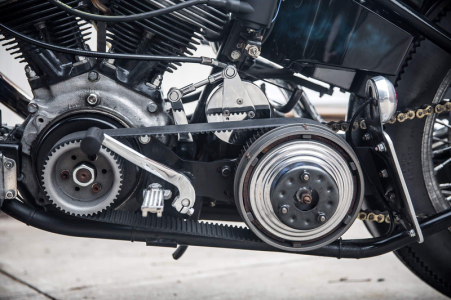
Yeah @Cheese final drive oilers are fairly easy to eliminate. Being external and easy to maintain, helps a lot, especially with modern O-ring chains. Trapped inside an enclosure makes that primary chain much more difficult. Of course it can be done. The Knuck I had through the 90s had a conversion kit, that ran a narrow belt, staying under the original cover.
That wasn't the available in those early years though. I swapped that out for the big 3" drive, after the major remodel I did to it.

@Packard you would really hate mine then. It has a belt on both drives. It is way cleaner that way. The final drive chain still needs oil, even if it is only done manually and infrequently. It still throws oil onto the tire. Those whitewalls that some nostalgia guys love, look absolutely horrible, when splattered with lube.
The Knuck still had a chain, mostly because of frame clearance. The newer one has both belts, but apparently, I don't have any pics from the left side. You can see the bely pulley back there though, in the last pic
 

Attachments

  • Orange Kunck2.jpg
    Orange Kunck2.jpg
    34.7 KB · Views: 9
  • DSC00054.jpg
    DSC00054.jpg
    88.7 KB · Views: 8
  • DSC00053.jpg
    DSC00053.jpg
    44.4 KB · Views: 9
Balls are one unending corner, nothing to cut :LOL:

Yeah @Cheese final drive oilers are fairly easy to eliminate. Being external and easy to maintain, helps a lot, especially with modern O-ring chains. Trapped inside an enclosure makes that primary chain much more difficult. Of course it can be done. The Knuck I had through the 90s had a conversion kit, that ran a narrow belt, staying under the original cover.
That wasn't the available in those early years though. I swapped that out for the big 3" drive, after the major remodel I did to it.

@Packard you would really hate mine then. It has a belt on both drives. It is way cleaner that way. The final drive chain still needs oil, even if it is only done manually and infrequently. It still throws oil onto the tire. Those whitewalls that some nostalgia guys love, look absolutely horrible, when splattered with lube.
The Knuck still had a chain, mostly because of frame clearance. The newer one has both belts, but apparently, I don't have any pics from the left side. You can see the bely pulley back there though, in the last pic
For several years, Kevlar belts were used as a replacement for timing chains. Unlike the chains, which would elongate over time and affect timing, the Kevlar belts were stable. But they could fail catastrophically. If your car’s engine was of the “non-interference” type, that is when the timing belt broke, the valves did not crash into the pistons, the engine would simply stop working.

But most engines were of the interference type and if the belt broke, the engine was scrap metal.

So you had to replace the belts (in most cases) at 60,000 mile intervals. On my Toyota, that was $800.00 in 1982. A timing chain cost more to replace but lasted twice as long or more.

I believe that belt driven timing is now history. Only older cars have them.

On a motor cycle, it means a cleaner (less oil) bike. It is going to be quieter too (but you would never notice it while riding). I suspect that you could make a roadside repair if you had a spare belt. All plusses, no minuses (except the “look”).
 
I researched a little more during Lunch yesterday. Mercedes had early versions of the Swing axle in both double and single pivot designs, versions played with for Racing and regular Road Cars. The beloved Gullwing 300SL was not immune to the issues of the Swing Axle loss of control. Saw a scary picture of one torn in half from wrecking.The horizontal spring version that I was thinking of was the last big modification, coming in at the end of the 60s, and being used far longer than I realized. Lowered pivot point and the spring was used to resist forces, preventing the tucking in that plagued Swing axle cars
I believe that horizontal leaf spring was also added to the 1964 Corvair before they changed to an IRS suspension in 1965.

I was also amazed that despite the 90º routing of the drive belt, these v-belts held up to a ton of punishment as the rev limit for the high HP Corvair engines was 6000 RPM or close to that number. That's a lot of steel cords spinning over small diameter pulleys and being subjected to varying torque loads and engine speeds instantaneously.

And yet we all feel sorry for that poor bandsaw blade that's being run over 14" diameter wheels at a constant 3000 rpm. :unsure:
 
On the TCM (Turner Movie Classics) channel tonight, they showed a 1979 movie called “Corvette Summer”, which I did not watch. But I did watch some filler footage after the movie, which was an ad for the first generation Corvair touting it as a viable alternative to the Jeep CJ.

They showed it fjording streams, going over rough terrain—-all Jeep-like stuff.

Found it online. The Jeep stuff starts about 2:20.


Have you ever seen footage of the Corvairs that were taken down to the Darien Gap as a promotional stunt by GM. they abandoned one there as well. 1961, " Daring the Darien "
 
Have you ever seen footage of the Corvairs that were taken down to the Darien Gap as a promotional stunt by GM. they abandoned one there as well. 1961, " Daring the Darien "
Of course they could have used 8 identical Corvairs to complete the video I posted. Like they always used twins when they shot movies with toddlers (in case they were cranky, not in case they died).
 
All this talk about leaky oil has me thinking back a lifetime ago. I was 24, I'll be 75 in January. Had a Tractor trailer leased to Mayflower the moving company for a few years. When we bought the tractor, it was a cab-over powered by a naturally aspirated 671N Detroit Diesel 238hp. The service manager came out to introduce himself and said " if that engine DOESN'T leak oil make sure you bring it back in and we'll fix it" When idling those engines, there was a seal or two that dripped a bit of oil. Never enough to be annoying and keep adding more but enough to let you know it was leaking.

Ron
 
On a motor cycle, it means a cleaner (less oil) bike. It is going to be quieter too (but you would never notice it while riding). I suspect that you could make a roadside repair if you had a spare belt. All plusses, no minuses (except the “look”).
Well, there is one gigantic minus, and it happened to a friend of mine. If you run it totally open, like mine is, there is a very real possibility of something getting caught in it. He rode his Panhead for over 10 years that way, until that one fateful day. He reached for the kickstand, while it was running, while standing off to the left side. (This is something that you should never do) He got his foot in the opening, wedging to the rear, and it went right around the rear pulley. Of course, he missed the kickstand, and the whole mess fell on him. Broken foot, broken ankle, trapped, bad day.
At least one manufacturer of those kits, makes a filler plate to prevent that.
 
When I got my first German Shepherd puppy, I worked with a former dog trainer for the U.S. Marine Corps. His home was in a particularly rough neighborhood in Brooklyn.

He had a big Electra Glide (circa 1970).

He also had a running feud with a neighbor a few houses down the road. So on sunny Sundays he would be out in front of his neighbor’s house polishing his Harley. Typically, that same evening, someone would break into his neighbor’s garage looking for the Harley. The neighbor never caught on.


Last edited:
Back
Top