
You are using an out of date browser. It may not display this or other websites correctly.
You should upgrade or use an alternative browser.
You should upgrade or use an alternative browser.
All you need to know about the old and new DF500s (including why paddles replaced the pins and why cordless) -- straight from the horse's mouth
- Thread starter ChuckS
- Start date
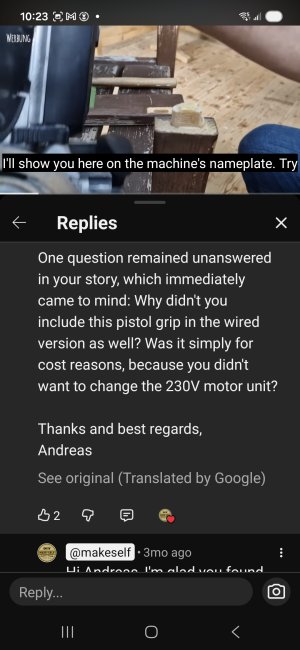
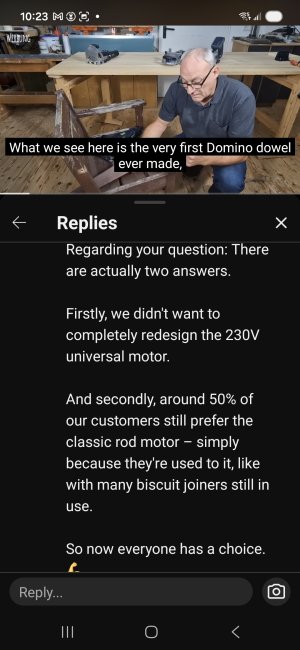
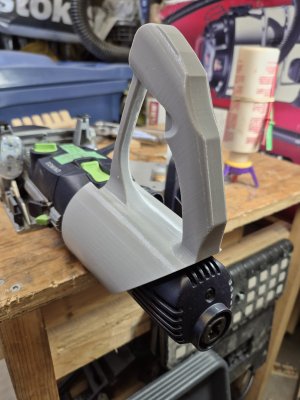
Looks like corded folks have to wait for a long time if they want a DF500 RQ with a handle. In the meantime, those who can't wait like me, they can consider a 3-D printed option (which, of course, is not as good as the one on the DFC that's lower and close to the base):

Cheese
Member
It's very interesting that Wolfgang considers both the original pin version and the newer lever version of the DF 500 to both be Generation 1 tools and it's basically the new dual column guide that graduates the new DF 500 to Generation 2 status. 

mino
Member
They probably developed both versions at the same time as alternates and so were mostly "free" to pick one or the other when actually making the tools.It's very interesting that Wolfgang considers both the original pin version and the newer lever version of the DF 500 to both be Generation 1 tools and it's basically the new dual column guide that graduates the new DF 500 to Generation 2 status.

luvmytoolz
Member
I thought the only reason they went later to the lever or paddle type was because of some patent issue with the pins?They probably developed both versions at the same time as alternates and so were mostly "free" to pick one or the other when actually making the tools.
mino
Member
Yes, that is the spoken /and likely/ cause why they switched the production model. Though when you develop new tools you prototype various paths ..I thought the only reason they went later to the lever or paddle type was because of some patent issue with the pins?
My take why they consider both 1st gen is because both were originally developed concurrently as alternates, along with the DF 700 version.
Cheese
Member
I don't believe that wives tail as the DF 500 was released in 2005/2006 while the DF 700 was released in the US & UK in 2013...that's a 7 year development time frame between the release of the DF 500 & the DF 700, That length of development is significant and certainly doesn't support the idea that these tools were developed in parallel time frames.My take why they consider both 1st gen is because both were originally developed concurrently as alternates, along with the DF 700 version.
I'd offer the suggestion that after releasing the DF 500, certain issues surfaced that Festool realized they needed to rectify before the release of their new DF 700.
+1, just like new car models getting ungraded and refined based on internal reviews as well as user feedback.
The reason given for the decision to release the cordless model was a big surprise to me, because the cord tangling with the hose, if it really was a problem, could be and has been easily fixed with much much simpler and cheaper solutions (cord ties, clips, etc.).
That business decision is gonna come back and bite the bottomline in the future when their bean counters report that they aren't selling. Unless they could find a way of designing the cordless model to be used without dust extraction.
Someone (Jeff?) mentioned about an upgrade kit (i.e. a new fence for the existing DF 500 Q owners). That would be a windfall for Festool if it could develop it. It's not worth the money to buy a new corded DF500 just for the new lever pins (now that we know it'll still be handle-less).
I remember the upgrade offer (for new beading blades) by Lee Valley Tools for its Veritas plow plane. Every plow plane owner I knew took advantage of it. Part of their philosophy to take care of their customers so that no one is left behind.
The reason given for the decision to release the cordless model was a big surprise to me, because the cord tangling with the hose, if it really was a problem, could be and has been easily fixed with much much simpler and cheaper solutions (cord ties, clips, etc.).
That business decision is gonna come back and bite the bottomline in the future when their bean counters report that they aren't selling. Unless they could find a way of designing the cordless model to be used without dust extraction.
Someone (Jeff?) mentioned about an upgrade kit (i.e. a new fence for the existing DF 500 Q owners). That would be a windfall for Festool if it could develop it. It's not worth the money to buy a new corded DF500 just for the new lever pins (now that we know it'll still be handle-less).
I remember the upgrade offer (for new beading blades) by Lee Valley Tools for its Veritas plow plane. Every plow plane owner I knew took advantage of it. Part of their philosophy to take care of their customers so that no one is left behind.
Last edited:
mino
Member
In the premium-hobby market there is an increasing cohort of customers who are cordless-only as matter of policy. This is an additional market to the traditional site-animal markets for cordless and it is untapped for Festool to a big extent. Such a customer may forego the DF just because it has a cord..The reason given for the decision to release the cordless model was a big surprise to me, because the cord tangling with the hose, if it really was a problem, could be and has been easily fixed with much much simpler and cheaper solutions (cord ties, clips, etc.).
That business decision is gonna come back and bite the bottomline in the future when their bean counters report that they aren't selling. Unless they could find a way of designing the cordless model to be used without dust extraction.
I see the corded DF as the more "pro" tool as far as market targeting goes. Same as with the sanders.
The cordless group you suggested is so small when it comes to the domino machine. Also, this so-called cordless group wants nothing attached to their tool. Last time I checked, the DFC still has a hose, even more bulkier than a cord, that the cordless group dislikes. (I suspect that they put a handle on the DFC but not the new RQ because they also know if the RQ has a handle, even fewer people would buy the DFC for the handle feature. That is, less selling point for the cordless model vs the corded one. Of course, even if this is true, no one from Festool or associated with Festool will tell you that.)
Almost all cordless routers are seen used on social media without dust extraction for a good reason!
Of course, only time will tell if I'm right about the cordless model.
The majority of domino machine owners I know or in the local woodworking club here are hobbyists (65% or so). And surprisingly, all DF700 owners are hobbyists.
That said, a local custom furniture maker and friend does everything with his DF500 no matter the size of the project his clients throw at him.

Almost all cordless routers are seen used on social media without dust extraction for a good reason!
Of course, only time will tell if I'm right about the cordless model.
The majority of domino machine owners I know or in the local woodworking club here are hobbyists (65% or so). And surprisingly, all DF700 owners are hobbyists.
That said, a local custom furniture maker and friend does everything with his DF500 no matter the size of the project his clients throw at him.
Last edited:
luvmytoolz
Member
I can never quite wrap my head around things like this, I well appreciate and applaud the idea of making the tools work for the project, but there comes a point where the size (or mass/weight) of the project exceeds the practical capabilities of the DF500 and the DF700 is then by far the more appropriate tool.That said, a local custom furniture maker and friend does everything with his DF500 no matter the size of the project his clients throw at him.
Especially for a business where time and reputation is money, and tools are tax deductible. I've bought many niche tools over the years even though I knew I would have a narrow use case scenario, but they filled a specific role that they were invaluable for.
And stunning cupboard by the way, very nice work!
Michael Kellough
Member
That (very nice) cupboard seems well within the capacity of the tenons available for the DF 500.
It looks like glue is still the primary bond in this case.
It looks like glue is still the primary bond in this case.
Cheese
Member
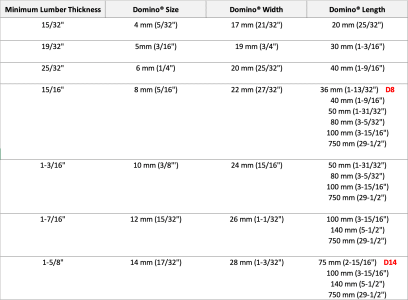
I did ask him why he wouldn't get the DF700 as it was tax deductible. His main reason was that he had been in the custom furniture business for a long time without the domino as it wasn't invented, and for the very very few projects that he would need the DF700, he would go back to what he was good at (M&T and dowels).I can never quite wrap my head around things like this, I well appreciate and applaud the idea of making the tools work for the project, but there comes a point where the size (or mass/weight) of the project exceeds the practical capabilities of the DF500 and the DF700 is then by far the more appropriate tool.
Especially for a business where time and reputation is money, and tools are tax deductible. I've bought many niche tools over the years even though I knew I would have a narrow use case scenario, but they filled a specific role that they were invaluable for.
And stunning cupboard by the way, very nice work!
He belongs to the "old-fashioned" furniture maker type with the domino and a dust extractor the only Festool machines in his shop. When he needs to break down sheets, he gets his married daughter to come home and help him, a routine, according to him, has been around since she was in her late teens. He insists that is far more efficient than using a track saw system as his shop has no space for a cutting station.
One of his specialties is to add a new piece that will blend in and look like it has been part of the existing furniture set up since Day 1. The hallway cabinet in the above picture matches both the main entrance door and other existing pieces in the hallway.
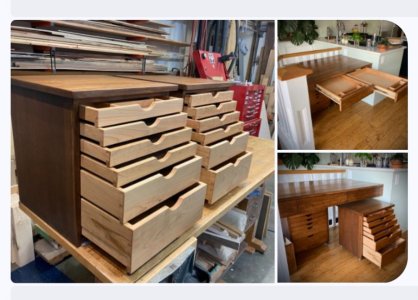
He custom built these desk and rolling cabinets for a client whose daughters needed a space for their painting hobby.
Attachments
Last edited:
luvmytoolz
Member
That makes sense, I'd imagine it would bring a great deal of satisfaction doing the M&T joints.I did ask him why he wouldn't get the DF700 as it was tax deductible. His main reason was that he had been in the custom furniture business for a long time without the domino as it wasn't invented, and for the very very few projects that he would need the DF700, he would go back to what he was good at (M&T and dowels).
I'm lazy though, so I'd always go the DF700 route in those instances, especially if it's an even somewhat tenuous excuse to buy a new tool! ;-)

MacBoy
Member
a local custom furniture maker and friend does everything with his DF500 no matter the size of the project
This is 50% of the reason why I just sold my Domino XL. The other 50% reason is it wasn’t getting used.
A retired cabinetmaker and furniture maker bought the Carvex and Accessory kit from me.
During our discussion, I learned he wanted my ETS EC 150/3 sander. He visited the next day to get it.
I then asked if he also wanted the Domino XL.
Upon leaving, he said “You nearly cleaned me out! I always walk around with $3000 in my pocket.”
Indeed, despite the new lever pins, grip handle/battery and v-groove construction in the newer models, the existing Q model performs well for most users who use it for the common and general applications. Those new features don't add on any new functions to the machine and are simply nice-to-have features.
I consider them refinements, not upgrades, just like the switch from the pins to the paddles/flaps. The battery is extra cost as it'll die, not to mention that you will need a spare battery if you are a heavy user.
That said, some after-market accessories like the TSO Big Foot and Veritas Domino Joinery Table add precision/handling capability to the domino machine in some applications. So the machine still has its limitations.
I was surprised that they didn't release their new models with a bigger support bracket, which, unlike redesigning the motor, would be a simple, no brainer thing to do.
Lastly, I don't buy the lazy/made-up argument that not putting a handle in the RQ model is offering buyers a choice. The claimed 50% of users who are ok with the use of the barrel (like operationg a biscuit joiner) is irrelevant. What about the other half (or perhaps more than half) who want a handle? You fix it if there's a deficiency.
I consider them refinements, not upgrades, just like the switch from the pins to the paddles/flaps. The battery is extra cost as it'll die, not to mention that you will need a spare battery if you are a heavy user.
That said, some after-market accessories like the TSO Big Foot and Veritas Domino Joinery Table add precision/handling capability to the domino machine in some applications. So the machine still has its limitations.
I was surprised that they didn't release their new models with a bigger support bracket, which, unlike redesigning the motor, would be a simple, no brainer thing to do.
Lastly, I don't buy the lazy/made-up argument that not putting a handle in the RQ model is offering buyers a choice. The claimed 50% of users who are ok with the use of the barrel (like operationg a biscuit joiner) is irrelevant. What about the other half (or perhaps more than half) who want a handle? You fix it if there's a deficiency.
Similar threads
- Replies
- 11
- Views
- 972

- Replies
- 65
- Views
- 3K
- Replies
- 15
- Views
- 635

- Replies
- 3
- Views
- 289
