Analyzing My Domino Error

onocoffee

Member
Joined
Sep 23, 2024
Messages
1,091
Location
Baltimore, Maryland, USA
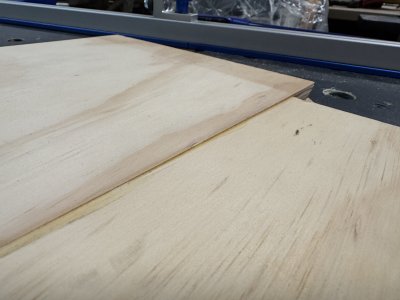
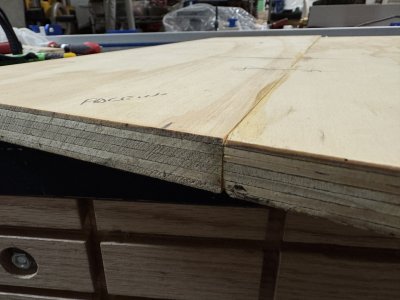
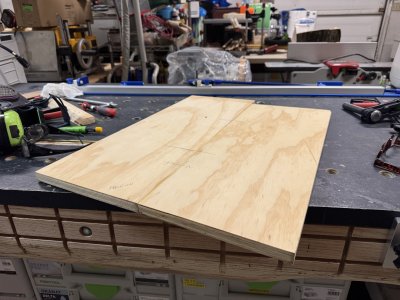
Last night, I glued up two small sheets of 18mm baltic birch plywood. Used the DF500 with 5x30 dominoes for the joinery. On the nearest edge in the pic, I used the flap to drill the mortise at 37mm and the other two at the random intervals where I put the pencil lines. The nearest mortises on both boards were at the narrowest setting. The two other mortises on the right board were also narrow, and the two on the left board were at the mid setting. Used TB2 and clamped them together overnight.

In the morning, I noticed that the farthest end had a little drift (maybe .5mm). On that end, I did not place a domino because I had the expectation that the other three would maintain alignment across the entire joint. I see now that I wrong.

But on the near edge, there is a slight amount of drift. Not as dramatic as the far end but I can see and feel it with my fingers. It's not perfect. The joint at the other two dominos are spot on.

My current assessment is that I must have plunged slightly incorrectly on at least on of the mortises to achieve this result. Does this sound correct?

By this point, I've drilled quite a lot of Dominos but it has been more than a couple weeks since my last use of the DF500. In the end, the far end will get cut off because it will just be excess for the finished panel and the near joint isn't dramatic enough to cause any issues for the end use of the panel. Just wanted to check in to see if my evaluation holds water and that I need to pay extra attention next time. Thanks!
 

Attachments

  • IMG_9350.jpeg
    IMG_9350.jpeg
    4 MB · Views: 41
  • IMG_9351.jpeg
    IMG_9351.jpeg
    1.9 MB · Views: 41
  • IMG_9352.jpeg
    IMG_9352.jpeg
    2.3 MB · Views: 41
Assuming you mortised from the same reference side of both boards, the likely reason for what you observed was either or both of the boards were not dead flat.
 
I struggled with this sort of thing when first starting with the Domino.

Aligning the edges of two boards using the paddles...
You can get bits of saw dust, or splinters caught between the paddle and the board - this can throw off the alignment by 0.5mm.
I place the domino on the board and slide the machine along until the paddles are against the reference edge, you don't need to force the machine against the reference edge.

Aligning the face of two boards...
Assuming you've referenced off the top face on each board and the fence hasn't moved...
If the machine doesn't sit flat against the reference face then the mortice will be in the wrong "elevation" on the edge.
If the board is hanging off the edge of your workbench and you're holding the Domino against the edge using the grip on the fence it's possible for the machine to angle upwards very slightly.
Put the board on your workbench so only 5mm to 10mm is over hanging your workbench.
Plunge the machine SLOWLY (it's not easy to do and takes a lot of practice, think of plunging the machine with a similar arm movement to playing pool [or snooker ;) ] )
Try to push the Domino from the very end of the motor housing, imagine you're trying to push the Plug-it cord into the machine.

Keep practicing, you'll get it. I did!! :)

The best tip??? Keep track of your references edges and faces, it's very easy to flip a board over and reference off the wrong edge/face - been there, done that many times :(

Bob
 
I wouldn't stress about it too much, unless it starts to be a consistent problem, especially since the test piece is on mid-tier plywood (btw, that looks like pine face ply rather than baltic birch, -- did someone sell it to you as BB? Unusual too that the left board seems to only be 6 layers rather than an odd number). A decade into plunging with the domino, this still happens on occasion with my projects, for the reasons articulated above -- boards aren't truly flat, dust and chip interference, misplaced pressure while plunging, etc. It never results in an error that a quick sanding or hand planing can't eliminate, and so the need for occasional correction is just part of my process now.
 
I wouldn't stress about it too much, unless it starts to be a consistent problem, especially since the test piece is on mid-tier plywood (btw, that looks like pine face ply rather than baltic birch, -- did someone sell it to you as BB? Unusual too that the left board seems to only be 6 layers rather than an odd number). A decade into plunging with the domino, this still happens on occasion with my projects, for the reasons articulated above -- boards aren't truly flat, dust and chip interference, misplaced pressure while plunging, etc. It never results in an error that a quick sanding or hand planing can't eliminate, and so the need for occasional correction is just part of my process now.
Got it. I didn't pay close attention to what it really is. I would think you're assessment is correct. And these were given to me from a friend who had leftovers from a house project he had worked on.

I don't typically work with plywood and usually mill my own lumber, so I wasn't sure if it was just my error but now it could be errors in the board. Thanks!
 
Back
Top