Floor Standing Drill Press On Wheels?

onocoffee

Member
Joined
Sep 23, 2024
Messages
1,516
Location
Baltimore, Maryland, USA
For the past year, I've been wanting to put casters on my floor standing drill press - an old Dayton 3Z919 cast iron. Being able to move it would be very convenient in my garage, but I have been concerned about the potential for toppling.

My current thought is to build a low-profile base out of white oak from a pallet rescue. I've got some plate-mounting 2.5" double locking casters from Woodcraft that I've used on quite a few shop projects and they've proven to be of very good quality and reliable.

The cast iron base is 450mm wide and 585mm deep. The cast iron table is a little larger in width at 472mm. Overall height is 36 5/8"/1371mm, and the total weight is 372 pounds.

I've been thinking of trying to do a build that would keep the cast iron base as low to the floor as possible and like the idea of the caster mounting plate being at a height higher than the base, but not quite sure the best way to build that for strength and durability.

I had been thinking that the base would need to sit on a panel made of white oak slats and noticed that the base is designed with four feet in the corners - those are the only contact points for the base, so I don't know if I would need to make an entire panel?

Any thoughts you might have will be appreciated.

Thanks!
 
I built a base inspired by this plan to fit my old cast iron Craftsman that my grandpa bought around 1970. It does not feel tipsy at all.


Hope this is of use.
 
“Overall height is 36 5/8"/1371mm” That’s too short for a floor standing drill press, typo?

I looked at photos of that model on Ebay and the width of the base I saw was about half the length.
In that case I’d put it on a dolly to make the footprint wider. (Strip off the carpet is it has it)
Unless you are shorter than average raising the machine about four inches higher shouldn’t much difference in operation.

I keep my drill press on a dolly with a bunch of heavy drill press related equipment stacked on the base.
The total weight pressing on the rubber tires on this particular dolly keeps it where I park it even while being used.
 
I built a base inspired by this plan to fit my old cast iron Craftsman that my grandpa bought around 1970. It does not feel tipsy at all.


Hope this is of use.
That's a great really practical design, but for me I'd have no open sections, as they'd fill up with swarf pretty quickly.
 
“Overall height is 36 5/8"/1371mm” That’s too short for a floor standing drill press, typo?

I looked at photos of that model on Ebay and the width of the base I saw was about half the length.
In that case I’d put it on a dolly to make the footprint wider. (Strip off the carpet is it has it)
Unless you are shorter than average raising the machine about four inches higher shouldn’t much difference in operation.

I keep my drill press on a dolly with a bunch of heavy drill press related equipment stacked on the base.
The total weight pressing on the rubber tires on this particular dolly keeps it where I park it even while being used.
I'm 5'8" so the additional few inches shouldn't be an issue for operation. I am just concerned about overall balance and tipping. I'll have a look at some dollies.
 
I built a base inspired by this plan to fit my old cast iron Craftsman that my grandpa bought around 1970. It does not feel tipsy at all.


Hope this is of use.
Thanks. I like their design. The idea I've been playing with has a similar lower case but with Systainer storage (of course). How did you handle the casters on your press?
 
I would make a base using two layers of 3/4” plywood and adding 5 casters. I have found from my photo studio days that a 5 casters base is much more easily maneuvered than a 4 caster base. Also, a 4” diameter polyurethane caster rolls much easier than other options. Harbor freight has them at a deep discount. They seem to be of decent quality. If you are using 5 wheels, all of them should be swivel. I don’t think you will need locking wheels, but your choice.

An oversized round base makes placing the casters easier. Make sure it is large enough to support your later-built cabinet. If you don’t move it often, a 4 wheel base is adequate.

In any case, make the base large enough that if you want to add the organizer to it, it simply drops in place.

The base with 5 wheels made from two layers of plywood can be built in an afternoon. The storage unit can be added when time makes it feasible.

My studio camera stand has an accessory shelf that is very handy. I put the items that I know I will be using on that shelf so I don’t have to go looking for them while I am shooting. When I get home, I will see if can get a photo of that shelf. As I recall, it is height-adjustable, but I have had it at the same height for 30+ years so I will have to take a look to be sure.

I see that the tray is now included (it should be—it is almost $3,000.00 more than what I paid in the 1990s—other sellers are charging the full $4,000.00 price—I think I paid about $1,200.00).

The odd looking caster placement is so that the camera could be wheeled up very close to the object being photographed. The caster placement and the small steel wheels, make rolling it about more difficult than it should be.

You can’t see the tray too well in this photo, so I will take a shot when I get home. The shelf will be very handy for the drill press as well.


Addendum:

The camera stand is about the only piece of studio equipment that has retained its value. The studio strobes are good for film cameras, so no resale value. The cameras (two Hasselblads + 3 lenses) are film and have some value lately, but were worth almost nothing a few years back. (Film, like audio records and record players are having a renaissance of late.)
 
Last edited:
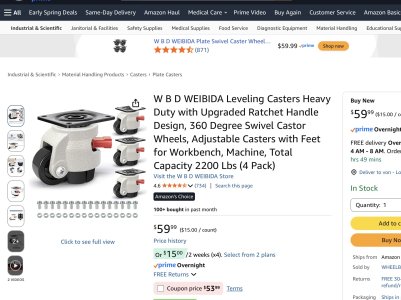
I do like Michael and have related stuff that resides on the bottom (floor stand) for ballast and have these type of casters.
I really don’t move it much, but when I do these are very close to the ground and work …so much so that they might not work with a really rough floor
They lower and lock in just seconds
 

Attachments

  • IMG_0930.jpeg
    IMG_0930.jpeg
    424.3 KB · Views: 14
@Packard Thanks for the thoughts and suggestions. My uncle had a camera stand very similar to yours in his studio (he too was a commercial photographer who would let me use the studio once in a while). That stand was pretty awesome.

Never was able to get into Hassie - always wanted to though. I did get the Mamiya 645 1000s instead. And you're right about film cameras. Back during the pandemic (of 2020, not 1916), I went to my local camera shop to see if they had any old Canon FD lenses for my old F1n and they quite literally gave me the lenses they had in stock - for free. They just wanted to get rid of them. Now, they have a pretty decent price.

And while I grew up shooting film - both in stills and motion picture, and I do love the look - the cost of film, processing and printing compared to digital is such a hassle now. Especially since I'd end up wanting to digitize the image anyway to utilize them!
 
@Packard Thanks for the thoughts and suggestions. My uncle had a camera stand very similar to yours in his studio (he too was a commercial photographer who would let me use the studio once in a while). That stand was pretty awesome.

Never was able to get into Hassie - always wanted to though. I did get the Mamiya 645 1000s instead. And you're right about film cameras. Back during the pandemic (of 2020, not 1916), I went to my local camera shop to see if they had any old Canon FD lenses for my old F1n and they quite literally gave me the lenses they had in stock - for free. They just wanted to get rid of them. Now, they have a pretty decent price.

And while I grew up shooting film - both in stills and motion picture, and I do love the look - the cost of film, processing and printing compared to digital is such a hassle now. Especially since I'd end up wanting to digitize the image anyway to utilize them!
Part of the resurgence of film is because CGI has gotten so good that digital crime scene photography has become less reliable as evidence and forensic departments are resurrecting film.

And artistically, film has has greater range of contrast that digital has not been able to match.

I understand that the new 60 megapixel Leica is doing a good job matching the tonal range of film.

When they stopped using film for TV shows, the results looked like newscasts. Lately the color rendering and tonal range is getting very close to film.

For anyone who has never seen a 70mm film projected on a wide screen in the theater, they should make an effort to see one if it becomes available.

Lawrence of Arabia is a film to be sought out (I used to include Gone With the Wind, but it is now culturally unacceptable).
 
I built a base inspired by this plan to fit my old cast iron Craftsman that my grandpa bought around 1970. It does not feel tipsy at all.


Hope this is of use.
Thanks a lot. Just bought this plan. Now I have another project to work on this summer.
 
@Packard The range of digital now is truly astonishing. One of my friends was the DP on Mandalorian and the cameras they used (I believe they were Sony Venice cameras) are so much more advanced than when it started on Phantom. Digital is amazing but my favorite is still the Panavision Platinum.

Agreed on 70mm. I never got to work with 70mm but I got to see the cameras at Panavision's HQ in Woodland Hills. Awesome - especially enclosed in its blimp. When they released Oppenheimer on IMAX, I drove up to King of Prussia to see it since it was the only theatre nearby that was screening the movie in its full format (1.43:1) - for those who are unfamiliar, most IMAX movies released at most IMAX theatres are digital releases with cropped formats or "blown up" from whatever the source was originally. And those IMAX cameras are LOUD. I met the boom operator for No Time To Die at an industry event a few years ago and asked him what that was like - and he was like "It was miserable." Location audio was completely unusable because of the chatter from the camera. If you ever get the chance to see a behind the scenes video of shooting an IMAX movie, you'll hear what I mean!
 
@Packard The range of digital now is truly astonishing. One of my friends was the DP on Mandalorian and the cameras they used (I believe they were Sony Venice cameras) are so much more advanced than when it started on Phantom. Digital is amazing but my favorite is still the Panavision Platinum.

Agreed on 70mm. I never got to work with 70mm but I got to see the cameras at Panavision's HQ in Woodland Hills. Awesome - especially enclosed in its blimp. When they released Oppenheimer on IMAX, I drove up to King of Prussia to see it since it was the only theatre nearby that was screening the movie in its full format (1.43:1) - for those who are unfamiliar, most IMAX movies released at most IMAX theatres are digital releases with cropped formats or "blown up" from whatever the source was originally. And those IMAX cameras are LOUD. I met the boom operator for No Time To Die at an industry event a few years ago and asked him what that was like - and he was like "It was miserable." Location audio was completely unusable because of the chatter from the camera. If you ever get the chance to see a behind the scenes video of shooting an IMAX movie, you'll hear what I mean!
There was a mountain climbing movie shot in IMAX. I think it was with Clint Eastwood. I saw it in the Colorado planetarium. I read about it in Outside Magazine.

During the entire movie, I kept asking myself, “How did the cameraman hold the camera on the cliffs, or on the ice, etc.”

They recruited real climbers and taught them to use the camera.
 
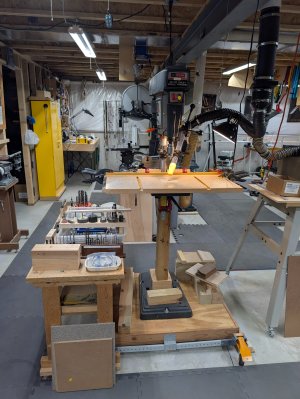
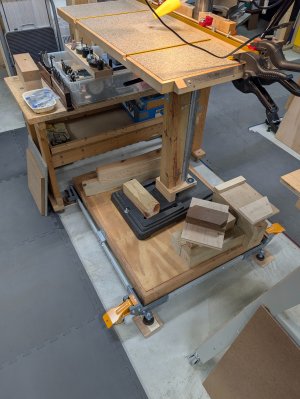
I have my 1980s vintage Craftsman 15-1/2" DP mounted on a large base with casters. It doesn't move often, but when it does they make it easy. You want the base to spread the support such that the drill press isn't tippy.
 

Attachments

  • PXL_20260324_131322090.jpg
    PXL_20260324_131322090.jpg
    1.7 MB · Views: 11
  • PXL_20260324_131550741.jpg
    PXL_20260324_131550741.jpg
    1.9 MB · Views: 11
I have my 1980s vintage Craftsman 15-1/2" DP mounted on a large base with casters. It doesn't move often, but when it does they make it easy. You want the base to spread the support such that the drill press isn't tippy.
One thing I learned from my photo studio days, is that a tripod always has all its legs firmly planted on the ground, but it is very “tippy”. Four wheels is much less tippy. Five wheels is about as stable as 4 wheels, but as I mentioned, it is easier to roll and maneuver.
 
I have that same Craftsman drill press from 1976. Mine is mounted on a cut down 1 1:8” solid core door blank. Like Kevin’s I added a table. Mine is 1 1:8” with 8020 slot extrusions and an 8020 15 series fence. I use Kreg hold downs and flip stops. I just finished a 24 pc splash guard job that required 3 1/4” holes on both side of 2x2” aluminum angle. I set the flip stops so that all 24 pcs of angle have exactly the same hole spacing without measuring each pc.
 
There was a mountain climbing movie shot in IMAX. I think it was with Clint Eastwood. I saw it in the Colorado planetarium. I read about it in Outside Magazine.

During the entire movie, I kept asking myself, “How did the cameraman hold the camera on the cliffs, or on the ice, etc.”

They recruited real climbers and taught them to use the camera.
The Eiger Sanction
 
Back
Top