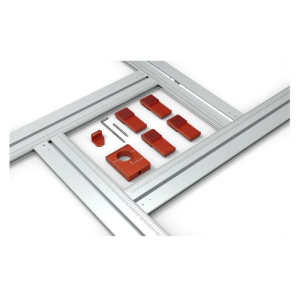
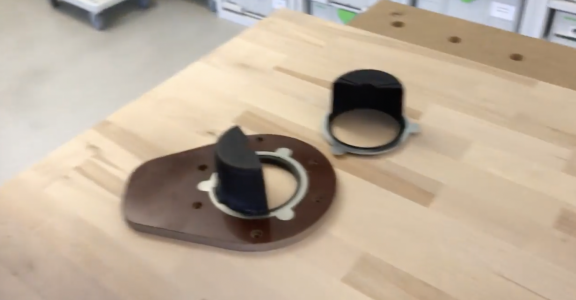
No definitely don't mind a few holes. I like this idea. Saves me a trip to hardware store or thinking about spending $$$ on another accessory. Can you rephrase"at the appropriate distance to guide/corral the router" so a slow 5-year could understand? Or point me to proper search terms for a video tutorial? Thank you!
The router base is basically round with a chunk of the perimeter missing. You’ll use the curved areas only. You need to find out the distance from the edge of the router to the edge of the bit. This will vary with different bits but if you know the distance for a 1/4” bit you know you simply set the fence 1/4” closer if you use a 1/2” bit. And so on.
With the bit you will use in the router (set to about 1/4” depth of cut), clamp a square to a largish scrap of wood. You’ll need to be able to put the square on opposite sides of the router with the leg pointing away from the router so the scrap should be at least two feet wide for comfort. It could be much smaller if you run different sides of the router against the square, moving it farther away each time.
With the square clamped to the scrap workpiece, run the router along the side of the square for an inch or ten (don’t hold back, get used to it).
Measure the distance from the square to the closest side of the groove you just cut. That is the distance from the cut line on the workbench to the fence you will nail to the workbench. But don’t do this yet.
For the utmost accuracy you should do this for the left, right, and back of the router. Keep the flat side of the router base towards you. But for this project you could get away with just the one fence to ditch measurement since in theory all three measurements will be the same. They’re probably very very slightly different.
When you know the offsets for all three sides of the vise cutout, draw lines on the workbench at those distance so you can see where to put the three strips of wood for the fence/corral/template. The great thing about a template is that it makes it impossible to cut where you don’t want to and it puts the maximum cut exactly where you want it.
Tack/nail/screw the side pieces on first. The fence pieces need to be secure enough to resist the pressure you will exert to keep the router tight to the fence. You’ll probably push harder than necessary since this is new to you (but you don’t need to because if the router wanders away from the fence a little it will just cut stuff you want to get rid of anyway and if you notice the sides of the recess you route away aren’t straight you can just make another pass along the fence to clean them up) so you might want to use screws to be certain the fence is secure. They need to extend from the front of the work bench to just short of the back offset line. Or they can be much longer but you have to cut the back fence piece short enough to fit within the side fence pieces.
On the first pass you will cut the perimeter, a C shaped cut that begins by cutting into the workbench along the left side fence then cuts across following the back fence and then follows the right fence until the bit exits the front of the workbench. When the bit exits it will probably knock chips off the front of the bench (tearout). If you want to avoid that you can either saw along the cut line on the front of the workbench (just on the right upside down side) or you can clamp a piece of sacrificial wood to the front of the workbench making sure it is flush with the surface (the bottom of the workbench) the router will ride on.
Use the router depth turret to make it easy to increase the depth of cut for subsequent passes. For the last pass you can test the depth by slightly routing into the remaining island and measuring the actual cut depth and then making your adjustment.
I suspect the router base is a little wider than the cutout for the vise. If that is so you don’t need to leave an island as the edge of the router can’t fall into the recess without running past the fence/corral. I that case just route all over with each pass at each depth setting.
Be sure to use dust collection and hearing protection. A note on dust collection, it will be better if you leave the outside edge of the vise cutout uncut until the very last. That is, leave a wall standing at the forward edge of the workbench until all the rest of the excess has been cut. A wall about 1/4” to 1/2” thick will do to corral the debris created by the spinning bit so more of it will get sucked up. When it’s time to take down the wall, use a chisel and strike a bout a 1/4” above the cut line so you don’t tearout beyond the cut line. Then turn on the router and all and finish up.
Alternatively, if you choose to clamp a piece of wood to the front of the workbench to eliminate tearout you you can use a longer piece that spans across the recess (requiring another clamp) and forget about leaving a wall. The sacrificial piece will dam the recess and corral the debris, just don’t plow too far into it at each depth. Cut enough into it so you have a recess to tilt the router and bit into at the begin of each new deeper cut. However, as a beginner you might want to skip this sacrificial piece and treat the router as a simple non-plunge type and enter the work from the outside while the router base is flat on the work.

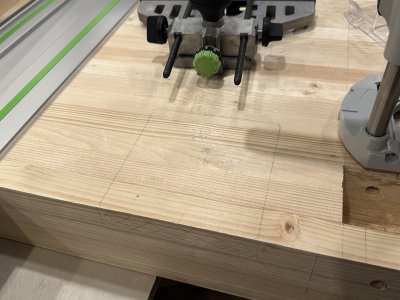 Thanks for any guidance you can provide. I'm a gal with no friends/neighbors who do anything like this that I can ask.