Is 12 x18 too big for a gift cutting board?

Granted I'm not making boards for others but if space is not an issue I tend to prefer large cutting boards even for general purpose daily use. I'm making one from a solid piece of 12x18 8/4 maple that will do double duty on a countertop and most importantly as a drop-in for a large stainless farmhouse sink. It has a shallow rabbet so it can drop-in and "lock" onto the exposed edge of the sink where it can safely slide left/right as needed without falling down. Since it's big, thick and heavy it will have handles cut into the bottom edge on all four sides and 304 stainless/silicone feet for use on a counter and to provide airflow for drying in-between uses. Granted in my case the board size is dictated entirely by the sink dimensions so I can certainly see how smaller could be more practical for countertop use only. Still, 12x18 doesn't seem too big for general use.

I have very limited countertop space which is why I wanted something that could transition to the sink if/when necessary. I also consider the large board part of the countertop when I'm not cutting so I don't feel as though I'm losing valuable space.

On a side note, I found this cutting board article quite interesting.
 
On a side note, I found this cutting board article quite interesting.
I was agreeing with the article until this:
Cross-contamination is a myth—Both vegetables and meat have bacteria on them, particularly E. coli, so let’s kill the cross-contamination myth right away. Cutting vegetables on a separate board, for example, accomplishes nothing, as harmful bacteria from veggies is just as likely to transfer to meat—or fruit, for that matter.
Raw meat, especially poultry, is far more dangerous than raw vegetables. While there may be some bacteria on vegetables, it's going to be in far less quantites and the likihood of serious illness if far less. Do not mix raw meat and raw vegetables on the same cutting board, even if you're cooking the vegetables afterwards since you may not be bring the vegetables to the temperature needed to kill bacteria.

And his saying that you need at least 24 hours - more like 48 hours - for the anti-bacterial effect to take place hampers cutting board use in restaurants and even most homes, unless you want to have a number of cutting boards you put in wash/dry rotation.

And his recommendation to use a soft furniture wax is also really dangerous, as many brands have solvent carriers that are not food safe.
 
I was agreeing with the article until this:

Raw meat, especially poultry, is far more dangerous than raw vegetables. While there may be some bacteria on vegetables, it's going to be in far less quantites and the likihood of serious illness if far less. Do not mix raw meat and raw vegetables on the same cutting board, even if you're cooking the vegetables afterwards since you may not be bring the vegetables to the temperature needed to kill bacteria.

And his saying that you need at least 24 hours - more like 48 hours - for the anti-bacterial effect to take place hampers cutting board use in restaurants and even most homes, unless you want to have a number of cutting boards you put in wash/dry rotation.

And his recommendation to use a soft furniture wax is also really dangerous, as many brands have solvent carriers that are not food safe.
I saw that article some time back and had the same issues. I make a lot of jerky and dog treats from beef and chicken and vegies, and I'm always extremely conscious of the cross contamination. Yes vegies can have E.coli and other bacteria, but mixing raw poultry and practically anything else, no way.
 
I was told, many years in the past, that many kosher laws and Halal laws were based on some health concerns, especially since early dishware was frequently made from wood.

Note: Kosher butchering was based on humane methods of animal slaughter. I believe that Halal had similar beginnings, but I have not researched that at all.

Kosher laws required separate vessels for dairy. Separate vessels for meat. And separate vessels for pareve (neither meat nor dairy). Cross contamination was the concern.
 
I was told, many years in the past, that many kosher laws and Halal laws were based on some health concerns, especially since early dishware was frequently made from wood.

Note: Kosher butchering was based on humane methods of animal slaughter. I believe that Halal had similar beginnings, but I have not researched that at all.

Kosher laws required separate vessels for dairy. Separate vessels for meat. And separate vessels for pareve (neither meat nor dairy). Cross contamination was the concern.
While I can't control what others do, I never cut meat on my end grain Maple board. I don't really cut uncooked meat at home anyway, but if I needed to, I have a plastic one.
 
While I can't control what others do, I never cut meat on my end grain Maple board. I don't really cut uncooked meat at home anyway, but if I needed to, I have a plastic one.
You’re doing it backwards. The end grain wood cutting boards don’t harbor bacteria by their nature, while the plastic ones do - especially when the plastic ones have knife cuts in them.

You have to be careful to sterilize the plastic ones (like in a high temp dishwasher) to be safe.
 
Cross-contamination is a myth—Both vegetables and meat have bacteria on them, particularly E. coli, so let’s kill the cross-contamination myth right away. Cutting vegetables on a separate board, for example, accomplishes nothing, as harmful bacteria from veggies is just as likely to transfer to meat—or fruit, for that matter.
I admit, I got a bit riled up by this and clicked on the link thinking "who is this joker?" But I gotta say, Dr. Robinson is well-informed about wood and its bacterial fighting qualities. I respect her knowledge in this field.

But cross-contamination is not about which product has "more" E. Coli than the other. It's about not transferring it from one product that is contaminated to another that isn't. And presuming that all produce (including proteins) "has" bacteria, it's also a question of how festering that bacteria is on the product. Has it festered in enough quantities to induce illness? This is what we concern ourselves with in foodservice.

In the home kitchen, it's probably not as much of an issue because of the different pace. In foodservice, you maintain separate boards partly because you need to work efficiently. At home, you can take a few moments to wash the board thoroughly between items. I equate it to woodworking. A professional, like CRG, may maintain a phalanx of routers each fitted with different bits because of their Mission Critical nature. The weekend woodworker isn't working on the same kind of time crunch and has the luxury of spending an hour working on a piece and changing bits on one router.
 
While I can't control what others do, I never cut meat on my end grain Maple board. I don't really cut uncooked meat at home anyway, but if I needed to, I have a plastic one.
You’re doing it backwards. The end grain wood cutting boards don’t harbor bacteria by their nature, while the plastic ones do - especially when the plastic ones have knife cuts in them.

You have to be careful to sterilize the plastic ones (like in a high temp dishwasher) to be safe.
 
Slightly off-topic, but pot filler taps seem to have some risk too.

A normal kitchen tap sits over a sink, and a fair amount of water flushes through the pipes.

In a restaurant, they fill multiple large kettles a night.

But in a residential kitchen, you might fill 2 quarts in a pot a 2 to 4 times a week. Not enough to keep the pipes flushed in my opinion. I have no real data to back that up, but my gut tells me it is probably not a good investment.
 
Such a timely post… I’ve recently been knee deep thinking about all the issues mentioned here.
My 2 cents FWIW…
TL;DR: go smaller… and a couple questions at the end.

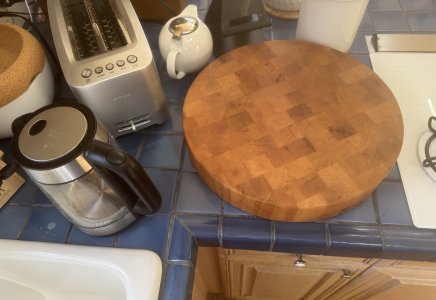
My long time favorite cutting board is an 18” round x3” end grain old Boos Block (BB). I love that it’s round, because when chopping veggies for soups etc, I don’t have to push the chopped veg to the side to do the next one, I simply spin the board to an open space. It speeds up workflow. But the down side to that BB is that it’s 3” thick— I’m 5’9, and like tall working heights, but ergonomically it is too tall. It’s also big, so takes up the whole countertop between cooktop and sink… and is too heavy to move around easily, so it lives there in that corner.
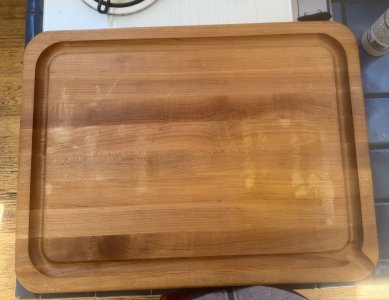
I have another old BB that is 18x24x2.25” edge grain. I only used it at the holidays for large barbecued turkeys. It was great for that with a deep juice groove. But it doesn’t fit in a cupboard and it’s heavy, so stores on my counter under my Vitamix.
It’s big and heavy, and I’m not sure I want to keep it.
I use a thin lightweight 9x12x0.25” composite board for raw meat that stores easily in a cupboard.
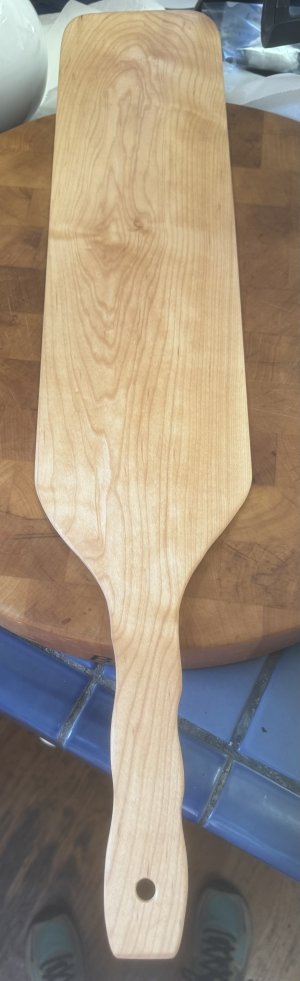
But I’ve recently been making bread… (just finished the baguette peel in the photos), so have been using a pastry board more frequently.
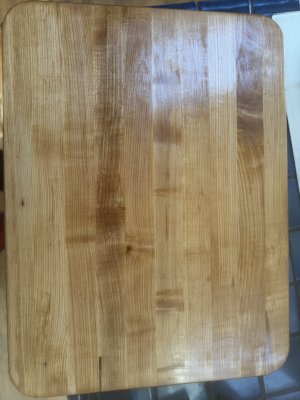
My old marble pastry board was heavy enough that when it broke in half some years back, I replaced it with a 20x15x1/2” plastic board. It’s nice and light and fits in a cupboard,… but it’s plastic, which I’ve been slowly getting out of my food prep. So before Thanksgiving I bought a piece of 4/4 maple to make a new pastry board— I was thinking 1/2” thick to keep the weight down. In the meantime I pulled out the big “turkey board” to use the back flat side… but found a crack across one of the more figured pieces. (the photo is mid re-oiling after my repair.) My everyday 18” round board gets re-oiled regularly… but the big 18x24 board is kinda ‘outa sight outa mind’… basically only getting re-oiled yearly when I would pull it out at the holidays for use. So while the big boards are nice to use, they’re just not practical, and if I had to do it over again, I would go smaller. Our natural urge is for bigger workspaces… but we should resist that urge and remind ourselves of all the other aspects… weight… storage… kitchen size… My uncle moved from California to Montana and built a 6000 sq ft dream home. But he and his new wife were both in their early 60’s… active and athletic,… but time still marches on. Within 3 years the upkeep of such a home and property became apparent. They spent the next >5 years trying to sell it, and moved into town to a much smaller place. They’re in their 80’s now…

My current thoughts are that instead of making a new pastry board out of that maple board acclimating in my basement, I could take the big “turkey board” and cut it down— both in footprint and thickness/weight.

I’m very much a noob in woodworking knowledge and skills… and tools… so is this doable? Practical? Smart? Overly optimistic? How thin should/could I go on cutting down the board? Is 1” (24mm) too thin for it to do double duty (mostly pastry board, with occasional holiday turkey carving)? Could I go all the way to 1/2” if I skip the juice groove and don’t expect to carry a turkey on it? Or will it likely warp over time? As the years go by, and family moves, etc, the size and frequency of my bbq turkeys grows smaller.

From reading here, it sounds like I could accomplish thinning it down using my old 1/2” shank router, a DIY slab flattening sled, and 2” spoilboard bit,… if I make sure to cut from both sides. Did I understand correctly? Or should I sell it and use the 4/4 board I bought and start fresh? I have an old 6” delta jointer, but no planer… yet…
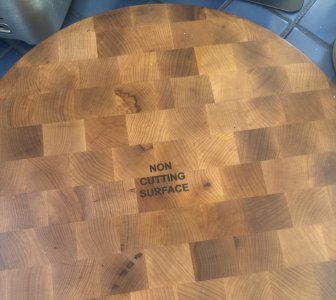
Can I cut down my 18x3” round end grain BB in thickness… say to 2” for at least better ergonomics? For some reason, the bottom is labeled “non cutting surface.” Is this related to to the type of glue used? The sides look the same to my ignorant eye. For this end grain round board, could I cut down from just the “non-cutting” side without movement issues? The Boos boards are maple, 11 years old. Or should I sell that one too and start fresh making my own? … and get a benchtop planer sooner rather than later?

I’ve added the photos to show just how much counter space these big boards take up. And with newer countertops being solid surface, large pastry boards just aren’t needed anymore. Even my circa 1989 tile is going to be replaced… hopefully sooner rather than later.
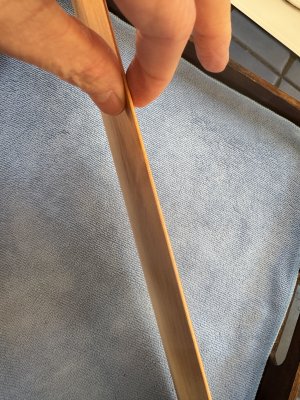
I included photos of the baguette peel too, cuz, well, as a noob… it was my first ever use of hand planes. It’s too long to fit in a cupboard, LOL, so I put a hole to hang it on a wall.
 

Attachments

  • IMG_7233.jpeg
    IMG_7233.jpeg
    2.9 MB · Views: 10
  • IMG_7231.jpeg
    IMG_7231.jpeg
    1.5 MB · Views: 10
  • IMG_7232.jpeg
    IMG_7232.jpeg
    3.3 MB · Views: 10
  • IMG_7230.jpeg
    IMG_7230.jpeg
    5.1 MB · Views: 11
  • IMG_7234.jpeg
    IMG_7234.jpeg
    2.4 MB · Views: 10
  • IMG_7159.jpeg
    IMG_7159.jpeg
    2.3 MB · Views: 11
Just thought, prompted ny Dane’s post above:

Copying the sizes of the most popular Boos boards would probably land you on safe ground.

Google A.I. says the most popular size is 18” x 12”, but in larger sizes, 18” x 24”.

Though I have no idea how A.I. collected the data (or if it even had any data).

 
Last edited:
@DanesRFun My guess about the "non-cutting surface" is that it may have defects, like bark inclusions. This would become a pocket for bacteria. It would be very wasteful/expensive to eliminate these pieces, which would be fine on the other side. Often you can't see that type of thing until the cross-cuts are made.

As far as the ones you already have, it's hard to say what would happen. Trying to cut an inch from the thickness, will be a challenge. First, you need to take it from both sides equally. It is going to take a flattening jig type apparatus, and one heck of a mess. All that, and it still might warp. It's a risk.
18" round isn't going through the average guy's planer anyway. There will be people who tell you that you can't run end grain through a planer. That is just not so. Take light cuts and be prepared for some tear-out, on the trailing edge. Strat with a piece that is longer than required, and trim that off.

The big one, with the groove, will probably need to be cut down enough, to cut off all of that groove. (all sides)


The plastic board might get used once a year.....might. If so, it goes it gets washed well and would never get vegetables on it anyway.
My Maple end grain board gets oiled regularly, with some citrus oil in the blend. I'm not concerned at all.

I have half of the strips glued up, but still not totally decided. I'm out of glue until tomorrow. I seem to have misplaced one? I know I had two.
I may glue up the whole thing and re-cut it, at least once. It's too "brickwork" looking for me, but I have to resist going overboard. It has to be finished by the 13th.
 
Back
Top