I am rethinking my workshop layout and could use some perspective.
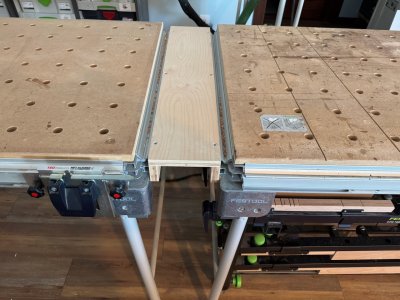
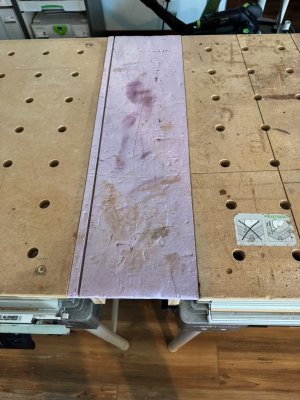
I currently run two MFT/3 tables as my primary work surfaces and also own an STM 1800, which I fitted with an MFT-style top and use it in extended form but without the expandable inserts. In theory, the STM gives me mobility and large panel support and I'm trying to use it as work-support when cutting long pieces on the MFT. In practice, however, it is less rigid than an MFT with cross braces and lacks the clamping flexibility I rely on. I only break down a few sheets at a time, and moving the STM upstairs from my basement shop is enough friction that I sometimes default to a simple frame out of 2x4s with adjustable feet.
I am debating whether to sell the STM 1800 and move to three MFT/3 tables instead, keeping one mobile (disconnected from the other two) for material support and assembly. It feels cleaner and more unified, but I am questioning whether this is thoughtful optimization or just shop restlessness. Or perhaps the pragmatic approach is to buy a third MFT, store the STM collapsed out of the way, and reassess in a year. If it has not been used, sell it then, without haste.
For those who have lived with both setups, which direction has proved more functional for you long term, and why?
I currently run two MFT/3 tables as my primary work surfaces and also own an STM 1800, which I fitted with an MFT-style top and use it in extended form but without the expandable inserts. In theory, the STM gives me mobility and large panel support and I'm trying to use it as work-support when cutting long pieces on the MFT. In practice, however, it is less rigid than an MFT with cross braces and lacks the clamping flexibility I rely on. I only break down a few sheets at a time, and moving the STM upstairs from my basement shop is enough friction that I sometimes default to a simple frame out of 2x4s with adjustable feet.
I am debating whether to sell the STM 1800 and move to three MFT/3 tables instead, keeping one mobile (disconnected from the other two) for material support and assembly. It feels cleaner and more unified, but I am questioning whether this is thoughtful optimization or just shop restlessness. Or perhaps the pragmatic approach is to buy a third MFT, store the STM collapsed out of the way, and reassess in a year. If it has not been used, sell it then, without haste.
For those who have lived with both setups, which direction has proved more functional for you long term, and why?