Tire pressure and cold temperatures. How do they warm up while driving?

Packard

Member
Joined
Nov 6, 2020
Messages
5,570
Location
Hudson Valley, NY
The last 10 days or so it has dropped below zero every night. Apparently, it dropped to -18 last night according to the weather guy on TV. It was minus 10 degrees (actual, not wind-chill) when I woke this morning. One of my tires dropped to 24 PSI, and the warning light came on. The other tires were all at 27 PSI.

I keep a Milwaukee portable tire pump (battery powered) in my car, so I did not have to run to the gas station. In a couple of minutes I was back up to the prescribed 30 PSI.

Question: I drove 4 miles to the local Starbucks. By the time I got there all the tires had warmed up enough to increase the tire pressure to 29 PSI. My guess is a couple more miles and they would have made it back to 30 PSI.

What is the mechanism that warms up the tires while driving? I imagine it is just the flexing of the tire walls while driving, but how would that work?

As an aside, I have a glue-up to do. My basement shop has gotten colder daily from the cold weather. What is the lowest temperature at which I can glue up using Woodworkers 3?
 
Friction.

Back in my circle/oval track days we would adjust the air pressure on the left and right (at times front to rear depending on the track) tires to make up for the two different distances the tires had to travel going around the track. Then came nitrogen…..(not really needed on a street vechicle).

47º

Tom
 
Friction.

Back in my circle/oval track days we would adjust the air pressure on the left and right (at times front to rear depending on the track) tires to make up for the two different distances the tires had to travel going around the track. Then came nitrogen…..(not really needed on a street vechicle).

47º

Tom
Friction between the rubber and the asphalt?

And 47 degrees minimum. My basement is down to 62 as of last night. So I am good to go. Thanks.
 
Friction between the rubber and the asphalt?

And 47 degrees minimum. My basement is down to 62 as of last night. So I am good to go. Thanks.
Yes, [primarily] the friction between the rubber and the asphalt causes the moisture that is in the air contained in the tire to expand.

Tom
 
Yes, [primarily] the friction between the rubber and the asphalt causes the moisture that is in the air contained in the tire to expand.

Tom
I was surprised how quickly the pressure changed when driving. But it is a small, enclosed chamber with nowhere for the heat to quickly vent—so thinking it through, it all makes sense.

Having lived through the era of the Ford Explorer/Firestone Tire recalls (like, 250 people were killed) and the issue of low tire pressure, I have remained hyper aware of my tire pressures. The tire pressure alert systems in my cars have only added to that.

The Milwaukee tire pump is A-1, and not too expensive if you already have the charger and batteries. I have the M12 compressor. There is now a M18, but for adding air to a tire, the M12 is sufficient. Handy and light. Nice now especially since gas stations are charging money to get air.

 
Ideal gas law:
Pv = nRT

P is pressure
V is volume
T is temperature
n and R are number of gas molecules and the gas (expansion) constant.
Filling a tire with Nitrogen reduces pressure fluctuations from temperature changes as Nitrogen has a lower gas constant

 
FWW
I had an OEM Firestone front tire on my 94 Ford Ranger blow on the interstate going about 75 MPH. Fortunately I was on a dead straight section of I-90 near SD badlands with no other vehicles nearby and merely had to keep things aligned while coasting on a slight uphill. Had it been the outside tire on a corner, well, maybe I wouldn't be typing this right now.....
 
Right, it's slower of a rise than what you'll see in the Summer, and highway speeds to add to that, but, with vehicles that can show tire pressures on the fly, it's a good way to see how pressures, and temps, if your display shows that info as well, are affected once you start driving the vehicle.
I think the TEMP reading is great, think of how many racers years and years ago would have loved having this info on board instead of having someone try to take a tire temp reading when they pulled into the Pit . We just take it for granted now, or, ignore the tire warning light all together... 🫣 🫣 :rolleyes::rolleyes:
 
..
What is the mechanism that warms up the tires while driving? I imagine it is just the flexing of the tire walls while driving, but how would that work?
..
Correct.

Most of the energy loss from tire rolling is turned into heat *inside* the tire. The friction-induced heat as it touches the asphalt is actually relatively small for a properly inflated tire, think 1/5 of the energy loss, not 1/2 going there.

When you realize the energy loss at the tires is in the kilowatts/hps range ... them heating up is not all that surprising .. also, the more under-inflated, the more flexing, the more energy loss and the faster a heat-up.
 
When a tire is underinflated, it deflects to a greater degree to the loads applied to it from vehicle weight, acceleration and braking. cornering and rolling along the road. The deflection absorbs energy from the vehicle drive system and the energy acts to increase the temperature of the tire and the air inside it, acting to increase the pressure and expand the tire. The reason for keeping tires inflated to specification (typically 35 psi these days) is to minimize these losses and obtain better fuel economy...handling and braking are also improved at specified inflation pressure.
 
I inflate my tires 2 pounds over the recommendations on my door jamb. It calls for 30 PSI, and I inflate to 32 PSI. The handling seems a bit more secure and the ride quality

During the Ford Explorer/Firestone Tire rollover debacle, Ford was recommending a very low tire pressure (24 PSI??) to combat the cars’ tendency to rollover. I never understood that, but Ford engineers thought it would combat the high center of gravity that the cars had.

As an aside, electric vehicles have long been touted for their superior handling. This was not an engineering feat, but rather the nature of the beast. With the (very heavy) batteries generally installed under the floorboard, the center of gravity will always be quite low. Also, they don’t need heavy CV joints with an electric drive, and that means the suspension components can rebound quicker with less inertia, also improving handling.

In any case, the wall flexing to heat the air is not quite intuitive. Friction heat generally requires two things to rub together.

At any rate, my tire pressure problem is resolved. Now I have to address the ice dam that is causing a leaky window (18-1/2” of snow and sub-zero nights for 10 days in a row being the culprit).
 
...
In any case, the wall flexing to heat the air is not quite intuitive. Friction heat generally requires two things to rub together.
...
The wall flexing heats the rubber, not the air. Should have used better wording. When mentioning "inside" the tire, I meant inside the rubber wall of the tire, not the air bubble trapped by it.

The air is heated by the warmed rubber walls in turn.
 
The wall flexing heats the rubber, not the air. Should have used better wording. When mentioning "inside" the tire, I meant inside the rubber wall of the tire, not the air bubble trapped by it.

The air is heated by the warmed rubber walls in turn.
Ah, I can visualize that. It makes it easier to understand.
 
FWIW...I highly recommend the Milwaukee tire inflator that @Packard mentioned. Milwaukee model number 2475-20 it runs on the small M12 batteries and will easily top-off 235/55 R19 tires 16-20 times before the battery needs to be recharged. Simply set the desired tire pressure on the front and it will fill each tire to that exact amount of pressure. It's also the only realistic way to get all 4 tires consistently set to the proper pressures.
 
I inflate my tires 2 pounds over the recommendations on my door jamb. It calls for 30 PSI, and I inflate to 32 PSI. The handling seems a bit more secure and the ride quality

During the Ford Explorer/Firestone Tire rollover debacle, Ford was recommending a very low tire pressure (24 PSI??) to combat the cars’ tendency to rollover. I never understood that, but Ford engineers thought it would combat the high center of gravity that the cars had.

As an aside, electric vehicles have long been touted for their superior handling. This was not an engineering feat, but rather the nature of the beast. With the (very heavy) batteries generally installed under the floorboard, the center of gravity will always be quite low. Also, they don’t need heavy CV joints with an electric drive, and that means the suspension components can rebound quicker with less inertia, also improving handling.

In any case, the wall flexing to heat the air is not quite intuitive. Friction heat generally requires two things to rub together.

At any rate, my tire pressure problem is resolved. Now I have to address the ice dam that is causing a leaky window (18-1/2” of snow and sub-zero nights for 10 days in a row being the culprit).
@Packard my Pacifica was bought new 12 months ago. The door label says the tire pressure should be 36 psi. The actual cold pressure at the dealership was 39 psi in all tires.

I also use the Milwaukee M12 inflator, but with the new rims I’ve only needed it once, a week or so ago, and that was probably because the ambient temperature was down to 10 degrees f.
 
@Packard my Pacifica was bought new 12 months ago. The door label says the tire pressure should be 36 psi. The actual cold pressure at the dealership was 39 psi in all tires.

I also use the Milwaukee M12 inflator, but with the new rims I’ve only needed it once, a week or so ago, and that was probably because the ambient temperature was down to 10 degrees f.
I have the Milwaukee inflator, and a lithium battery jumper. So far, I have used both several times to help strangers, but only a couple of times to help myself.

My mechanic claims that agreeing to using my car battery as a jumper for another car with a dead battery is risky. Apparently it can damage the electronics in my car. In any case, the lithium booster works and avoids that risk. (And it fits in a glovebox.)

I don’t remember what brand I bought, but it was highly rated and about $90.00.

Milwaukee is now making one, but is $300.00, which seems expensive to me.
 
If you inflate to specified pressure, say 35 PSI in cold winter temperatures the inflation pressure increases as ambient temperatures rise. I routinely check and inflate my tires in late fall to somewhat above spec for the upcoming colder weather, then recheck them the first time ambient temperature gets really low and add air if necessary. Likewise in spring I bleed off some pressure as ambient temperatures rise to keep them in spec.
 
One thing that surprises me is the advancement in tyre/rim construction. I remember it was a regular event for my first few cars to check the tyre pressure weekly or so, and they frequently needed topping up. The cars we've had the last 10 or so years I've almost never needed to top up. They just don't lose air like they used to.
 
Sometime before I was old enough to understand, my dad had a blowout on a tube tire. That was probably in the late 1940s or 1950s.

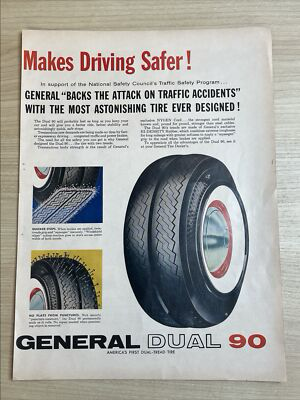
When General Tire came out with the “Dual 90s” he quickly had all his tires replaced with them. The Dual 90s were tube tires (tubeless tires came later). And while tubeless tires can lose air, they rarely (very rarely) experience a “blowout”, a catastrophic loss of air and typically loss of vehicular control. Apparently, my dad’s experience with a blowout made a lasting impression.

The Dual 90s, had two tubes in two separate chambers side by side within one tire. A blowout in one tube, would not cause the second tube to blowout too. So safer.

So, at any rate, be thankful for tubeless tires. Modern tires typically lose air slowly or quickly but rarely experience a blowout.

I would note that a steady loss of air pressure from a modern tire is more likely due to rim damage, or valve damage, than from a defective tire (based on my experience.)

Modern casting techniques have improved wheels and rims. And I do love my tire pressure indicator valves.

1770928172131.png
 
Back
Top