WAGO connections

Rick Herrick

Member
Joined
Feb 7, 2020
Messages
799
I need to run a few ceiling junction boxes to add more light to my new shop. I have heard several of you guys using Wago connectors so I thought I would try them out. I just replaced every outlet and light switch in my house for many reasons but at this point I am sick of wire nuts.

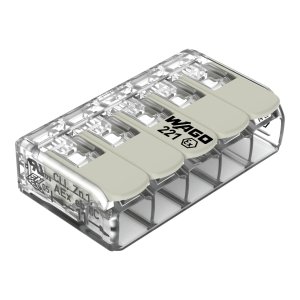
I did a quick test to make sure I liked them. When I put in the wires, you can feel it is very secure but I can sort of move the wire around. Not twist it or pull it out but I don't like that unstability. Am I doing something wrong or is this normal? I am using the 221-413 3 connecters.
 
There is some movement of the wires with them. The 221 series are designed for both stranded and solid wire. The push-in types are only for solid wire.

Search Youtube for Wago vs Wire Nuts. Several videos on their use, considerations, etc. Ideal has released a competitor to the Wago's that is similar but the release latch is a bit more recessed. They claim it prevents disconnects when pulling the wires out of the box and inadvertently releasing the Wago.

I personally have not had any issues with Wagos and prefer them to wire nuts in most cases.
 
There is some movement of the wires with them. The 221 series are designed for both stranded and solid wire. The push-in types are only for solid wire.

Search Youtube for Wago vs Wire Nuts. Several videos on their use, considerations, etc. Ideal has released a competitor to the Wago's that is similar but the release latch is a bit more recessed. They claim it prevents disconnects when pulling the wires out of the box and inadvertently releasing the Wago.

I personally have not had any issues with Wagos and prefer them to wire nuts in most cases.
Thanks. Your point about push-in types has me curious. So there is another, not 221, series? I will poke around. Appreciate it.
 
I did a quick test to make sure I liked them. When I put in the wires, you can feel it is very secure but I can sort of move the wire around. Not twist it or pull it out but I don't like that unstability. Am I doing something wrong or is this normal? I am using the 221-413 3 connecters.
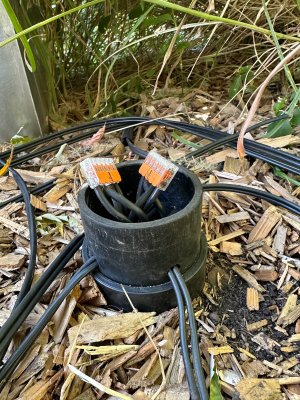
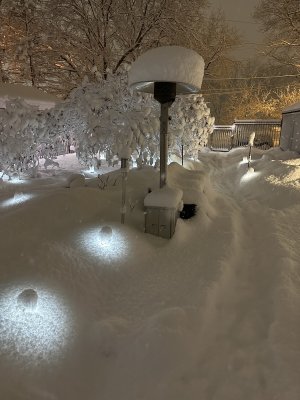
That's normal Rick as the wire is being held in 2 places, the bottom of the metal connector and the top of the connector spring. Every time I need to do any service on an outlet/switch/electrical box, I replace the wire nuts with Wago connectors. I've also used them for outdoor yard lighting of which I have 31 bollards, 22 fence lights and 7 other lit items...a lot of potential choke-point issues as the lights on the various electrical legs are daisy-chained. The original push-on style were installed 8 years ago while the newer lever style were installed 3 years ago.

Here are a couple of photos of the conditions in the winter that they have to survive. :D
 

Attachments

  • 5776 S original.jpg
    5776 S original.jpg
    1.1 MB · Views: 24
  • 15475 lever style.JPG
    15475 lever style.JPG
    1.4 MB · Views: 24
  • 6813.JPG
    6813.JPG
    1 MB · Views: 24
  • 12729.JPG
    12729.JPG
    769.7 KB · Views: 23
Last edited:
That's normal Rick as the wire is being held in 2 places, the bottom of the metal connector and the top of the connector spring. Every time I need to do any service on an outlet/switch/electrical box, I replace the wire nuts with Wago connectors. I've also used them for outdoor yard lighting of which I have 31 bollards, 22 fence lights and 7 other lit items...a lot of potential choke-point issues as the various electrical legs are daisy-chained. The original push-on style were installed 8 years ago while the newer lever style were installed 3 years ago.

Here are a couple of photos of the conditions in the winter that they have to survive. :D
Thanks Cheese, appreciate the info and pictures. I hope to test some of my boxes today or tomorrow. Those outdoor light pictures drew me in too. Another thing I inherited on this house is a bunch of weird outdoor lighting scenarios. They are not on my radar right now but hopefully I can get some tips on that later on. Thanks for the info.
 
The best tips I can give you for outdoor lighting is to use wire designed for outdoor use and to tin every single connection. Most of these electrical runs were installed in 2007 and they still work every day...on a dusk-to-dawn sensor. Interestingly enough, I've gone through 3 Intermatic sensors in that period of time so the wiring methodology is more robust than the light sensor. :D All in all that's a good thing because replacing a single sensor is easier than replacing 8 electrical legs and over 150 electrical connections. 🙏
 
Last edited:
One thing you might want to do with the Wagos (I love them) is to run a piece of electrical tape around the levers to make sure they don't lift when moving wires into a potentially crowded box. I saw that suggestion a while back. I usually did the same with wire nuts like several of the electricians I know.

I went away from the big box store ideal connectors because they were not removable. My local Home Depots carry the Wagos now and even the inline 2 connector which is nice in an uncrowded box like you might find in a light box.

Peter
 
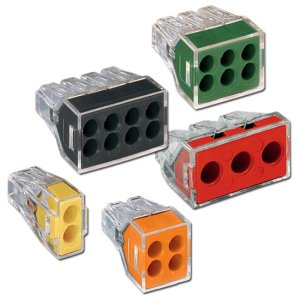
FWIW...the push-on Wago & Ideal connectors work well on solid coper wire but are difficult to remove because the individual wires have to be twisted back-and-forth to "walk" them out of the connector. Once the Wago/Ideal connector has 4 or more wires pushed into it, it's just about impossible to remove the wires. I found it easiest just to snip the wires, re-strip the wires and then use Wago 221 Series Lever Nuts.
 

Attachments

  • Wago-Push Wire Wall Nuts.jpg
    Wago-Push Wire Wall Nuts.jpg
    55.4 KB · Views: 6
  • 221-415 Orange 12 AWG.jpg
    221-415 Orange 12 AWG.jpg
    186.7 KB · Views: 6
  • 221-485 White 12 AWG.jpg
    221-485 White 12 AWG.jpg
    176.3 KB · Views: 6
Last edited:
Many years ago, I was wiring a large 150 unit apartment complex. We were given the push in Wagos and we had several issues with them in those units and returned to our usage of the “3M Electrical Spring Connectors” wire nuts as we went back and swapped them all out.
Fast forward many years when the 221 series lever nuts came on the market in the US. I have used them heavily since and I personally have not had any issues with them.
With that said, I do think it is possible to have issues with them. As with any product, it’s important to learn how they function and make sure they are used and installed correctly.

@Cheese I too use them in outdoor lighting, but I first pre-fill them with silicone based dielectric grease. This removes the need to tin any of the copper. The silicone grease prevents the oxidation and keeps moisture out.
Also, I no longer use photocells for any type of lighting control. Too short of service life. For any outdoor lighting, I use Lutron Caseta Smart switches. Once configured, they track sunup, sundown, and any other possible combination of time based scheduling. No batteries required, but the hub does need a wired Ethernet connection. Ultimately, you get the flexibility of a digital timer, but the programming interface is an app on your phone, not tiny buttons and a screen in a single gang yoke. Bonus is that it looks just like any other rocker style switch.
 
On the subject of making electrical connections easier and safer, these NSI Polaris multitap connectors are wonderful if you need to connect larger wire sizes. Insulated, solid hex screw connection and come pre-filled with an oxide inhibitor. great if you need to work with larger diameter wire.


Ron
 
Back
Top