Your Thoughts on Acclimatizing Wood to The Shop?

onocoffee

Member
Joined
Sep 23, 2024
Messages
1,018
Location
Baltimore, Maryland, USA
I've often heard the recommendation for people to buy their lumber, bring it to their shop and allow it to acclimatize to the shop environment for a few days to several months. And while I have not had any real warping or twisting issues, I have been wondering how important that acclimatization period is in my particular example?

Typically, I will buy slabs or rough sawn lumber from my local sawyer or a couple of sawmills in my region that are top-notch. Lumber from any of these places has been rough sawn, stickered and laid out for a couple months and then kiln dried (I'm talking about lumber from trees cut in my area: walnut, white oak, hickory, cherry, etc) down to 8-9%MC before being offered for sale.

In at least two of these sources, the dried lumber is kept in either an open-air barn or a non-temperature-controlled barn. My garage workshop is not temperature-controlled either and is prone to the swings of temperature and humidity that my lumber sources' barns are subject to - meaning that, it is my belief that their storage conditions are, essentially, the same as my garage conditions. Where there is deviation is during the winter: when I'm in the garage working, I turn on a propane heater which can warm the garage to a comfy 60+F.

My feeling is that I don't necessarily have that much to worry about temp/humidity fluctuations causing issues, but I could be wrong. Might you have any thoughts on this particular situation? Thanks!
 
For me it's important. I had a job that needed rework because of expansion due to a higher level of moisture than I was advised.

Wood will dry differently depending on the part of the tree it came from, how it's stacked and stickered, if there's air flow on part or all of the wood, etc.

I've since bought a pinless moisture meter and after acclimatising the wood for a period, I'll check the MC with the meter regularly until it's reasonably uniformly low across the board on both sides. I don't worry too much about getting it super low, just reasonably low.

I know others aren't anywhere near as strict, but given my stuff can go from my unheated shed into a heated/cooled house, I minimise the risks as much as possible.

Plus I'm very, very patient. I'll happily and opportunistically buy timber when it's cheap and let it sit for a few years or more if needed. A good mate buys exotic timbers and a bit always heads my way, but it's not far off green almost so I leave them aside for as long as possible.
 
I have done both: waited to let the wood acclimatise, and just used it as it was. I can't say I noticed any significant difference. But TBH humidity doesn't fluctuated wildly around here. Still, I prefer to leave the wood for a few weeks in my shop before using it. Even if your shop is non-temperature controlled, I presume it will be closed to the wind. That will have its influence on moisture levels. And burning propane in your shop will definitely influence it. But wood needs time to equalise its moisture levels. So if it is in your shop for a short time, then that influence will be limited. Also, the moisture level of the place where your workpiece will finally end up might be more important to keep note of.
 
I should point out I live in Melb in Oz so we get all 4 seasons in one day, with days in Summer of extreme humidity mixed with days of 32-40c, and other days with thunderstorms/hail. So if you're in a more temperate place like hdv it might not be so critical.
 
I'm in the UK. I've had problems building things out of solid timber (pine mostly) in my unheated garage and then moving them into the house - the pieces shrink.
I found this site:
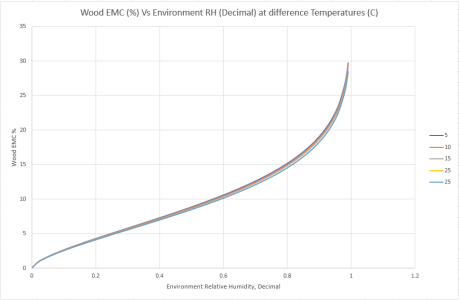
It has an equation to estimate the equilibrium wood moisture content, i.e. the moisture content of a piece of wood if it's left to sit somewhere for a very long time.
The equilibrium moisture content depends on the relative humidity of the room and the temperature of the room.
If you build a spreadsheet and plot the equation, the wood equilibrium moisture content varies more with relative humidity than it does it with temperature.
That means it's not the difference in TEMPERATURE between your shop and house that causes problems, its the RELATIVE HUMIDITY that causes problems.
Try to control the relative humidity in your shop to be the same as in your house, a simple dehumidifier will work - you don't need AC to control humidity.

1762778735261.png

Bob
 
When I buy lumber, it is always kiln dried, but just the same I try to let it acclimate in my shop for a couple of weeks before working it.

I bought a pinless moisture meter that gives me a confidence that the wood moisture level really is where I think and hope it is. Working in a non climate-controlled environment is always going to present challenges, but without the moisture meter you are shooting blind.
 
I measure moisture content on stock when I bring it into the shop, the supplier I use most often kiln dries and the moisture levels are typically similar to wood that has been on my rack for years. Once I rough cut a board to lengths, I will spot check the internal sides of the cuts to verify that the board is equilibrated throughout. I will occasionally see very modestly higher internal moisture levels. In any case I generally make it a practice to buy wood a few weeks before I plan to start jointing, planing and cutting.
 
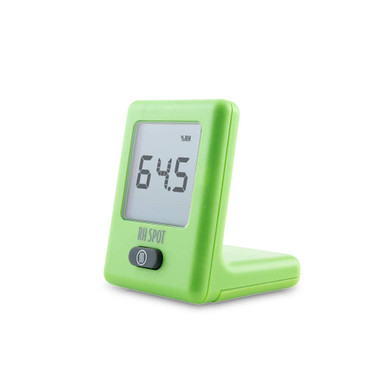
Just remember that one of the by-products of using a propane heater is water vapor, so it may be useful to purchase a RH meter for the shop just to monitor and possibly trouble shoot any future issues. Here's an inexpensive one from Thermoworks. They also offer other models that come with NIST certification which is traceable.


As far as acclimatization goes, I think it varies mostly with the end use of the product. I've installed a lot of 3/4" thick wood strip floors in maple, jatoba, oak & cherry. For those applications I remove the wood from its packaging, usually cardboard boxes, spread it out in the room where it will be installed and let it sit for at least 7-10 days.
 
I should point out I live in Melb in Oz so we get all 4 seasons in one day, with days in Summer of extreme humidity mixed with days of 32-40c, and other days with thunderstorms/hail. So if you're in a more temperate place like hdv it might not be so critical.
Hotel De Ville?
 
Back
Top