
3D Printing Wood - I Don't Know If I Like It

onocoffee

Member
Joined
Sep 23, 2024
Messages
1,420
Location
Baltimore, Maryland, USA
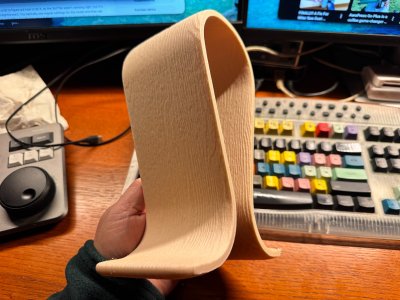
I heard about it so I ordered a roll of Elegoo PLA Oak Wood 3D Filament and printed this headphone stand. The designed gave it a coarse wood grain texture that's very reminiscent of red oak, so I guess that's apropos. There is definitely a "feel" to it that is different from the standard PLA and PETG I've been using. I'm reading more about it but I think these can even take some finishes?

The oak color is definitely very white/pale. I thought about ordering the walnut but the pics didn't look that appealing and it looked too dark. Any thoughts?

I asked this about CNC work and the response was overwhelmingly that CNC woodworking IS Woodworking. Could the same be said of Wood 3D Printing?
 

Attachments

  • IMG_0588.JPG
    IMG_0588.JPG
    2.5 MB · Views: 38
  • IMG_0589.JPG
    IMG_0589.JPG
    1.7 MB · Views: 40
  • IMG_0590.JPG
    IMG_0590.JPG
    3.3 MB · Views: 39
For me personally I'm sick of hearing people very proudly, publicly and loudly proclaim that CNC isn't woodworking because it's not pure to the idea. You can be guaranteed those same people use electricity and power and hand tools to achieve anything they do, which I'm sure the purists could argue just as well that they're not real woodworkers because they use power, etc.

Having said that, I'm not so convinced myself you could call 3D printing woodworking, even though the filament is supposed to be "wood filled", whatever that means. The trouble I have is when I run a job on a CNC for 12 hours, I'm starting with a timber slab or project primarily composed of wood. And I'm removing parts of that wood to alter the appearance of it to help shape it to a design that I may have spent a week on, but it's still fundamentally wood, that then also usually requires a huge amount of manual labour (woodworking) to bring it to full completion.

As good as 3D printing looks, and the stand you made looks really great by the way, there's no getting around the fact that while it may be "wood-like" or "wood filled", it's still plastic. Your 3D printer with that filament could be considered woodworking by some, I would call it an associated or complementary technology to woodworking.

The 3D resin printer I have though I would say flat out I would never consider to be any form of wood working.
 
NO!
To me 3D printing is an offshoot of Computer Aided Design. The printing is easy, just load the file and press go. The CAD work is the hard part.
I would call CNC cutting wood and then assembling it wood work, but I would call CNC cutting aluminium on the same machine metal work even if they were cutting the same object.

@onocoffee if you're starting to print with filament that contains fibres (wood, cork, carbon etc) you might need hardened nozzles or large diameter nozzles.

Regards
Bob
 
Last edited:
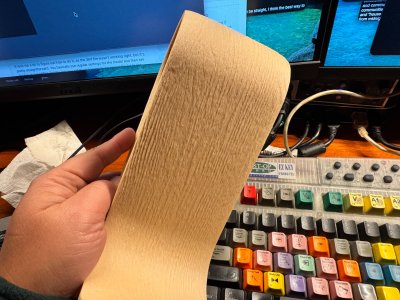
I heard about it so I ordered a roll of Elegoo PLA Oak Wood 3D Filament and printed this headphone stand. The designed gave it a coarse wood grain texture that's very reminiscent of red oak, so I guess that's apropos. There is definitely a "feel" to it that is different from the standard PLA and PETG I've been using. I'm reading more about it but I think these can even take some finishes?

The oak color is definitely very white/pale. I thought about ordering the walnut but the pics didn't look that appealing and it looked too dark. Any thoughts?

I asked this about CNC work and the response was overwhelmingly that CNC woodworking IS Woodworking. Could the same be said of Wood 3D Printing?
Nice- I need one of those. I had an Ender 3 Pro for a few years but just decided to upgrade to a Bambu Lab P2S with a four spool feed they call AMS 2 Pro. It is supposed to get here tomorrow so I can't wait. I purchased a lot of HF Matte PETG for my builds. I only used PLA in my Ender 2 Pro. May need to bug you about setting for the PETG.
 
Nice- I need one of those. I had an Ender 3 Pro for a few years but just decided to upgrade to a Bambu Lab P2S with a four spool feed they call AMS 2 Pro. It is supposed to get here tomorrow so I can't wait. I purchased a lot of HF Matte PETG for my builds. I only used PLA in my Ender 2 Pro. May need to bug you about setting for the PETG.
I was actually gifted the Ender 3 over a year ago. Nice printer. But my brother, who has been printing for awhile, said to me: "It's a good printer if you want your hobby to be 3D Printers instead of the 3D printing." Funny guy, but a couple months later, it started getting wonky and I just didn't have the bandwith to do the bed tuning and muck with it. I left it alone for the rest of 2025. I think you will find the P2S to be an enjoyable experience. One of my YouTuber friends has one and loves it. I love that I can sit back, use the app and start a print without having to move. No more slicing and then transferring to a card and taking that card to the printer. And the AMS - a month ago, I thought the notion of multiple AMS was silly (much like I thought Bluetooth was silly on a CT). Lately, I've been thinking "sure would be nice not to have to get up and change the spool in the AMS when I can have 17 filaments with the max AMS units".
 
The best description I've ever heard of this phenomenon is "Bambu sells products, not projects". They really did revolutionize the industry and make 3D printing so much more accessible in such a short time.
 
I held out on the whole 3D printing thing precisely because it seemed to be more of a hobby around the 3D printer rather than the printing, itself. Then comes Christmas and my wife got us a Bambu A1 Mini. While its build plate is small, that thing is a champ. It just does its job and it seems to be pretty fast.
 
I believe that 3D printing wood filament fails to be "woodworking" in that it is missing the "working" aspect --- the nearest to it would be sculpting something out of putty or clay.

It also fails the check of the "worksmanship of risk" vs. "worksmanship of certainty" as discussed in David Pye's The Nature and Art of Workmanship:


When I was a kid making stuff by mixing piles of sawdust w/ Elmer's School Glue, no one characterized the result as "woodworking"....
 
We can all pretend, and also be pretenders ;-)

My mom proudly told the new people in town, “My son is an Electrical Engineer”.

They quickly ask if I can fix their television, toaster, ceiling lights …”

She retorted with “He only designs those fancy computer boards, not fixing broken things!”

It’s embarrassing to graduate as an Electrical Engineer, but not be able to do any of the practical things around the house.

Since then I’ve improved my DIY skills thanks to Bob Villa, Norm Abram and the Family Handyman, WOOD and Fine Woodworking magazines.

And now we have resourceful gems on the interwebs!
 
@MacBoy I'd be glad in your shoes. When I did Electronics Engineering every person I remotely knew would hassle me to "urgently" fix everything from microwaves to VHS players, it was insane. I ended up having to downplay it and say no as a flat rule.

Funnily enough I've found it's the same doing woodwork.
 
The P1S, and I'm pretty sure the P2S as well as the H2 series can have up to four of the AMS units plus the one single, which I believe is a total of 17 filaments.
You're correct. I have no idea what I was thinking or where my math was going. Up to four of the four slot AMS units and one AMS HT.
 
I heard about it so I ordered a roll of Elegoo PLA Oak Wood 3D Filament and printed this headphone stand. The designed gave it a coarse wood grain texture that's very reminiscent of red oak, so I guess that's apropos. There is definitely a "feel" to it that is different from the standard PLA and PETG I've been using. I'm reading more about it but I think these can even take some finishes?

The oak color is definitely very white/pale. I thought about ordering the walnut but the pics didn't look that appealing and it looked too dark. Any thoughts?

I asked this about CNC work and the response was overwhelmingly that CNC woodworking IS Woodworking. Could the same be said of Wood 3D Printing?

Every woodworker I know (typically over 50) looks at CNC woodworking as an automated form of woodworking. If I owned a CNC and made something out of a CNC in wood, I wouldn't say it's a handcrafted or handmade piece.

None of them own a CNC but a couple of them have laser machines and 3D printers. They don't call themselves a woodworker because of the activities imvolving the use of the latter machines.
 
I believe that 3D printing wood filament fails to be "woodworking" in that it is missing the "working" aspect --- the nearest to it would be sculpting something out of putty or clay.

It also fails the check of the "worksmanship of risk" vs. "worksmanship of certainty" as discussed in David Pye's The Nature and Art of Workmanship:


When I was a kid making stuff by mixing piles of sawdust w/ Elmer's School Glue, no one characterized the result as "woodworking"....
It is “woodworking” like using wood putty like modeling clay is woodworking. The basic product is mainly a wood product, the process is not.

I visited a New York based company (Abe Munn, Inc.) that made “hand carved” and “accurate” replicas of antique gilded picture frames. They used a 3D pantograph router to rough carve the moulding, and a technician would clean up the carving with gouges and sandpaper. It did not seem like “hand carved” to me.

Further, there was no single person who could execute the entire process. Each technician mastered a single component of the work. It took 8 to 10 different people to create one frame.

Creating wood products with 3D modeling, seems more like CGI than anything I would call “woodworking”. And if I were doing it, it would not “feel” like woodworking.

Note: I get particular pleasure from the final hand sanding of projects and I will largely skip the belt sander, random orbital sander and vibratory sander (though I own examples of all of them).

In the end, for me, woodworking has to feel like I was working with wood; 3-D printing fails on that single premise.
 
Every woodworker I know (typically over 50) looks at CNC woodworking as an automated form of woodworking. If I owned a CNC and made something out of a CNC in wood, I wouldn't say it's a handcrafted or handmade piece.

None of them own a CNC but a couple of them have laser machines and 3D printers. They don't call themselves a woodworker because of the activities imvolving the use of the latter machines.
I hear you and I seem to fit that age description.

I recently had the chance to tour the Thos Moser Workshop in Maine where they have a fair bit of automation via large scale CNC machines that cut out chair components all day long. After that visit, it challenged my viewpoint on CNC and handmade. Certainly, a YouTube video I saw where the creator was talking about one of his best selling products: a CNC made spoon (the machine would cut and shape the spoon and then they would hand sand and apply oil) - this process struck me more as "manufacturing" than woodworking. But in the case of Moser, the parts were cut and then they were hand fit, assembled and finished - this reflected more of that Handcrafted approach, much like we might use a Domino vs hand cut tenons.
 
Every woodworker I know (typically over 50) looks at CNC woodworking as an automated form of woodworking. If I owned a CNC and made something out of a CNC in wood, I wouldn't say it's a handcrafted or handmade piece.

None of them own a CNC but a couple of them have laser machines and 3D printers. They don't call themselves a woodworker because of the activities imvolving the use of the latter machines.
I guess they could apply the term “creator” in that case.
 
The P1S, and I'm pretty sure the P2S as well as the H2 series can have up to four of the AMS units plus the one single, which I believe is a total of 17 filaments.
I have an H2D. According to the specs on Bambulab.com, it can connect up to 4 AMS 2 Pro units plus up to 8 AMS HT units for a total of 24 colors. I think the external spool is not included because the AMS units need to be connected to both hotend inputs. I haven't looked at all the details, though.
 
I hear you and I seem to fit that age description.

I recently had the chance to tour the Thos Moser Workshop in Maine where they have a fair bit of automation via large scale CNC machines that cut out chair components all day long. After that visit, it challenged my viewpoint on CNC and handmade. Certainly, a YouTube video I saw where the creator was talking about one of his best selling products: a CNC made spoon (the machine would cut and shape the spoon and then they would hand sand and apply oil) - this process struck me more as "manufacturing" than woodworking. But in the case of Moser, the parts were cut and then they were hand fit, assembled and finished - this reflected more of that Handcrafted approach, much like we might use a Domino vs hand cut tenons.
I've seen a similar chair making video (not sure if it was Moser chairs).

I suppose it's a matter of degree for me. If I made something out of just a domino joint that involved nothing else (e.g. all the parts were pre-bought off-the-shelf), I'd probably call myself an assembler, like any soccer mom who puts together an Ikea dresser or bookcase.🤣

We can call ourselves anything we want, but deep down, your peers will judge based on their own definition of woodworking!
 
Back
Top