BMW has patented a new screw head designed to prevent non-dealer repairs

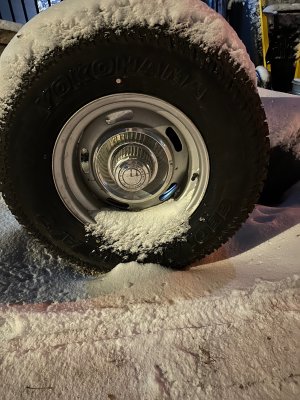
The OEM wheels were steel, with a small hub cap and “glamor rings”.
This is a holiday tribute to you Packard...I dashed out in my shorts and T-shirt in 7º weather just to catch this photo, check out the snow.... An original 8" to 8-/1/2" wide Rally wheel from a 1970 something Corvette. I replaced these wheels with 8" & 10" American Torq-Thrust wheels on the Corvette and placed the Rally wheels on my motorcycle trailer instead.
 

Attachments

  • 16994.JPG
    16994.JPG
    1.1 MB · Views: 12
What legislation is that?
Without getting into political territory, take your pick of the many options, such as the compulsory land access laws, the hate crime and harassment laws which sound good until you see what's actually considered an offence, etc.
 
That's no different than the big computer companies, when they quit "supporting" older Operating Systems. The tech drives away from not only the old hardware, but the Firmware too.
Years ago, I had a Lifetime update agreement with an image editing Program, when you could still buy them as DVDs, in retail stores. The company was sold to JASC, and it was invalidated at that point. I really don't understand how this is legal. Why is the purchasing company not required to honor those previous agreements? It is likely written in the fine print, that nobody ever fully understands.
My 2014 Camaro had a built-in phone. It worked through the screen and sound system, wholly independent of a separate mobile phone. It could share the contacts, through Bluetooth, but didn't require that to function. Eight years later, the entire network of the old 2G platform was shut down, presumably because the mobile phone market had gotten so saturated. FiveG was in the hands of the early adopters, 4g for most everyone else, who knows about 3?
I assume that there was some kind of backwards-compatibility issue somewhere along the line here? Though I have no idea, it just seems to make sense.
Hasselblad cameras were/are the ultimate in backward compatibility. The lens, camera body and camera back (film holder) are three separate components and all three have seen upgrades over the years but still remain compatible. Even my 1980s Hasselblad 500CM can be upgraded to a high end digital camera by replacing the camera back with a digital one.

Oh, but the cost! The “Phase I” digital back (50MP) was over $5,000.00 about 15 years ago. It would be cheaper to buy a new camera. Of course I have several high quality Zeiss lenses for the Hasselblad, so that goes into the equation (all manually focused, though).
 
Hasselblad cameras were/are the ultimate in backward compatibility. The lens, camera body and camera back (film holder) are three separate components and all three have seen upgrades over the years but still remain compatible. Even my 1980s Hasselblad 500CM can be upgraded to a high end digital camera by replacing the camera back with a digital one.

Oh, but the cost! The “Phase I” digital back (50MP) was over $5,000.00 about 15 years ago. It would be cheaper to buy a new camera. Of course I have several high quality Zeiss lenses for the Hasselblad, so that goes into the equation (all manually focused, though).
I always yearned for a Hassie - especially the 500CM. But alas, all I could afford in those days was the Mamiya M645 1000s - which, in its own right, is a great medium format camera. But all the best shooters had the 500.
 
I always yearned for a Hassie - especially the 500CM. But alas, all I could afford in those days was the Mamiya M645 1000s - which, in its own right, is a great medium format camera. But all the best shooters had the 500.
It orbited the moon in 1968 on Apollo 8. No special camera. NASA sent someone to a camera store with a credit card and he bought it. One of the most famous photos in history.


Earth over the moon’s horizon:
1767294442748.jpeg
 
I ran across this video today and it made me want to go back 20 years for so many reasons. Take a minute to watch:


Peter
 
This is exactly what a think tank here (sponsored at arms length by our gov) is proposing to mandate for ALL vehicles!

All in the interests purely for public safety of course!

It's just a horrifying thought when you factor in all the other draconian legislation actually being passed.
Yeah, "they claim" it would prevent police chases, which I am sure is true. However, it becomes a "slippery-slope" argument. Many people have objections to this type of thing, but they often materialize as stated.....or worse.
The "Law of unintended consequences" is rarely defeated.
 
Which part? The Hyundai rear brake service or the stupid door handle? Or both? :unsure:

Peter
From what I have recently heard, the taillight of a newer F150 is the same situation. It's an LED, and apparently non-serviceable. You cannot get the "bulb" itself. You need to replace the entire housing.
My usual cynical thinking says that the local scrap yards/dismantlers know this and adjust prices accordingly.
 
From what I have recently heard, the taillight of a newer F150 is the same situation. It's an LED, and apparently non-serviceable. You cannot get the "bulb" itself. You need to replace the entire housing.
My usual cynical thinking says that the local scrap yards/dismantlers know this and adjust prices accordingly.
After watching that video another started which I only caught the start of before closing the page, but it was about a LED bulb that was serviceable for this particular model car, but needed to be installed and "enabled" in software by the dealer!

So you could change the bulb no problem, but it just wouldn't work!

You just can't hate these companies enough. With the original video above, given the engine fiasco that's cost GM money they couldn't afford to lose, further alienating your customer just seems a stupid policy.
 
-ishYeah, "they claim" it would prevent police chases, which I am sure is true. However, it becomes a "slippery-slope" argument. Many people have objections to this type of thing, but they often materialize as stated.....or worse.
The "Law of unintended consequences" is rarely defeated.
I really try to avoid politics here, but here I have to bite:

The objective is openly being stated: Control population movements. Without ability to move independently, it becomes impossible for the population to present any form of realistic resistance to the government. Be it justified or not. Legal or not.

The only discussion left: 'how much that is a problem'. To that I will refer on how such powers were used during COVID and what we know about the actual impacts of those 'flat' decisions today.

You trust the gov: Then good. Allows it to be more effective.
You do not trust the gov: Then bad. Allows it to be more effectively bad.

The usual dilemma comes: The moment you give someone absolute power ... you are removing an ability of the system to course-correct. That is the real issue with all these '84-ish things. The eventual loss of an ability to course-correct without a major upheaval, French style.

/end OT

---
On topic, I believe we are being unnecessarily hard on BMW here. There are places on today cars, and not only, where you really, really do not want people disassembling it.

In many such cases the joints are a "set and forget" type so that it does not even matter if you cut the bolt off or unscrew it - it has to be replaced.
 
RE: Ford Truck Tail lights - here is an ai answer to my question: "what is the issue with ford truck tail light costs?"

"The issue with Ford truck taillight costs stems from
widespread theft of high-tech LED taillight assemblies (especially from F-150 and Super Duty models), their inherent expense due to integrated sensors (like BLIS for blind-spot monitoring) and complex electronics, making replacements incredibly pricey, often exceeding $1,000-$2,700 per side, sometimes totaling over $5,000 for a pair, creating huge financial burdens for owners and fueling a lucrative black market for stolen parts. Thieves target these units because they are valuable and relatively easy to remove quickly by accessing the tailgate.
Why They're So Expensive & Targeted:
  • Advanced Technology: Modern Ford taillights aren't just lights; they're integrated units with LED arrays, circuit boards, and sensors for features like Blind Spot Information System (BLIS) and Cross-Traffic Alert, significantly raising part costs.
  • Easy Theft: Thieves can often pop the tailgate, unbolt the light, or even pry them out with tools, removing them in minutes, making them a high-value, low-effort target.
  • Complex Systems: Because they're tied into the truck's network, replacing them often requires dealer programming (flashing VIN data), adding to labor costs, and the truck may not run correctly without them.
  • High Demand & Black Market: Stolen lights are sold online, creating a significant profit for thieves, while owners face huge bills for replacement, sometimes hitting $5,000-$7,500 for both, notes.
Solutions & Owner Actions:
  • Security Devices: Aftermarket products like special screws or tailgate covers (e.g., Latchlid) are available to block access.
  • Used Parts: Some owners find used OEM lights and program them themselves using tools like ForScan to save money.
  • Increased Awareness: Owners are advised to park in well-lit areas and be aware of the theft risk. "

Peter
 
RE: Ford Truck Tail lights - here is an ai answer to my question: "what is the issue with ford truck tail light costs?"

"The issue with Ford truck taillight costs stems from
widespread theft of high-tech LED taillight assemblies (especially from F-150 and Super Duty models), their inherent expense due to integrated sensors (like BLIS for blind-spot monitoring) and complex electronics, making replacements incredibly pricey, often exceeding $1,000-$2,700 per side, sometimes totaling over $5,000 for a pair, creating huge financial burdens for owners and fueling a lucrative black market for stolen parts. Thieves target these units because they are valuable and relatively easy to remove quickly by accessing the tailgate.
Why They're So Expensive & Targeted:
  • Advanced Technology: Modern Ford taillights aren't just lights; they're integrated units with LED arrays, circuit boards, and sensors for features like Blind Spot Information System (BLIS) and Cross-Traffic Alert, significantly raising part costs.
  • Easy Theft: Thieves can often pop the tailgate, unbolt the light, or even pry them out with tools, removing them in minutes, making them a high-value, low-effort target.
  • Complex Systems: Because they're tied into the truck's network, replacing them often requires dealer programming (flashing VIN data), adding to labor costs, and the truck may not run correctly without them.
  • High Demand & Black Market: Stolen lights are sold online, creating a significant profit for thieves, while owners face huge bills for replacement, sometimes hitting $5,000-$7,500 for both, notes.
Solutions & Owner Actions:
  • Security Devices: Aftermarket products like special screws or tailgate covers (e.g., Latchlid) are available to block access.
  • Used Parts: Some owners find used OEM lights and program them themselves using tools like ForScan to save money.
  • Increased Awareness: Owners are advised to park in well-lit areas and be aware of the theft risk. "

Peter
That right there is a 100% perfect example of "unintended consequences"
I totally understand the expense of the entire unit, even having it "paired" to a specific vehicle, if that's what it takes to prevent theft. However, that is in no way reasonable that the actual LED unit (module) is not replaceable.
Then the only need the dismantlers would supply is actual physical damage, from a crash. This would really skew the demand downward.

@mino I don't think this needs to turn political, though I'm sure lawmakers would prefer to get involved.
They could easily come up with some of the usual legal ramblings, which "appear" to do something, but it's usually surface level. Then the loopholes just get exploited and the cycle continues.
If consumers would just be left free to vote with their wallets, this would likely subside on its own. People just have to refuse to buy these products. Again, it's supply & demand. If the buyers refuse to be the demand, the suppliers will adjust (or perish) Over-complicating is just not necessary and will lead right into the unintended consequences again.

Some people's first reaction is "There should be a law...." when the real reaction is "don't buy it"

Cars/trucks have already been seriously overcomplicated. They have gone from transportation to rolling entertainment systems with so many distractions and gadgets that it's overwhelming.
Case in point: Just yesterday I discovered something about my truck. I had a low tire pressure light come on while I was driving to a lunch meeting. It was nothing serious, just below the threshold, probably from temperature. It so happens that the place I was going has a convenient air hose, just inside one of the side doors. I pulled up and filled the tire. Just as I reached the correct pressure, the horn chirped? This is hardly the first time I have put air into any of the tires on this truck, but it was the first with the engine running. Turns out that was the thing.
I went inside to my meeting and relay this story, to which, I got the side-eye. We looked it up on the internet of course, and sure enough, that's a thing on a few vehicles. Six years and I never knew, it has a feature I never cared about :LOL:
 
I think FORD did it to themselves in the Location ,Location ,Location old real estate adage, with respect to the tail lights, IF, they had the sensors mounted somewhere else on the body of the vehicle like most cars are doing, then the lights would be just basically lights, even if pricey as LED and not incandescent lights.
You put all your eggs in one basket on a modern vehicle, that basket gets expensive to replace.
 
In 1967 I had an Alfa Romeo sports car, not as exotic as the current models but about 1/3 more expensive than a Fiat or MG or Triumph of that time.

My neighbor backed into my car shattering the lens on the tail light. No other damage.

Alfa only sold the “assembly”, which included the reflector, lens and bulb receptical even though each of those parts were separate. My neighbor paid for the assembly, but I only used the lens.

There was some noise at that time about outlawing that practice. I don’t know what came of that. They were separate pieces. They should have been sold separately.

No doubt that the practice was profit-motivated. Fewer parts to carry as inventory, bigger sale and more profit.

My neighbor had every expectation to have to pay $2.00 to $5.00 back then, but reimbursed me approximately $65.00 (parts only). In 2026 dollars that is $640.36.

I do wonder if my neighbor would have been so willing to fess-up to hitting my car if he knew what it would cost him.
 
Last edited:
In 1967 I had an Alfa Romeo sports car, not as exotic as the current models but about 1/3 more expensive than a Fiat or MG or Triumph of that time.

My neighbor backed into my car shattering the lens on the tail light. No other damage.

Alfa only sold the “assembly”, which included the reflector, lens and bulb receptical even though each of those parts were separate. My neighbor paid for the assembly, but I only used the lens.

There was some noise at that time about outlawing that practice. I don’t know what came of that. They were separate pieces. They should have been sold separately.

No doubt that the practice was profit-motivated. Fewer parts to carry as inventory, bigger sale and more profit.
Still goes on- Mercedes and other often only sell you a whole assembly of something, no separate repair parts.
 
Still goes on- Mercedes and other often only sell you a whole assembly of something, no separate repair parts.
To be fair, in many/most cases that is how they themselves procure the parts from suppliers.

The core issue is that, for efficiency reasons, the whole sub-assemblies are procured for new-car manufacturing where the supplier warranties the whole assembly. Would a car manufacturer take such an assembly apart, the supplier warranty goes invalid.. The car manufacturer often does not even /need to/ know how/if the sub-assembly can be take apart reliably.

Then, given there is no economical advantage to compensate the cost of *actively* dis-assembling those sub-assemblies to sell individual components, it is not done. Though in many cases the original component assembly suppliers do sell the component parts, but no longer under the car manufacturer guarantee. Also, there generally exist no /official/ guidance on how to repair/install such a sub-component.


IMO most of this is tech-development driven and is one of the things where legislation has become warranted - what IS the most efficient for a car manufacturer, is NOT necessarily the most efficient/desirable on a societal level.
 
To be fair, in many/most cases that is how they themselves procure the parts from suppliers.

The core issue is that, for efficiency reasons, the whole sub-assemblies are procured for new-car manufacturing where the supplier warranties the whole assembly. Would a car manufacturer take such an assembly apart, the supplier warranty goes invalid.. The car manufacturer often does not even /need to/ know how/if the sub-assembly can be take apart reliably.

Then, given there is no economical advantage to compensate the cost of *actively* dis-assembling those sub-assemblies to sell individual components, it is not done. Though in many cases the original component assembly suppliers do sell the component parts, but no longer under the car manufacturer guarantee. Also, there generally exist no /official/ guidance on how to repair/install such a sub-component.


IMO most of this is tech-development driven and is one of the things where legislation has become warranted - what IS the most efficient for a car manufacturer, is NOT necessarily the most efficient/desirable on a societal level.
I would say to your post, maybe ;) ... Once the Car Manuf is confronted with a Warranty Repair that can be lowered in cost for just a lesser sub part being installed, it's AMAZING how that part suddenly becomes available for a Recall or Service Campaign.... :ROFLMAO::ROFLMAO:
I've seen it over and over, magically internal parts become available instead of an entire assembly needing to be replaced under warranty or a Federal Recall action.
 
Back
Top