Can Festool replace my jointer?

bwehman

Member
Joined
Mar 21, 2016
Messages
426
In my never ending quest to eliminate my large tools, I've successfully killed off my table saw and router table, now my sights are set on the jointer. I already use a TS55/75 on longer boards to edge join, but I do make small parts too, though not as much. I have the HL850 but it's too large to edge joint small things that the track saw can't do. Any chance that smaller planer (not in the USA yet) might be what I need? Anybody successfully get rid of the jointer?
 
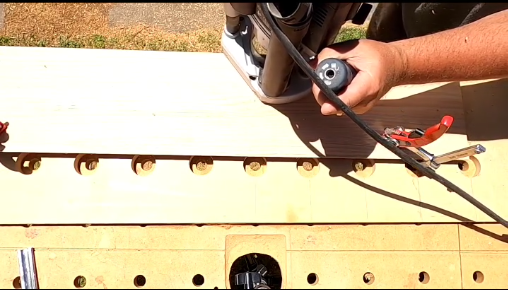
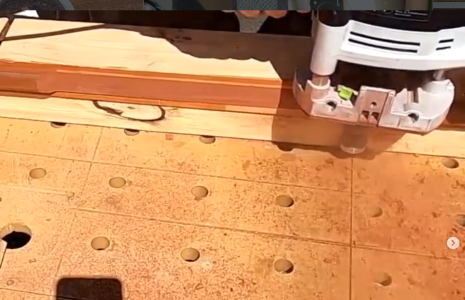
I do an awful lot of small jointing, and by far the easiest and quickest method I've found to true up boards is to use an MDF guide and a carbide insert spiral cutter with the router. Especially as my jointer always seems to be buried under a pile of projects/timber, etc.

I just line up the MDF guide with the marks and route away. Perfect 90 degrees angle and dead straight every time. No fuss!

For the longer stuff I have some aluminium extrusions I use as the straightedge, which are also what I true up the MDF guides with.
 

Attachments

  • jointing.1.PNG
    jointing.1.PNG
    268.8 KB · Views: 37
  • jointing.2.PNG
    jointing.2.PNG
    279.9 KB · Views: 36
Clever! Any solution you've found for face jointing? I can use a planer sled for bigger pieces, but again... it's the small pieces I need the biggest tools for.
 
The short answer is no. A jointer has some inherent qualities that other tools do not have. The most important is the fact that any discrepancy in function when face jointing can be compensated because of those 'faults': if there is even the slightest error in the squareness of the guide you can compensate for that by turning the next board around its longer axis before jointing it — that way the edges will perfectly join up.

This can hardly be achieved with a router set up. And even when using a track saw to achieve this it is a time consuming process that involves sawing through the edges in situ.
 
Clever! Any solution you've found for face jointing? I can use a planer sled for bigger pieces, but again... it's the small pieces I need the biggest tools for.
I'm a bit spoiled for face jointing, I just run it all through my drum sander! By far one of the best ROI I've made!
 
The short answer is no. A jointer has some inherent qualities that other tools do not have. The most important is the fact that any discrepancy in function when face jointing can be compensated because of those 'faults': if there is even the slightest error in the squareness of the guide you can compensate for that by turning the next board around its longer axis before jointing it — that way the edges will perfectly join up.

This can hardly be achieved with a router set up. And even when using a track saw to achieve this it is a time consuming process that involves sawing through the edges in situ.
I agree the alternate edge method is great for evening out any discrepancies and is what I used to primarily do, even if I felt the fence and tables were dialled in 100%.

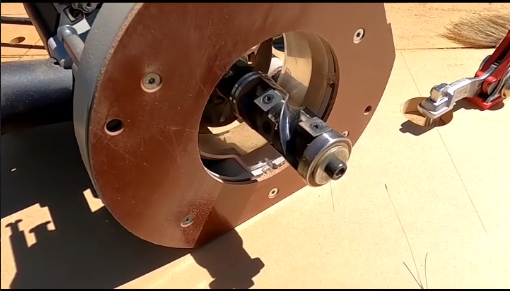
But I disagree very strongly with not being able to achieve perfect joints with a router, it's simply not true and it's far easier than most would think. It only requires a known dead straight guide, and the ability to use a router and hold it flat without pivoting it. That's where using a good quality and large spiral insert cutter like the one in my earlier pic comes in to play, it makes very short work of machining so you don't have a cutting load to worry about, just push the router along.

I routinely joint a very large number of small boards, and the occasional 1.5-1.8m boards using this method without anything less than a result at least as good as from the jointer. I also find it far easier and more accurate than using a tracksaw.

In the pic below I'm machining 32mm x 15mm deep in a single pass using this method on some super hard Jarrah for a table with perfect results! Probably not recommended to hog quite that much but what I lack in skill I make up for in confidence! ;-)
 

Attachments

  • jointing.3.PNG
    jointing.3.PNG
    948.4 KB · Views: 33
Last edited:
OK so here's my plan of attack for replacing the face jointing operation of a jointer...

1. For the most challenging/larger pieces, I forgot (I know, dumb) that I have that Woodpeckers slab flattening mill +2200 that I could use.
2. For medium sized boards, I'll just use a planer sled.

...For small parts, like 12" and under in length, and maybe 6" wide, I'm at a bit of a loss.
 
Last edited:
I sold my jointer and built a router sled that completely meets all my needs. The downside is that the process takes more time and creates more dust. You also need to be sure your MFT table is flat.
 
Jointer and thickness planer are 'foundation' tools - there are no real substitutes, in my opinion. 'Work arounds', yes, but not substitutes.
Agreed about thickness planer, that's staying, but the jointer can be replaced by other means. In some cases I'm already having to do a different operation whenever the board is wider than the jointer width.
 
Agreed about thickness planer, that's staying, but the jointer can be replaced by other means. In some cases I'm already having to do a different operation whenever the board is wider than the jointer width.
Drum sander!

I think I've used my thicknesser maybe twice since getting the drum sander! And yes, you absolutely can thickness sand really well with them, they're not just for very fine passes!
 
Agreed about thickness planer, that's staying, but the jointer can be replaced by other means. In some cases I'm already having to do a different operation whenever the board is wider than the jointer width.
This.

Foundation tools don't mean they can't be done with. Boards can be jointed on the table saw (my preference), with a router/guide or even a handplane (my secret weapon). I don't have a jointer either and work with rough lumber all the time.

With a 20T rip blade, jointing can be a lot quicker (in just one pass) on the table saw than on the jointer.
 
Last edited:
I've been successful with the router method as mentioned here a couple of times.

My favorite method is a hand planer with a shooting board. Fast, simple and reliable.
 
You can joint on a router table. Reasonable for small parts.
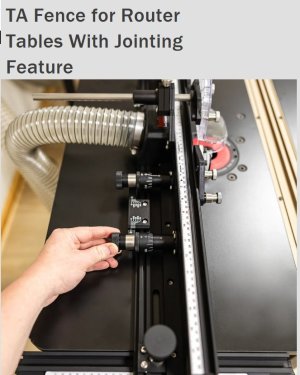
Jessem has a fence where the left hand half of the fence has micro adjusters that lets you move it forward for jointing set-up.
Like all things Jessem, its expensive but well built, but you can achieve the same thing with most router table fences and a piece of Formica laminate as a spacer.
 

Attachments

  • Jessem Fence.jpg
    Jessem Fence.jpg
    79.3 KB · Views: 15
This.

Foundation tools don't mean they can't be done with. Boards can be jointed on the table saw (my preference), with a router/guide or even a handplane (my secret weapon). I don't have a jointer either and work with rough lumber all the time.

With a 20T rip blade, jointing can be a lot quicker (in just one pass) on the table saw than on the jointer.
Poster has already done away with his table saw.
 
The first tools I use on virtually all solid wood projects are:
-jointer to flatten one face and establish an edge at 90 degrees (or other angle)
-bandsaw to rip to width
-thickness planer to flatten second face parallel to first

The order may vary depending on the particulars of the project and stock I am starting with, but those three tools are foundational. I could use hand planes to cover some jointer tasks and do when we get down to the last few thousandths, but I don't want to work that hard. You can have my jointer (and bandsaw and thickness planer) when you pry it from my cold, dead hands.
 
In my never ending quest to eliminate my large tools, I've successfully killed off my table saw and router table, now my sights are set on the jointer. I already use a TS55/75 on longer boards to edge join, but I do make small parts too, though not as much. I have the HL850 but it's too large to edge joint small things that the track saw can't do. Any chance that smaller planer (not in the USA yet) might be what I need? Anybody successfully get rid of the jointer?
The smaller planer won't really help. You already have the 850, maybe try and find the benchtop stand for it.
 
Back
Top