Dados vs Dominos (DF500)

doozer_diy

Member
Joined
Sep 3, 2024
Messages
16
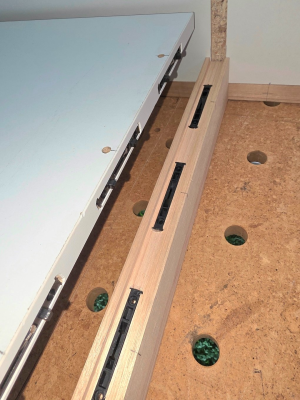
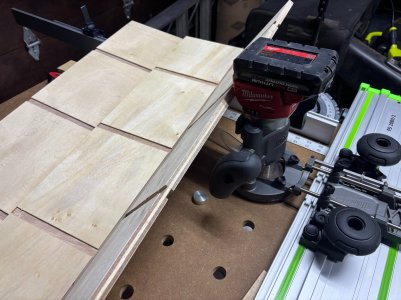
When I make cabinets (typically 1/2 or 3/4" ply) I tend to use dados for shelves and miter folds on the frames (where needed). I might add rabbets for backer. I've never really found the need for a domino in this workflow, although I can see it could be useful for miter folds. I can knock out dados pretty quickly using a router, squared on a rail on an MFT/3. Is it any quicker to use dominos? I would have thought it would require a similar mark-up time.... and structurally, the glued dados do a great job of holding a project together. I guess if I wanted to make knock-down furniture with mechanical dominos, then that's another use case for using a DF500. Anyway, guess the question is... can anyone see benefits to the domino workflow vs dados for the use case I've described that uses sheet goods? Thanks.
 

Attachments
  • IMG_1234.HEIC_compressed.JPEG
    IMG_1234.HEIC_compressed.JPEG
    355.7 KB · Views: 26
Last edited:
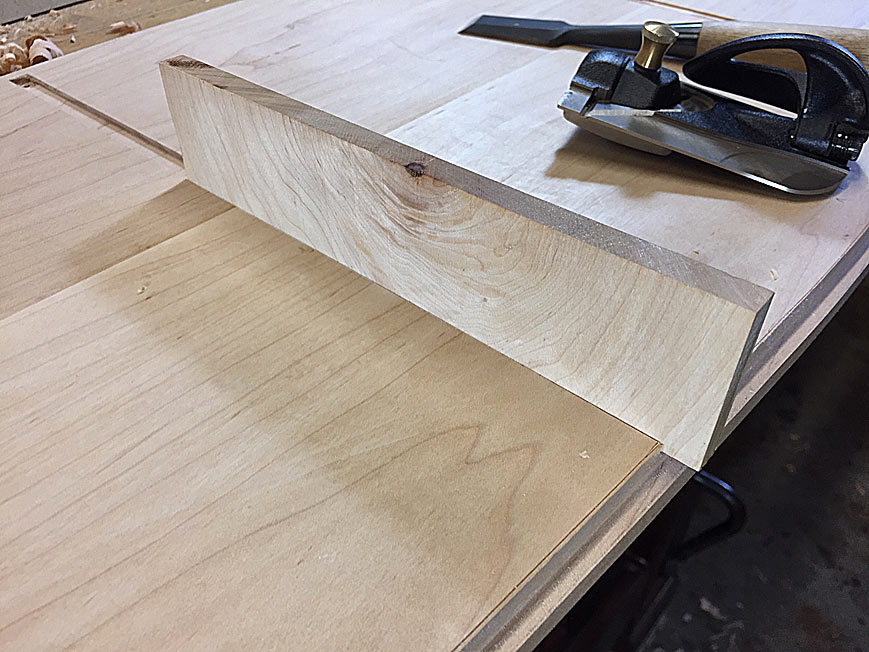
I generally set all my sides and shelves into dado's, but I do also use the Lamello Zeta for attaching the face frame and the Domino for joining the narrower parts of the timber frame.

If I didn't have the Zeta, I'd definitely be using the Domino on the face frame. Fantastic for alignment and adding strength.

Case in point.
 

Attachments

  • image.png
    image.png
    2.1 MB · Views: 28
I cut dadoes on the tablesaw, not with a router. But that was 10 years ago as since I picked up the DF500, I have no longer used dadoes by and large.

One significant benefit of the DF500 for me is all the boards are cut to the same length without allowance for the dadoes. I also no longer need any test cuts to ensure the dado width to match the thickness of the boards. Lastly, the glue-up is easier with the domino joinery than with the dadoes as boards won't shift or need to be flushed up as you put them together.
 
I generally set all my sides and shelves into dado's, but I do also use the Lamello Zeta for attaching the face frame and the Domino for joining the narrower parts of the timber frame.

If I didn't have the Zeta, I'd definitely be using the Domino on the face frame. Fantastic for alignment and adding strength.

Case in point.
Ah yes, face frames. I've been using pockets, but the dominos would be much cleaner.
 
I cut dadoes on the tablesaw, not with a router. But that was 10 years ago as since I picked up the DF500, I have no longer used dadoes by and large.

One significant benefit of the DF500 for me is all the boards are cut to the same length without allowance for the dadoes. I also no longer need any test cuts to ensure the dado width to match the thickness of the boards. Lastly, the glue-up is easier with the domino joinery than with the dadoes as boards won't shift or need to be flushed up as you put them together.
Great points.
 
Way less dusty with Dominos.

Also, all the front edges easily get aligned with the precision of the Domino machine. One would use the paddles and mortise to the narrow width.
 
@doozer_diy For the way you work now, Dominos would be similar, as far as the layout/setup, but that's where it ends. Dominos aid in edge alignment. They are far faster/easier for face frame construction, over mortise and tenon, especially for doors. However, the real benefit might just be a change in your workflow. Having this ability can expand the way you look at future projects.
 
The poor man’s Domino is the biscuit cutter. Simpler than a dado.
They are ok for edge glue-ups or aligning/attaching a face frame to a cabinet, maybe an outside corner of a big crown molding, but that takes some skill. Other than that? I'm not a big fan. I had a DeWalt, used it for years, but it was effectively retired when I got my first DF500. Both were melted in a fire and I never replaced the biscuit joiner, still don't miss it. There is absolutely nothing a biscuit can do that a Domino can't, but it doesn't work the other way.
 
I NEVER would use dominos or biscuits for attaching quality shelves. Yes, these appear to work, but the important advantages of a dado are ..

1. There is support across the full length of the shelf,

2. But especially, with exapansion and contraction, the edges are hidden inside the dado.


Regards from Perth

Derek
 
I NEVER would use dominos or biscuits for attaching quality shelves. Yes, these appear to work, but the important advantages of a dado are ..

1. There is support across the full length of the shelf,

2. But especially, with exapansion and contraction, the edges are hidden inside the dado.


Regards from Perth

Derek
Full support across the shelf can easily be achieved by using adequate number of dominoes in the design.
 
Regardless of the joinery used, yes, we need to deal with wood movement. Applying glue only where a rigid connection is needed, leaving the areas that need to move unglued is one technique. Building cabinets with shelving using dominoes and ply sheets instead of dados and hardwood is another. Some domino joiner users make breadboard ends with dominoes, keeping in mind the need to allow for wood movement.

In short, concerns about movements and gaps shouldn't deter anyone from using dominoes, and in most cases, the dominoes outweigh the dados in terms of pros and cons in typical furniture and cabinet making.

To paraphrase CRG, there is absolutely nothing a dado can do that a Domino can't, but it doesn't work the other way.
 
Last edited:
I built some bookshelves when I needed to move all my books, they were two metres long and held about 60 years of National Geographic magazines and I would seriously doubt that any Dominos would have held the weight on those shelves. They were 45mm thick pine and over the many years the magazines were on them did not bend.
 
I have had no experience with any 2-meter long shelving, whether built with dadoes or floating tenons. I suspect the problems one expects with long length and heavy loading are sagging and racking. As such, a builder might include some kind of support in the middle in their design. Another critical concern in a heavy load cabinet or shelfing is uncontrolled racking, which can break any joint, dadoes included.

I don't know if anyone has done a joinery strength test on dominoes vs dadoes. I found this video on dominoes vs rabbets, but not a test.


Inherently, dadoes are stronger because of glue surface, but the key is to employ enough dominoes and use the suitable wood. If someone has a particular project that they think something else other than dominoes should be used, by all means, go with it. All roads lead to Rome, eh? I'm just pointing out dominoes are an effective alternative to dadoes for the majority of users.

For all the cabinets (3 to 4 feet wide?) built with dominoes instead of dadoes since over 10 years ago, I have not seen joinery issues of any kind. One of them holds all the issues of Fine Woodworking from issue #1 as well as many many issues of Furniture & Cabinetmaking plus all the "guru" books (Krenov, Tage Frid, etc.). To prevent sagging (as the shelf is 3/4"), a middle support is included.
 
Last edited:
Wood movement is a real concern when you’re trying to fuse pieces of wood together with glue, especially the pieces have opposite grain directions. But you don’t need that kind of joint (dados) for shelves unless the expected load will be very high.

Remember, most shelves these days ar supported by four little 5mm diameter pins.
 
For years I made my shelf units using dadoes. I would cut the dadoes 3/8” deep with a jig across a 24” sheet of 3/4” ply. I would then rip the sheet into two 11.75” boards. In that way, I knew that the left and right sides would align perfectly. Glue ups were easy. And I knew that the shelves were well-supported by the dadoes.

That all ended after reading a report of testing done for the Kitchen Manufacturers Association. They contracted a testing/engineering firm to test various fastening methods. Judging from the test, they were primarily concerned about racking strength (rocking left and right).

The test consisted of a single vertical panel with a horizontal shelf supported from one side only. They would then load the end of the short shelf to see when it would fail. No glue was used and they were only interested in what mechanical strength was added by the joinery method.

They tested dadoes, dowels, confirmats, drywall screws and 1/4 turn fasteners. They did not test Dominoes, presumably because they did not lend themselves to high production use and were not widely used by the associations’ members.

The results surprised me. (Note, the below is based on my memory of the study. It might still be available online somewhere.)

The dadoes fared poorly. The joint failed with the minimum weight, so they could not get an accurate read out.

The 1/4 turn fasteners did not do much better. Drywall screws came in third from the bottom.

Confirmats did very well as did the dowels.

I would also note that the RTA also had an engineering firm run similar tests and got similar results.

I forget which one said, “regardless of the type of fastener, no fastener should be within 2” of the end of the board. So a 12” wide board would have 8” of available space for fasteners. This because the board needs space on both sides of each fastener to prevent the board from blowing out.

To me, the tests made more sense for the RTA industry than the kitchen cabinet industry. Most cabinets are fastened to the wall and the wall becomes part of the structure greatly improving resistance to racking. Ready to Assemble Furniture is generally free-standing and racking strength would be essential.

In reality, once you get used to a type of joinery, the work-load becomes similar regardless of the system. I find it no more difficult to use dowels than to use dadoes.

I rarely use the Confirmats because then I have to make decisions: Will this Confirmat show when installed? It is easier to just use dowels.

Of course, whether using Dominoes, dowels, or Confirmats, you have to use sufficient number to meet the stresses involved. I simplified my dowel spacing by always using all the template’s holes (32mm spacing). I don’t know how you decide on the spacing for Dominoes. I acknowledge that the 32mm spacing brings the dowel closest to the edge less than 2”.

Addendum: I would note that the testing labs used multiples of joints to come up with a result (10 or 12 each as I recall). Unlike the magazine articles that generally test a single example for their results. I found the testing labs conclusions believable.)
 
"The test consisted of a single vertical panel with a horizontal shelf supported from one side only. They would then load the end of the short shelf to see when it would fail. No glue was used and they were only interested in what mechanical strength was added by the joinery method."

That a "hung" dado joint fared poorly in the lab test should be obvious to anyone even with little woodworking experience because in a typical 3/4" sheet good, the depth was only 1/4 to 3/8" or roughly one-third of the material's thickness. There is no way a friction joint is good enough for shelfing or cabinetry.

In the practical world, no one would use dadoes without glue (some even toenail it in addition to gluing it) in cabinetry work if strength is desired. As such, the Association's test is of no to limited value to me.
 
I built some bookshelves when I needed to move all my books, they were two metres long and held about 60 years of National Geographic magazines and I would seriously doubt that any Dominos would have held the weight on those shelves. They were 45mm thick pine and over the many years the magazines were on them did not bend.
Bending of the shelf has nothing to do with the joinery at the ends. The shelf just needs to be stiff enough. Often just the fact that it is attached to a back, is enough. It is free-standing/one from both sides, that take extra engineering. Generally, that means thicker shelves.
 
Back
Top