Did I Dent My Bandsaw Blade? If so, what to do?

onocoffee

Member
Joined
Sep 23, 2024
Messages
1,442
Location
Baltimore, Maryland, USA
I tend to get into trouble mainly because I go ahead with not a lot of knowledge and plow through it until something happens.

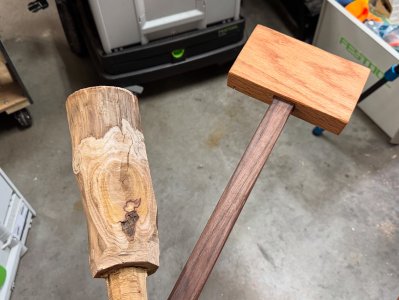
Yesterday, I thought that I would make a couple of mallets. One of white oak and the other of Black Locust from a branch that I cut off the tree that fell in my yard earlier this summer. I got the idea from a Japanese woodworkers' video I saw on YouTube. He was more masterful with a chainsaw and a hatchet, I had my old 1934 Delta 14" bandsaw. I scored a line around the center and started cutting away the handle with a Carter Green Wood 3TPI blade. Overall, it went well. I would cut a slice off along the length of the handle and then, if the center line wasn't deep enough, cut the slice from the piece. During one of those crosscuts, I jammed up the piece and stopped the saw.

After shutting off the saw and dislodging the workpiece, I went back at it. The saw was making a decidedly different sound and I could see a wobble in the blade and I'm thinking that I kinked the blade. I've got a video below showing the situation. Can this be rectified? Is it a matter of tightening and increasing tension? Later, as I was cleaning thing up, I checked the motor belt (one of those adjustable multi-link belts) and it seems a little loose compared to when I restored the saw. Could the jam have loosened the belt and is causing this issue?

I don't know enough about bandsaws to accurately diagnose the issue which is why I'm asking here. Or is it just a simple matter that I have kinked the blade and the only course of action is replacement?

Thanks!


These are the mallets so you can see the size of the Black Locust.
 

Attachments

  • F2CE65FF-A43F-4697-AE87-BBAB5703F435.jpeg
    F2CE65FF-A43F-4697-AE87-BBAB5703F435.jpeg
    2.1 MB · Views: 12
I'd pull the blade and take a close look at it, if you kinked it you can probably straighten it out. While the blade's off, I'd also look at the tires for any debris caught between the tires and the blade. The upper blade guides appear to be set pretty wide and they should be set tighter once you unkink the blade. It's a good practice to lower the upper guide as much as possible to keep it as close to the wood as possible.

If you're happy with the Delta, I'd suggest you think about changing over to ball bearing blade guides, the cut is much more precise especially for any resawing you do.
 
Blade looks very tweaked to me.
I've found you can almost never really untweak a tweaked blade - at least if you want to run your guides close and not have a wider and rougher than usual kerf.
I second @Cheese 's recommendation for guide upgrade, but they make different versions you might want to check out. I wish I had tool-less adjustments on my Carter upgrade (for a different saw):
 
I'm right with all of them. You might be able to straighten the blade somewhat, but it's not likely to be right again, ever. It will need to be off of the saw to do it, though, tension enough won't do it. If it is still decently sharp, you might want to save it, for when you do dumb stuff :oops: The problem is, most people hate changing them, so the just don't. They hold onto that blade and never use it.
Save yourself the frustration and replace it. That's where you will end up anyway.
Also, they're right about the blade guides too. I've had the Carter rollers on mine for decades.
 
I'd pull the blade and take a close look at it, if you kinked it you can probably straighten it out. While the blade's off, I'd also look at the tires for any debris caught between the tires and the blade. The upper blade guides appear to be set pretty wide and they should be set tighter once you unkink the blade. It's a good practice to lower the upper guide as much as possible to keep it as close to the wood as possible.

If you're happy with the Delta, I'd suggest you think about changing over to ball bearing blade guides, the cut is much more precise especially for any resawing you do.
I will check those and readjust the guides. Presuming that the blade is kinked, what's the way to correct it? Hammer on an anvil?
 
I'm right with all of them. You might be able to straighten the blade somewhat, but it's not likely to be right again, ever. It will need to be off of the saw to do it, though, tension enough won't do it. If it is still decently sharp, you might want to save it, for when you do dumb stuff :oops: The problem is, most people hate changing them, so the just don't. They hold onto that blade and never use it.
Save yourself the frustration and replace it. That's where you will end up anyway.
Also, they're right about the blade guides too. I've had the Carter rollers on mine for decades.
The blade is essentially new. Oh, well... At least Woodcraft has a sale on Starrett blade this month. I'll keep the blade because I most certainly will probably be doing the "stupid stuff"!

@smorgasbord I had been thinking about the Carters. However, I thought the cut performed well enough with the stock guides. I'll look more into them and see what options are available.

@P_K I will check out those bimetal blades. Thanks.
 
I thought the cut performed well enough with the stock guides.
The main reason for upgrading guides is ease of adjustment after changing blades or changing depth of cut. I suppose there are bandsaws that are so well made that as you move from 1" above the table to 15" above the table you don't have to adjust the top guides, but I've not used one of those.

Also, unless you're doing tight curves or resawing thick lumber, exact guide placement may not be critical.
 
The bandsaw we had in our machine shop had both a dedicated welder built in and a grinder. The tool room would order large coils of bandsaw blades and cut and weld to size.

They sell those big commercial saws used for just a few hundred dollars. Of course you need good ceiling height and a rigger to bring them into your shop. Used horizontal band saws and drill presses can also be bought very cheaply from commercial used machinery dealers. But the size and weight of these machines usually means it is better to buy new, even if the new one has less capacity.

I was never involved with the process, but apparently it was simple and effective. I have a crappy bench top band saw. The blade guide is difficult to adjust and fairly ineffective in keeping the blade in line. It also does not have enough depth to be useful in resawing. I don’t know why I bought it.
 
Another vote for replace. I'm less enthusiastic than the others regarding ball bearing side guides. I have phenolic "cool blocks" on my small curve cutting band saw, and I can run them very very close to the blade without damaging the blocks or the blade.

Everyone has a favorite band saw blade brand...this is mine. https://www.pswood.com/
 
What do you guys running ceramic guides think of them?

I'm toying with the idea of upgrading my 10" bandsaw soon, and I've more or less narrowed it down to the Laguna BX 18 with the ceramic inserts over the Harvey HW615 with the bearing guides.
 
+1 on Timber Wolf Band saw blades. Very good quality.

I've got a 20 inch Powermatic model 81 that rolled out of the factory in Tennessee in 1974. Bought it at auction from a factory that made model plane kits. It spent its life sawing balsa wood. It has Carter roller bearings both upper and lower.

Ron
 
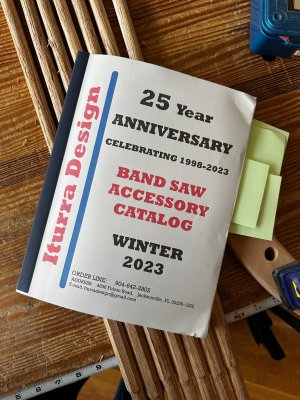
I've mentioned this several times before, but if you're interested in tuning up a standard size band saw, I'd seriously suggest you contact Iturra Design in Florida. They publish a free 250+ page catalog highlighting modifications, accessories, and various items that they recommend for Delta style bandsaws. The catalog is not a quick read...you'll probably spend many hours pouring over the suggestions and the improvements they highlight.
 
Yeah, from what you’re describing, it sounds like your blade probably got kinked when it jammed, and honestly, those usually can’t be fixed, so you’ll likely need a replacement. That said, a loose motor belt can also make the saw feel off or wobble, so I’d check the belt tension and make sure the blade is tracking correctly before blaming everything on the blade. When I’ve done crosscuts on hard woods like oak or locust, going slow and supporting the piece really helps prevent jams, otherwise the saw can get into trouble fast. Once you replace the blade and tighten everything up, it should run smooth again.
Thanks. I will check on those. Probably going to get the new blade today.
 
I will check those and readjust the guides. Presuming that the blade is kinked, what's the way to correct it? Hammer on an anvil?
I think to deal out that kink you might heat it up to some high temp so you see a color change and then do hammering on anvil.
Could be a frustrating exercise.
 
I managed to pull the blade off my drive wheels just recently and kinked the blade.
I put the blade back on the wheels and finished my cut, but then ordered a new blade.

Once you put a kink in the blade, the steel has yielded and has become work-hardened. Not going to fix that (not properly anyways).
 
Back
Top