
Cheese
Member
Well you’re not alone if that makes you feel any better.I feel so old school reading all you guys and your cnc’s


Well you’re not alone if that makes you feel any better.I feel so old school reading all you guys and your cnc’s
If you" want to get into it ", buy a used Shapeoko 3 or 4 to learn the ins and outs. I think the expectations of this level of machine is what turns people away - expecting them to cut like a large CNC, but you are limited to 1/8" or 1/4" passes at slow speeds and they get frustrated quickly.I've experienced #1 many times... with my Domino machines, my first 3D printer (which i outgrew quickly), home automation stuff and so on. #2 is the primary reason I want to stay away from the OneFinity/Shapeoko/Altmill, while they look like great machines, I get the feeling that you outgrow them pretty fast. I think i'm going to shelve the idea until i can come up with a solid use case other than "I want to get into it", thanks for all the feedback!
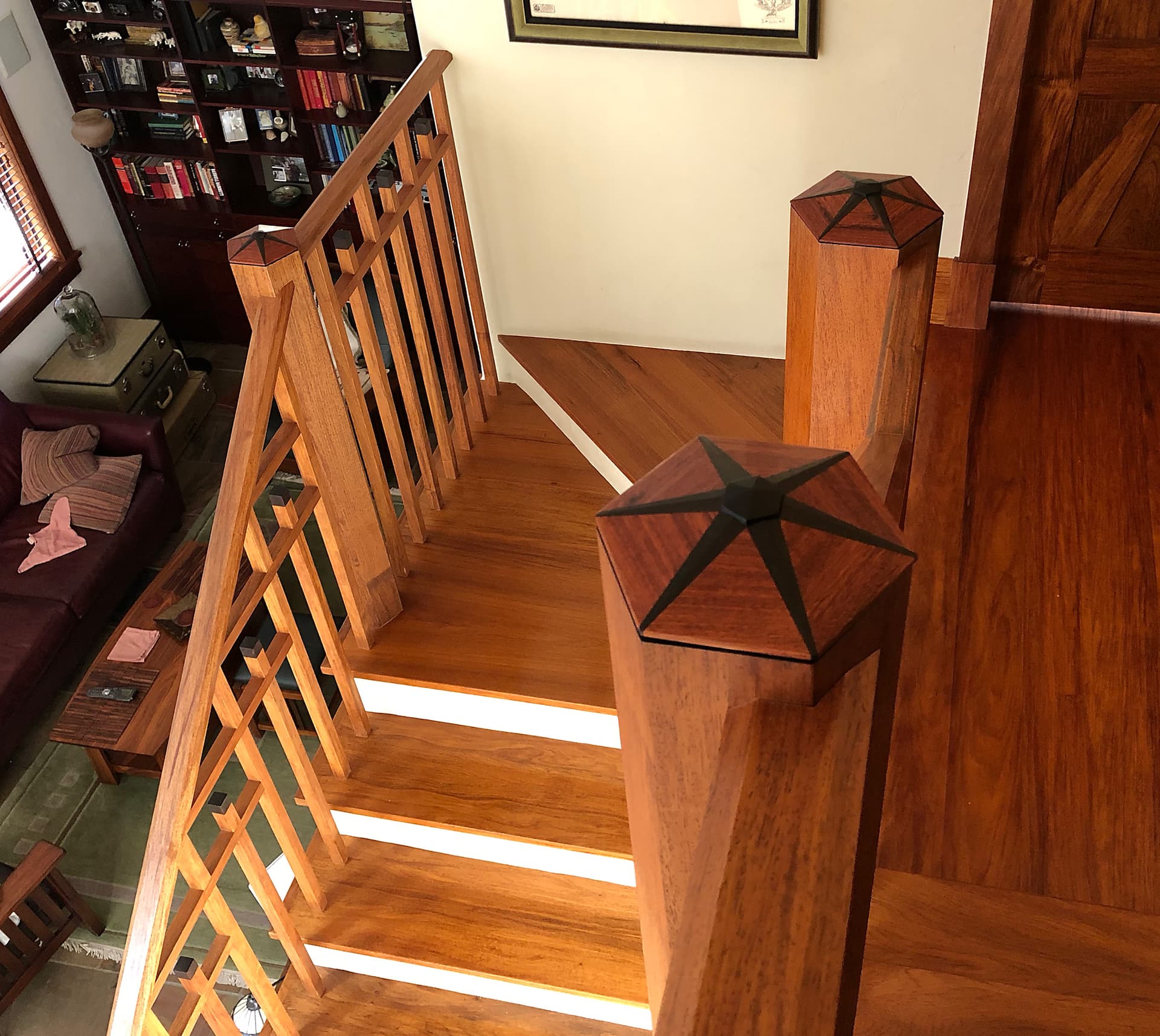
Beautiful project nicely done! I can’t imagine how it could be done on the Shaper. Even with your CNC I expect you had a lot of Z steps to sand out they turned out great.Note that, unless I'm wrong, even with Bench Pilot, you're not getting true Z-axis manipulation while cutting with the Shaper Origin. That doesn't matter for a lot of things, like engraving, inlays, cutting out sheet goods, even most joints. My first CNC project was a staircase newell topper, which my design was a hexagon (which are the best-agons), that was pyramidal, and built of two contrasting woods. I do not think that is still today possible on a Shaper Origin.

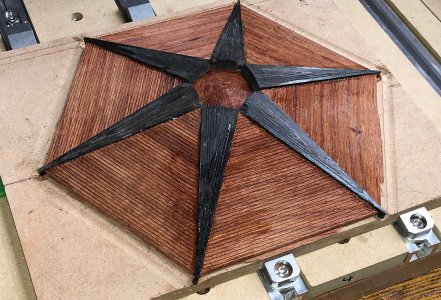
Actually not much sanding. The ebony wedges were made separately on the CNC, then glued into a roughly machined on the CNC body:Even with your CNC I expect you had a lot of Z steps to sand out they turned out great.
 a
aThings are just getting started here.I feel so old school reading all you guys and your cnc’s

A lot of heated (ignorant) responses I see on social media think that's exactly what CNC is right now, tap the icon of the desired object, and off it goes pumping it out the end fully finished!Things are just getting started here.
At some point, software like Fusion 360 will be at the point where you won't even have to define your own toolpaths. You just design the object you want in the software, specify the material and tolerances, load up the blank in the machine and press Go. And it seems like 3D printing is even closer to this state.

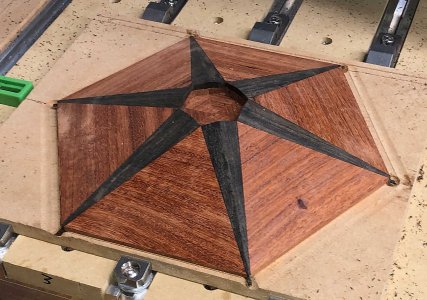
Really nice job on these @smorgasbordActually not much sanding. The ebony wedges were made separately on the CNC, then glued into a roughly machined on the CNC body:
View attachment 379750
And then a finishing pass with a 1" core box bit:
View attachment 379749a
If you look closely, you can see where the core box bit cut into the sacrificial MDF platten.
Then the CNC machined center hex plug was glued in.

This is what I found most surprising and irritating about the Shaper Origin. It took many, many passes and a lot more grunt to push the router through the walnut than I expected.but you are limited to 1/8" or 1/4" passes at slow speeds and they get frustrated quickly.
Ok this is interesting to me! I thought at one point of getting a Shaper for inlay work in mainly hardwoods (which are often harder than Walnut), but having used CNC machines for years the physics of the Shaper always baffled me as everyone seems to rave about how capable, powerful and fast it is, but given the size and power I just couldn't see it.This is what I found most surprising and irritating about the Shaper Origin. It took many, many passes and a lot more grunt to push the router through the walnut than I expected.
Saw this Thos. Moser video, which briefly shows use of a 5-axis CNC:
But, they still have over 150 jigs.
A side note is that they keep the humidity at 43% as the mid-point for expansion/contraction when the piece is in its final home.
A debate that will never end.I see that more as manufacturing than "woodworking" - or am I off?
IMO hell yes it is! CNC's are just another tool in the arsenal so far as I'm concerned.The CNC is something I've been debating in my mind a bit lately: "Is it REALLY 'woodworking'?"

