
You are using an out of date browser. It may not display this or other websites correctly.
You should upgrade or use an alternative browser.
You should upgrade or use an alternative browser.
“Do it all” drill
- Thread starter l0pht
- Start date
demographic
Member
- Joined
- May 9, 2015
- Messages
- 859
I have a C18 drill and its the least ergonomic drill I own.
Bleedin orrible contraption.
Then I also own a DWC4500 drywall gun which, shape wise is everything the C18 isnt. Far and away nicer shape.
Mind, I only have five fingers (well technically four fingers and a thumb) on each hand so possibly thats whats wrong.
Bleedin orrible contraption.
Then I also own a DWC4500 drywall gun which, shape wise is everything the C18 isnt. Far and away nicer shape.
Mind, I only have five fingers (well technically four fingers and a thumb) on each hand so possibly thats whats wrong.

JMDUK
Member
- Joined
- Dec 21, 2021
- Messages
- 17
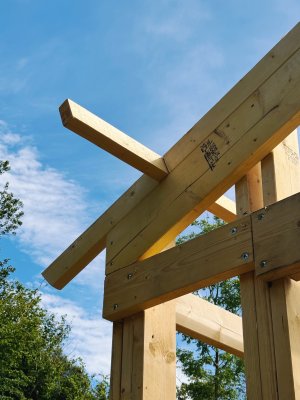
I built an entire 100m2 timber post-framed workshop with three powertools, a CXS 12, TPC 18/4 (and an HKC55):
- Glued and screwed triple-ply 6x6” columns with 6x120 cylinder heads
- 6x2 girts with 8x120 washer heads
- Big lag bolts for concrete brackets
- 12x200s for rafters and beam connections
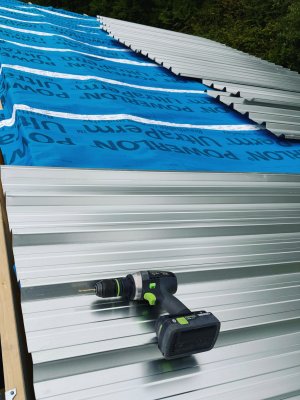
- Roofing and wall steel with Techfast screws
- Concrete anchors for internal walls and column brackets
- Drywall hanging
- Consumer unit setup, hanging all sockets and pipework
- Floor joist brackets, OSB subfloor
- Cabinet assembly and hanging
Theoretically I could have do it all with just the TPC but my wrists would have hated me and no doubt the finishing would not have been as tight, as the finesse of the low weight, one-handed ergonomics and gentle torque of the CXS12 allows for much more precise and delicate work like fixing sockets, snugging up terminals, sinking drywall screws on a ladder etc.
I’d really recommend going with a CXS12, then grabbing a TPC when funds allow. The TPC does 90% of the work a dedicated SDS would do for me renovating homes, building small structures, and designing, and fitting cabinetry. Also the 1/2” metal chuck fits the CXS12 just fine and I use it regularly for putting bigger holes through drywall.
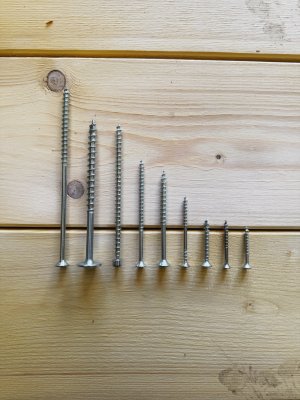
Screws below, five to the left are handled by the TPC, 4 to the right are done with CXS. TPC also does great with HSS bits through steel, and of course holes for anchors in masonry and concrete. I couldn’t live without either!
- Glued and screwed triple-ply 6x6” columns with 6x120 cylinder heads
- 6x2 girts with 8x120 washer heads
- Big lag bolts for concrete brackets
- 12x200s for rafters and beam connections
- Roofing and wall steel with Techfast screws
- Concrete anchors for internal walls and column brackets
- Drywall hanging
- Consumer unit setup, hanging all sockets and pipework
- Floor joist brackets, OSB subfloor
- Cabinet assembly and hanging
Theoretically I could have do it all with just the TPC but my wrists would have hated me and no doubt the finishing would not have been as tight, as the finesse of the low weight, one-handed ergonomics and gentle torque of the CXS12 allows for much more precise and delicate work like fixing sockets, snugging up terminals, sinking drywall screws on a ladder etc.
I’d really recommend going with a CXS12, then grabbing a TPC when funds allow. The TPC does 90% of the work a dedicated SDS would do for me renovating homes, building small structures, and designing, and fitting cabinetry. Also the 1/2” metal chuck fits the CXS12 just fine and I use it regularly for putting bigger holes through drywall.
Screws below, five to the left are handled by the TPC, 4 to the right are done with CXS. TPC also does great with HSS bits through steel, and of course holes for anchors in masonry and concrete. I couldn’t live without either!

luvmytoolz
Member
That's very reassuring to see they were so capable for you!I built an entire 100m2 timber post-framed workshop with three powertools, a CXS 12, TPC 18/4 (and an HKC55):
- Glued and screwed triple-ply 6x6” columns with 6x120 cylinder heads
- 6x2 girts with 8x120 washer heads
- Big lag bolts for concrete brackets
- 12x200s for rafters and beam connections
- Roofing and wall steel with Techfast screws
- Concrete anchors for internal walls and column brackets
- Drywall hanging
- Consumer unit setup, hanging all sockets and pipework
- Floor joist brackets, OSB subfloor
- Cabinet assembly and hanging
Theoretically I could have do it all with just the TPC but my wrists would have hated me and no doubt the finishing would not have been as tight, as the finesse of the low weight, one-handed ergonomics and gentle torque of the CXS12 allows for much more precise and delicate work like fixing sockets, snugging up terminals, sinking drywall screws on a ladder etc.
I’d really recommend going with a CXS12, then grabbing a TPC when funds allow. The TPC does 90% of the work a dedicated SDS would do for me renovating homes, building small structures, and designing, and fitting cabinetry. Also the 1/2” metal chuck fits the CXS12 just fine and I use it regularly for putting bigger holes through drywall.
Screws below, five to the left are handled by the TPC, 4 to the right are done with CXS. TPC also does great with HSS bits through steel, and of course holes for anchors in masonry and concrete. I couldn’t live without either!
View attachment 382094View attachment 382095View attachment 382097
I'm extremely happy with the Festool drills I've bought so far and I'm strongly considering the CSX12 set!

waho6o9
Member
The CSX12 looks like an awesome set with a good systainer.

Cheese
Member
I prefer the new CSX 12 over the older CSX 10.8. The CXS 12 is a lot more flexible than the CXS 10.8 because of its improved power and higher speed.The CSX12 looks like an awesome set with a good systainer.
The only thing I don't like about the CXS 12 is the noise.


mino
Member
It makes me wonder .. maybe Festool could create multiple firmware profiles in their newer tools?I prefer the new CSX 12 over the older CSX 10.8. The CXS 12 is a lot more flexible than the CXS 10.8 because of its improved power and higher speed.
The only thing I don't like about the CXS 12 is the noise.
I am sure the newer CXS and TPC could be made quieter by restricting the peak power to like 80% of the maximum. It would be a great use of the Festool App and the related Bluetooth capability.
It makes sense to have full power to compete with the "big brands" but there is a market for C18/T18/PDC style smoothness as well.
One of the things I love about my DRC is how smooth and quiet it is even at 3800 rpm. My corded 3000 rpm drill is incomparably louder...
Last edited:
Cheese
Member
Great idea…It makes me wonder .. maybe Festool could create multiple firmware profiles in their newer tools?
I am sure the newer CXS and TPC could be made quieter by restricting the peak power to like 80% of the maximum. It would be a great use of the Festool App and the related Bluetooth capability.

luvmytoolz
Member
I noticed with the CXS18 I got that it wasn't overly noisy until you hit a certain spot with the speed. And then it was a very loud and shrill whine.I prefer the new CSX 12 over the older CSX 10.8. The CXS 12 is a lot more flexible than the CXS 10.8 because of its improved power and higher speed.
The only thing I don't like about the CXS 12 is the noise.
The other thing I noticed is that the variable speed control is sensational, and I could hold that exact speed indefinitely if wanted or just go either side of it.
Michael Kellough
Member
Relative to speed control.
Around 15 years ago I was asked to make a rig to turn a very large Rolodex (the largest) for a commercial. The client was several states away and didn’t know what speed would be needed and I didn’t know how much torque would be needed so I made a few interchangeable gear reduction units and brought my good-ol Milwaukee 1/2” corded drill. Lotta torque. Way more than any cordless drill running at low speed at the time.
Turned out the cards wouldn’t flop over nicely so we went to plan B and did stop-motion animation but before we got to that point I found out via high speed video playback that my electric drill was VERY INCONSISTENT speed-wise. It wouldn’t have worked even if the cards played nice. The prop department PA happened to have a no-name cordless drill that delivered absolutely rock solid speed. Would have been perfect…
Around 15 years ago I was asked to make a rig to turn a very large Rolodex (the largest) for a commercial. The client was several states away and didn’t know what speed would be needed and I didn’t know how much torque would be needed so I made a few interchangeable gear reduction units and brought my good-ol Milwaukee 1/2” corded drill. Lotta torque. Way more than any cordless drill running at low speed at the time.
Turned out the cards wouldn’t flop over nicely so we went to plan B and did stop-motion animation but before we got to that point I found out via high speed video playback that my electric drill was VERY INCONSISTENT speed-wise. It wouldn’t have worked even if the cards played nice. The prop department PA happened to have a no-name cordless drill that delivered absolutely rock solid speed. Would have been perfect…
Cheese
Member
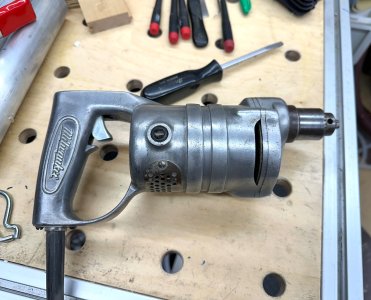
Over the last 50+ years I've owned many + many Milwaukee drills...I always considered they were the best because of their longevity for commercial service use, and as a testament to that thought, I also own a Milwaukee S-114 that my father used when he was installing commercial HVAC equipment back in the early 50"s. He used it daily for well over 40 years...it's on its 3rd pair of brushes while everything else is original.
However, after purchasing Festool drills, I immediately noticed a difference in the trigger control between the Milwaukee's and the Festool's. The Festool trigger control is significantly smoother and more linear. The Milwaukee trigger is pretty much like a JATO rocket...it's either on or off.
However, after purchasing Festool drills, I immediately noticed a difference in the trigger control between the Milwaukee's and the Festool's. The Festool trigger control is significantly smoother and more linear. The Milwaukee trigger is pretty much like a JATO rocket...it's either on or off.
Attachments
Last edited:
luvmytoolz
Member
That's certainly a beautiful old drill!Over the last 50+ years I've owned many + many Milwaukee drills...I always considered they were the best because of their longevity for commercial service use, and as a testament to that thought, I also own a Milwaukee 14D that my father used when he was installing commercial HVAC equipment back in the early 50"s...the thing still works well after 40 years of continuous use...it's on its 3rd pair of brushes and everything else is original.
However, after purchasing Festool drills, I immediately noticed a difference in the trigger control between the Milwaukee's and the Festool's. The Festool trigger control is significantly smoother and more linear. The Milwaukee trigger is pretty much like a JATO rocket...it's either on or off.
As pretty as these old drills are though, they just don't compare to newer models.
Mini Me
Member
I've got two Protool versions, has anyone come up with a fix for the stiff speed change lever. One went back under warranty when the speed control totally seized and couldn't be moved.One problem with the older versions is the gearbox (switch). But overall amazing drill and very well build!
Cheese
Member
I'd say that's the case for pretty much all modern hand tools. The new versions are more powerful, weigh less and require less maintenance. That S-114 from my dad weighs over 5-1/2# and only draws 2.8 amps...not exactly a powerhouse now but back then it was a stunner. Here's how it was advertised in the early 50"s,As pretty as these old drills are though, they just don't compare to newer models.
The same rugged design may be instantly recognized by a glance at any Milwaukee Portable Electric Tool. "More power per pound," so essential in a portable tool is embodied in each and every machine. Sturdily built with ball or roller bearing construction in all tools.
A complete line of small drills up to and including the smallest and lightest 1/4-inch electric drill on the market, having the most power for its small size and light weight.
However, I don't think that's the case for large manually operated machine tools, I'm thinking knee-mills, lathes, drill presses, surface grinders et al.

leakyroof
Member
- Joined
- Mar 23, 2011
- Messages
- 2,625
For my old PDC, I've just learned to live with it. It's the only thing I don't like about that Drill.I've got two Protool versions, has anyone come up with a fix for the stiff speed change lever. One went back under warranty when the speed control totally seized and couldn't be moved.
Michael Kellough
Member
From the SlashGear site, Milwaukee’s “earliest success came when Henry Ford asked the company to develop a new power drill to help speed up his automobile production lines. In response, Milwaukee's founder developed the Hole Shooter, a ¼-inch one-handed drill that fit Ford's brief perfectly.”I'd say that's the case for pretty much all modern hand tools. The new versions are more powerful, weigh less and require less maintenance. That S-114 from my dad weighs over 5-1/2# and only draws 2.8 amps...not exactly a powerhouse now but back then it was a stunner. Here's how it was advertised in the early 50"s,
The same rugged design may be instantly recognized by a glance at any Milwaukee Portable Electric Tool. "More power per pound," so essential in a portable tool is embodied in each and every machine. Sturdily built with ball or roller bearing construction in all tools.
A complete line of small drills up to and including the smallest and lightest 1/4-inch electric drill on the market, having the most power for its small size and light weight.
However, I don't think that's the case for large manually operated machine tools, I'm thinking knee-mills, lathes, drill presses, surface grinders et al.
Read More: https://www.slashgear.com/1943731/who-owns-every-major-tool-brand/

- Joined
- Oct 16, 2015
- Messages
- 5,820
Do it all drill? No such thing.
This is exactly where I see it.For me, a single drill doesn't make sense. For a lot of projects I use one drill for drilling holes and another set up for driving screws. Not having to switch bits is helpful to me.
Bob
A drill that can do the biggest jobs is way too much for regular everyday use. Personally, I would never drive a screw with an ordinary drill. That is impact driver territory. The only exception is machine screws for hardware, they get CXS.
It might just be me and my usual excess, but IMHO, it really takes 4.
CXS for hardware and small drilling
A mid-sized 18v cordless, for bigger things, like spade bits, Forstner bits, and holesaws.
An impact driver for wood screws, assembly tasks
A corded hammer drill 1/2" just because.
In my early days, in the cabinet shop, I always had 4 going at once. (Makita)
A drill with a tapered bit/countersink combo bit and an impact driver with a #2 Robertson, at the assembly bench.
A complete duplicate set up at the case clamp. It was just a few steps away, but I alternated back and forth all day.
In addition was the little Bosch Pocket driver, for pulls/knobs. I had a cordless hammer drill too, but rarely used it.
As I moved onto bigger architectural projects, keeping multiples, in different locations, maintained the efficiency.
Hobby woodworkers, likely don't need any of that overkill, but minimizing/compromising isn't necessarily the best either. You will likely kill a mid-sized drill with a big hole saw, but it's too much for driving a bunch of deck screws.
As of now, in my small shop:
Makita LXT drill (teal)
matching Impact
Makita LXT compact drill (Black)
matching Impact
CXS
Corded DeWalt hammer drill
luvmytoolz
Member
Absolutely agree there, hunking old mass and raw grunt will always win out.However, I don't think that's the case for large manually operated machine tools, I'm thinking knee-mills, lathes, drill presses, surface grinders et al.
At the same time technological advances like those Nova has brought to their drill presses really improves an already good machine.
Similar threads

- Replies
- 65
- Views
- 3K

- Replies
- 56
- Views
- 2K


- Replies
- 11
- Views
- 741
- Replies
- 20
- Views
- 4K