Drinking Water Filters

Mike Goetzke

Member
Joined
Jul 12, 2008
Messages
1,215
We live in the Chicago area and get Lake Michigan water. Even though I feel this is high quality water my wife and daughters say this bottled water from Sam's Club taste way better. In a quest to eliminate the space and waste (maybe cost?) of the bottled water I started looking at the under sink filtration systems. There are RO and just filters available. I also called a place that specializes in putting a system together for your water needs and the rep said for my supply water I don't need a RO system - just sediment and charcoal filters. Then I read some articles on the internet from some saying they tried the filter route and found the RO to taste much better. I have also read the RO systems may remove minerals in the water that give it good taste. Also, I don't like that RO systems waste water.

Any water guru help appreciated - Thanks

IMG_0248.jpeg

IMG_0247.jpeg
 
@Mike Goetzke you might want to take a look at this thread:


@Cheese talks about the filtration system he uses.

Ron
 
I remember being invited to my parents’ home for dinner every few months for the main purpose of replacing the under sink water filter.

If there is a reasonable way to locate the filter somewhere that did not involve removing stored items and working in tight quarters on your back, the you should opt for a alternative. Ideally, somewhere that does not involve moving stuff around and that can be comfortably accessed.

This will be a labor commitment for the duration you are living there, and may seem increasingly odious over the years.

No suggestions on systems, just on the approach to the project. Don’t underestimate how much you will grow to resent changing the filters.
 
In the world of coffee, my compatriots spend princely sums on their water systems. Luckily, Baltimore's water supply is near perfect for coffee, and my resultant comparative spend has been quite minimal over the years.

First off, how does the water taste from your tap? Does your family truly hate it? Or do they find it not appealing because it doesn't taste like the bottled water they've grown accustomed to? I know it seems weird but different bottled waters taste differently (to me they can taste wildly different - like the difference between some crappy no-name router and the OF 2200).

Reverse Osmosis systems basically strip the minerals out of your water and then you use a mineral formulation that you add back to your water supply to craft the flavor of your water. It's cool but it's both expensive (at least good RO systems are) and wasteful - because the system will dump a not-so-small-percentage of the water as waste. Mainly it's because the filtration system isn't able to keep up with the water supply flow. Imagine a Brita pitcher - open it up, put it under the faucet and let 'er rip. The flow from the supply (faucet) will quickly overwhelm the Brita and the excess water will overflow its reservoir. This is, essentially, what happens in an RO system.

I have a system in my home because we're on well water and it's super hard - like the kind of hard that when I run out of salts, the soap refuses to become sudsy. I've tried to accustom myself to drinking it, but...

What you might try doing is surreptitiously taking some empty Sam's bottles and filling them with your tap water - and passing it to your wife and daughter. See if they even notice a difference. Don't say anything. Just let them drink it and see if they comment about it. I do think that most people who say the bottled water is "better" think that because they've convinced themselves of that fact. Coming from an era when we drank for garden hoses and park fountains, I'm aghast at how many bottles we waste. That said, I do bring in Deer Park 5ga bottles for home drinking.

 
I'll just add that the RO process is slow, it takes about an hour to produce a gallon of water. You'll not be filling up too many pasta pots with that system. You also need a minimum of 50 psi water pressure to achieve some reasonable system efficiency and some systems need to have electricity available. Did I mention price yet? :unsure:
 
I'm on well water, so I actively monitor and manage our water quality. My wife is a water snob, and I've gotten our water to the point where she takes a gallon of it with her when we car travel. Decades ago she did a blind test and correctly identified different brands of bottled water.

OK, for most people on municipal water, the first big thing is getting rid of the chlorine. That's actually easy - just use an activated carbon filter. The thing to remember is that these filters wear out and so you need to replace them periodically. Also, you need to have the filters sized for the flow.

If you're going to spend money on real filters, you should get your water tested. You can go cheap and buy testing strips, which will give you a rough idea of what's in your water, and you can use them at any stage in your water pipeline. But, before spending big money on filters, get your water tested by a lab. You'll want to collect it from your tap, into a sealed jar with no air, and send it off overnight to the lab (not on a Friday). That'll tell you about a whole list of possible contaminates, as well as the hardness.

The Brita and similar filters can be OK - when we go on an extended vacation we've use the ZeroWater (now owned by Culligan) thing. It holds a few gallons and has a spigot at the bottom. It takes a while for the water to pass through the filter into the reservoir, but then you've got 2-3 gallons ready to go at any flow. You can get a cheap TDS (Total Dissolved Solids) meter to check that the filter is filtering.

Note that if you have a water softener, you'll probably want to bypass that for your drinking water, otherwise you're spending money filtering out stuff you're putting in. The general advice is to not have the company supplying your filter do the test - get an independent testing lab.
 
In the world of coffee, my compatriots spend princely sums on their water systems. Luckily, Baltimore's water supply is near perfect for coffee, and my resultant comparative spend has been quite minimal over the years.

First off, how does the water taste from your tap? Does your family truly hate it? Or do they find it not appealing because it doesn't taste like the bottled water they've grown accustomed to? I know it seems weird but different bottled waters taste differently (to me they can taste wildly different - like the difference between some crappy no-name router and the OF 2200).

Reverse Osmosis systems basically strip the minerals out of your water and then you use a mineral formulation that you add back to your water supply to craft the flavor of your water. It's cool but it's both expensive (at least good RO systems are) and wasteful - because the system will dump a not-so-small-percentage of the water as waste. Mainly it's because the filtration system isn't able to keep up with the water supply flow. Imagine a Brita pitcher - open it up, put it under the faucet and let 'er rip. The flow from the supply (faucet) will quickly overwhelm the Brita and the excess water will overflow its reservoir. This is, essentially, what happens in an RO system.

I have a system in my home because we're on well water and it's super hard - like the kind of hard that when I run out of salts, the soap refuses to become sudsy. I've tried to accustom myself to drinking it, but...

What you might try doing is surreptitiously taking some empty Sam's bottles and filling them with your tap water - and passing it to your wife and daughter. See if they even notice a difference. Don't say anything. Just let them drink it and see if they comment about it. I do think that most people who say the bottled water is "better" think that because they've convinced themselves of that fact. Coming from an era when we drank for garden hoses and park fountains, I'm aghast at how many bottles we waste. That said, I do bring in Deer Park 5ga bottles for home drinking.

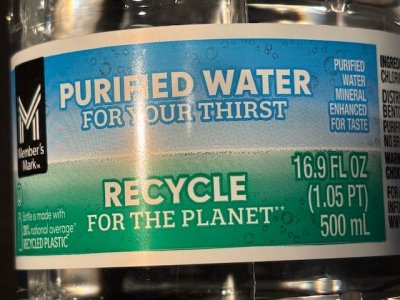
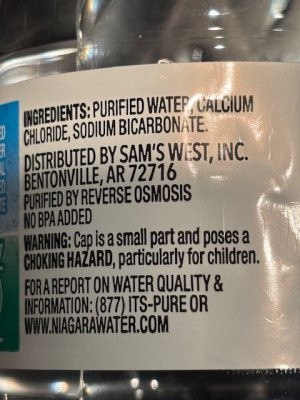
I have actually thought of doing this. I could leave the water out for a day to de-gas the chlorine first.
 
Was just thinking, I actually have a 10" filter housing under the sink that houses a carbon filter - bought these at Menard's few years ago. I put this in to reduce chlorine smell and taste. I stopped using it because it was plumbed to the main faucet so whenever cold water was on it was filtered. Filter needed replacing too often. So was thinking if they like the de-gassed (chlorine) water I could look at routing the filtered water to a separate faucet.
 
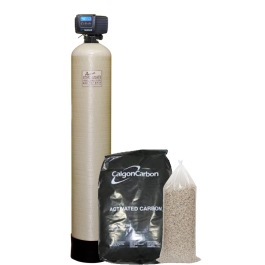
No more chlorine, Jacobi media will last around 7 years. A 10x54 sized tank will serve 2-3 adults.
 
Actually, chlorine is fairly easy to get rid of in small quantities. Just place the water in a container with a lid that can “breath”, and the chorine will evaporate.

At room temperature it takes about 24 hours to evaporate. I don’t think you need to worry about chlorine for cooking as it will quickly evaporate from boiling water.

I just looked it up and it takes about 15 minutes for chlorine to evaporate from boiling water. Of course, if you are planning on drinking it, then you have to wait until it cools off.
 
One of the components of drinking water that is quite undesirable yet common and very hard to remove /economically/ are nitrogenic compounds - NO2(-) and NO3(-).

Check what are the properties of your water .. usually this stuff is publicly available or you can pay for an analysis - it is not that expensive as this type of a check is done for private well all the times.
If the water has a relatively high nitrogen compounds content, do not bother with filters and stick to kegs of packaged water for drinking. It is not worth it.

Compared to that chlorine may have unpleasant taste but is otherwise completely harmless the nitrogen stuff is not only not tasteful but very much is not healthy to boot. It is usually high in surface-sourced water and comes from agriculture fertilizers and animal poop in the rivers.

Either way, before planning for any filtration, do the research about the composition of your water. Do not trust any "universal" filtration systems. The are either not reliable or expensive/wasteful. Beyond filtering for mechanical particles /included bacteria/ anything else needs a targeted approach to be economical.
 
Back
Top