
You are using an out of date browser. It may not display this or other websites correctly.
You should upgrade or use an alternative browser.
You should upgrade or use an alternative browser.
How about wooden L-tenon connectors from Festool for DF500 or 700
- Thread starter ChuckS
- Start date
Michael Kellough
Member
It does add a little strength to the joint. Not enough to be worthwhile for ordinary cabinetmaking but he has a good reason to do this. (To be clear, this joint is less strong than using Dominos the usual way, at 45 degrees to both parts)
He carves the parts, sometimes carving around the corner.
Using the finger jointed tenons at ninety degrees to one another allows the tenons to stay in the middle of the boards keeping them well below the finished surface of the part compared to the usual tenon reinforced miter joint which uses a tenon at 45
degrees to the part surface so the end of the tenons are just below the surface. He probably exposed one while carving...
He carves the parts, sometimes carving around the corner.
Using the finger jointed tenons at ninety degrees to one another allows the tenons to stay in the middle of the boards keeping them well below the finished surface of the part compared to the usual tenon reinforced miter joint which uses a tenon at 45
degrees to the part surface so the end of the tenons are just below the surface. He probably exposed one while carving...
Michael Kellough said:He carves the parts, sometimes carving around the corner.
Good point.
He did mention a couple of names in the video, but I haven't tried to look into the backgrounds of them and wonder if they are carvers, too, or do work with a focus on carving.
Michael Kellough said:It does add a little strength to the joint. Not enough to be worthwhile for ordinary cabinetmaking but he has a good reason to do this. (To be clear, this joint is less strong than using Dominos the usual way, at 45 degrees to both parts)
He carves the parts, sometimes carving around the corner.
Using the finger jointed tenons at ninety degrees to one another allows the tenons to stay in the middle of the boards keeping them well below the finished surface of the part compared to the usual tenon reinforced miter joint which uses a tenon at 45
degrees to the part surface so the end of the tenons are just below the surface. He probably exposed one while carving...
ah ha, I see it all clearly now!
Tinker

HarveyWildes
Member
- Joined
- May 3, 2016
- Messages
- 941
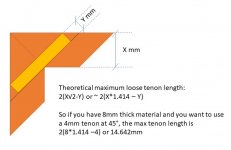
I do see some advantages to drilling the mortises straight in from the ends on thick hardwoods such as 6/4 walnut. You would be going with the grain. When drilling at 45 degrees you are sort of going cross grain and the machine can "scoot" crooked on you. No problem with softer woods and composite material.
As I understand [member=297]Michael Kellough[/member] explanation, it is possible that super strength is not so important. I make a lot of serving trays. For those, I would not use the joint as the OP shows. For wood carving joint as Michael explains, if I were doing that joint, I would definitely want my carving tools to be REAL sharp.
Tinker
Tinker
Anyone interested in learning more about this L-tenon application can check out the FW #254–May/June 2016 Issue (p. 54- 59), including a wooden/aluminum L-tenon variation and a plywood version. After seeing the sample builds employing these tenons in the article (including large scale cabinets, chair, etc.), I am convinced that this kind of L-tenon has its role in more than just carved boxes.
The article offers other advantages of this kind of tenon. It certainly gives me food for thought next time when I approach another mitered project with dominoes as the joinery.
The article offers other advantages of this kind of tenon. It certainly gives me food for thought next time when I approach another mitered project with dominoes as the joinery.
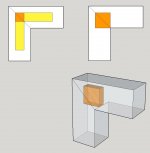
I simply use hidden splines (see attached picture). They are quick and easy to cut. I put one every 4-5 cm. Compare the glue area of finger joint of L-tenons on the left (light brown area is what matters). 1 spline is roughly equivalent to 1 L-bracket with 4 "fingers". Not worth the effort IMHO.
Now, if L-tenons were aluminum, that's a different story.
You could chop them up from thick aluminum angle and have a knockdown joint!
Now, if L-tenons were aluminum, that's a different story.
You could chop them up from thick aluminum angle and have a knockdown joint!
Attachments
Michael Kellough
Member
[member=15585]Svar[/member] How do you cut the mortises? Domino before the miters are cut?
I used to do it on a router table after cutting miters. Do all parts referencing from the same side, move the fence, repeat.Michael Kellough said:[member=15585]Svar[/member] How do you cut the mortises? Domino before the miters are cut?
Later I made a jig - strip of ply with notches in it at equal intervals. Similar to what's used for dovetails. Clamp it to the edge of the miter, rout with straight bit and guide bushing. One side of the slot turns out rounded. You can either square it with chisel or round the splines.
If you have dovetail jig that would be the best to cut these slots.
smorgasbord
Member
Encurtis has a video out today on L Tenons made from plywood:
He uses the Domino to cut the mortises, and apparently doesn't bother rounding the ends.
He uses the Domino to cut the mortises, and apparently doesn't bother rounding the ends.

- Joined
- Oct 16, 2015
- Messages
- 5,791
I just saw this today. Obviously, but this thread alone, it's not new. I did this years ago, with waterfall table legs.
IMHO, he is shorting the technique, by considering it a DF500 thing. He could have shown (or at least mentioned) that it could be done with a plunge router.
That's how I did it, with far bigger/longer tenons.
IMHO, he is shorting the technique, by considering it a DF500 thing. He could have shown (or at least mentioned) that it could be done with a plunge router.
That's how I did it, with far bigger/longer tenons.
smorgasbord
Member
Near the end of the video, he did comment on the puny-looking tenons and talked about making larger ones for DF700 cut mortises.IMHO, he is shorting the technique, by considering it a DF500 thing.
- Joined
- Oct 16, 2015
- Messages
- 5,791
Sure, but there are a whole lot more plunge routers out there than DF700.
I would bet there are fewer than there are DF500.
I would bet there are fewer than there are DF500.

luvmytoolz
Member
It'd be really fascinating if Festool released sales numbers and demographics on some of their tools like the Domino's.Sure, but there are a whole lot more plunge routers out there than DF700.
I would bet there are fewer than there are DF500.
smorgasbord
Member
I suspect that's highly valuable proprietary information. The competition would be willing to pay a lot of money for that - and I suspect they actually do hire consultants to try to gather that information for them. At least, that's what other high competitive businesses do, but I don't know about the woodworking equipment business.It'd be really fascinating if Festool released sales numbers and demographics on some of their tools like the Domino's.
Similar threads
- Replies
- 30
- Views
- 2K

- Replies
- 7
- Views
- 1K


