
Lapping The Sole of a Hand Plane

onocoffee

Member
Joined
Sep 23, 2024
Messages
1,541
Location
Baltimore, Maryland, USA
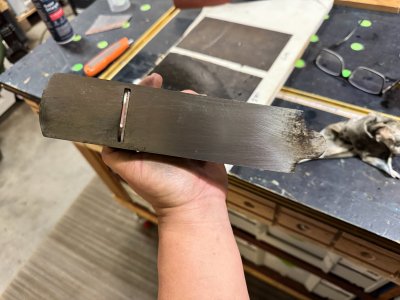
As I've been exploring hand planes, I've ended up with a few vintage planes. I think I have successfully restored a couple of cheap, 1970s era Stanley No. 4 planes - but I don't really know what I'm doing other than watching videos. A few months ago, I found a Craftsman/Millers Falls No. 3 and started to work that. My understanding is that you want the nose, as well as the front and back of the mouth to be flat, but how far back? On the No. 3, the tote has a bump out on the back of the sole. That tail end is significantly "higher" than the rest of the sole. Do I need to flatten all of that? Is that critical? Or just flatten ahead of it across the width of the sole?

And while my understanding is that smoothing planes (3 & 4) need to have flat soles, how critical is that for the larger 6 and 7 planes? I do have one of each that will need attention.

I worked this No. 3 last night and while I think it's a fascinating journey, it is a lot of work. A lot of work that makes me think that perhaps I should only buy new Veritas or Lie-Nielsen planes in the future! :ROFLMAO:
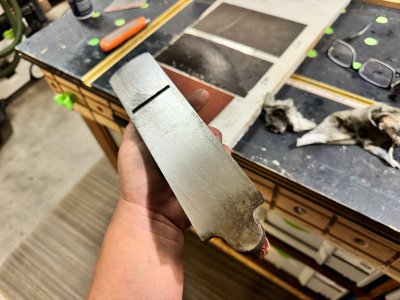
 

Attachments

  • IMG_2743.JPG
    IMG_2743.JPG
    2.8 MB · Views: 23
  • IMG_2744.JPG
    IMG_2744.JPG
    2.6 MB · Views: 23
We used to shave the heads on my go-kart engine by rubber cementing emery cloth abrasive to a sheet of smooth glass. Glass it typically very flat.

Then it was a simple gliding the head back and forth until it was smooth.

Of course the heads were aluminum, so it cut fairly fast. I think you can get a small amount of bow out of a steel platen with that same method and a lot of patience. You should try to find a steel cutting abrasive cloth. And I would only use this method to take a couple of thousandths off, espeially if there is a low point somewhere in the middle.

This is an atypical method that worked 65 years ago on a racing go kart by a couple of 13 year olds, so take it for what is it worth.
 
I would chase that #3 a little farther. You don't need every bit of the bump-out for the handle, but I would want the pitting right in front of the blade opening gone.

The sad part about this job is, the closer you get to finished, the slower the work goes.
 
Just to add...

I have a couple older planes where I've worked on the sole and gave up on them when they were close. You know what? They cut pretty well. A sharp iron, properly aligned makes as much (or more) difference as a perfectly flattened sole. That's not an excuse to work with a warped sole, but perfection is the enemy of completion.
 
“A lot of work that makes me think that perhaps I should only buy new Veritas or Lie-Nielsen planes in the future! ”
Since this is the FOG, I think you know the answer already. You sand with a sander, you plane with a plane. Sanding a plane?! Stick with new ready to work tools, unless you just like to mess with old stuff.
 
“A lot of work that makes me think that perhaps I should only buy new Veritas or Lie-Nielsen planes in the future! ”

Since this is the FOG, I think you know the answer already. You sand with a sander, you plane with a plane. Sanding a plane?! Stick with new ready to work tools, unless you just like to mess with old stuff.
+1 for the above!

I've been collecting planes most of my life and admit I'm a massive sucker for them, but I've very rarely ever reconditioned one to any extent. Sharpening the blade, sometimes, is about the limit of my interest.

I think with the exception of people like Derek on this forum who love using hand tools, reconditioning old planes definitely requires a certain mindset and passion for it.

Just for the hell of it though I wouldn't mind making some Krenov style planes at some point.
 
It is highly unlikely a woodworker has the equipment or skills to get a true flat surface and it is most probably unnecessary anyway. If you want to see possibly the best samples of metal tool making for woodworking see anything written by David Weaver*. he has slowly retreated from social media for numerous reasons and removed all his forum posts and YT videos he made which is very unfortunate but he does write the linked blog.

https://ofhandmaking.com/blog/

Hand scraping

*EDIT to add surname
 
Last edited:
It is highly unlikely a woodworker has the equipment or skills to get a true flat surface and it is most probably unnecessary anyway. If you want to see possibly the best samples of metal tool making for woodworking see anything written by David W whose last name I cannot remember. he has slowly retreated from social media for numerous reasons and removed all his forum posts and YT videos he made which is very unfortunate but he does write the linked blog.

https://ofhandmaking.com/blog/

Hand scraping
In my early metalworking phase scraping was something I considered getting into, and then came to my senses luckily!

Yeah, nah! That's just next level stuff and a hobby I just couldn't afford the time for in reality.
 
In my early metalworking phase scraping was something I considered getting into, and then came to my senses luckily!

Yeah, nah! That's just next level stuff and a hobby I just couldn't afford the time for in reality.
I worked as a saleman for a company that rebuilt punch presses. Scraping the gibs and ways (the bearing surfaces) was part of the rebuild. The purpose was to collect small amounts of lubricants to reduce friction.

As part of my indoctrination, I had to hand scrape one of those bearing surfaces. We used a standard metal working file, with the leading edge (the end of the file opposite the handle) ground to a radius resembling a parentheses. It yielded two cutting edged on opposite sides of the file.

After struggling for a half an hour, I was getting the hang of it and I felt fairly competent (slow, but competent). I kind of enjoyed it, except my hands started to cramp up.
 
It is highly unlikely a woodworker has the equipment or skills to get a true flat surface and it is most probably unnecessary anyway. If you want to see possibly the best samples of metal tool making for woodworking see anything written by David W whose last name I cannot remember. he has slowly retreated from social media for numerous reasons and removed all his forum posts and YT videos he made which is very unfortunate but he does write the linked blog.
So, in this era of the internet, this is where the weirdness sets in for me...why do folks go to the effort of joining an internet group and then at some time remove all of their previous posts...? At some time you posted your strongly held personal observations/beliefs or shared a personal held ideology and now you remove the post? Why?...you either believe in yourself and your solution for a problem or you don't. If you don't have solutions that work, then forget about posting and go back to playing mahjong or chess in your leisure time.
 
So, in this era of the internet, this is where the weirdness sets in for me...why do folks go to the effort of joining an internet group and then at some time remove all of their previous posts...? At some time you posted your strongly held personal observations/beliefs or shared a personal held ideology and now you remove the post? Why?...you either believe in yourself and your solution for a problem or you don't. If you don't have solutions that work, then forget about posting and go back to playing mahjong or chess in your leisure time.
Ask him, he is easily contactable via his website/blog so his answer would be interesting.
 
I'm a little surprised by some of the comments regarding old planes. While I'm not the type to tackle a rusted out hulk, fettling an old plane that is not in horrible shape is something I enjoy. I have a mix of both new and old planes, with Lie-Nielsen making up about a third of the stable, vintage Stanleys about a third, a couple new Cliftons, a couple vintage less common brands (Sargent and Millers Falls) and my very first -- a #5 corrugated sole Paragon from Garrett-Wade I bought in 1982. There are 4 or 5 block planes and bench planes from a #3 to a #7 with a few duplicates. All are ready to take out of the till and use. I find a different sort of satisfaction from grabbing one of the older boys, knowing I had a big part in its performance.

I use my planes mostly for the first step after final assembly...work that many would do with abrasives I find I maintain the detail better with planes and scrapers. That said, if I had a glue-up wider than my planer (which is only 10"), I wouldn't be afraid to tackle it with my planes rather than a Rotex. Sometimes when I'm doing a glue-up, fine tuning a joint with my #7 is just as fast and effective as going back the the power jointer.

If I were working professionally, I might feel differently. The time it takes to use and maintain the planes would have to be accounted for, where to me it's part of the therapy of my shop.
 
Last edited:
I'm a little surprised by some of the comments regarding old planes. While I'm not the type to tackle a rusted out hulk, fettling an old plane that is not it horrible shape is something I enjoy. I have a mix of both new and old planes, with Lie-Nielsen making up about a third of the stable, vintage Stanleys about a third, a couple new Cliftons, a couple vintage less common brands (Sargent and Millers Falls) and my very first -- a #5 corrugated sole Paragon from Garrett-Wade I bought in 1982. There are 4 or 5 block planes and bench planes from a #3 to a #7 with a few duplicates. All are ready to take out of the till and use. I find a different sort of satisfaction from grabbing one of the older boys, knowing I had a big part in its performance.

I use my planes mostly for the first step after final assembly...work that many would do with abrasives I find I maintain the detail better with planes and scrapers. That said, if I had a glue-up wider than my planer (which is only 10"), I wouldn't be afraid to tackle it with my planes rather than a Rotex. Sometimes when I'm doing a glue-up, fine tuning a joint with my #7 is just as fast and effective as going back the the power jointer.

If I were working professionally, I might feel differently. The time it takes to use and maintain the planes would have to be accounted for, where to me it's part of the therapy of my shop.
I think it all just comes down to priorities and personal preferences. I would never begrudge anybody spending inordinate amounts of time on restoring planes, I think it's actually a very worthwhile endeavour, but personally I would spend hardly any time on fixing up an old plane unless it was something particularly appealing to me, but I do absolutely love the look of them and often use some of them for brief jobs, especially the moulding planes which can really be fun to use. I've actually thought when I rebuild my study I might make a huge wall display of my planes.

Conversely I really love spending ages getting that perfect rubbed in finish on a project, agonising over every aspect, while I know many absolutely hate spending too much time on the finish and would think me weird.

Just as an aside, I know they tend to be looked down on by a lot of people for reasons I've never understood, but one of my favourite types of planes are the transitional's, I do really love the idea that brought about their creation and the look of them.
 
Take care of the frog and iron first, then work on the sole with the frog and iron installed. It may affect the flatness of the sole if you flatten without them. As far as the handle 'tail', don't worry about it if protrudes above the stock.

I would work the soles down until they are flat and has a uniform finish. If you have some pitting it's not a big deal unless it impacts performance or bothers you.

Keep in mind the larger planes were also made with corrugated soles to reduce friction.

How far you finish them is a personal preference. I have a couple of Stanley block planes I polished to 2000 grit. Shiny and smooth. It is a noticeable improvement on how they handle compared to planes which I only go to 320 grit. Not sure I would go that fine on a #3 or larger, a high polish can also make it harder to push the plane when there is full contact of the sole on a flat board.
 
Back
Top