Love a high speed chase.

Packard

Member
Joined
Nov 6, 2020
Messages
5,259
Location
Hudson Valley, NY
One of the TV stations was having a marathon of “Fugitives on Tape”. These are high speed chases recorded live (but watched taped). They can be pretty exciting. I recorded 7 or 8 of the shows. I’ve watched 5 over the last week and a half.

If I find it exciting to watch, the cops in the chase cars have to be in adrenaline overload.

Some observations.

When I was a kid, the cops were not allowed to initiate a chase for minor traffic infractions. So if you failed to signal, or did not come to a complete stop, the cop could light you up with his cherry lights, but not chase you.

All that is changed. In once case, the cop chased a car for not having the license plate light working. They hit speeds up up to 150 miles per hour (the fastest I’ve seen on the shows). The cop initiated a PIT maneuver and the car flipped over several times. No serious injuries, but I suspect they don’t broadcast those chases.

A PIT maneuver (Precision Immobilization Technique) involves using the front fender of a cop car to nudge the side of the chased car. To be effective contact needs to be behind or even with the chased car’s rear wheel. The technique was devised in the early 1980s and was considered relatively safe. But then Bosch and Mercedes in Germany, conspired to make it far less safe.

Mercedes, with the assistance of Bosch created the Advanced Stability Systems. I believe that most modern cars now have some version of that system and in normal use, it makes the car much safer. But when a PIT maneuver is applied, it makes spinning out the fleeing vehicle much more difficult, and seems to result in an awful lot of flipped cars (judging from the TV videos).

To justify the high speed chases, they have made it a felony to flee at high speeds.

Now, it is likely that there are reasons other than the failure to signal that prompted the eluding. But the police have no probable cause for that (whatever “that” turns out to be).

At the end of each chase, they list the criminal charges the driver faces. Very often it is the minor offense that prompted the chase, and a charge of “aggravated eluding”. So the only serious part of the charges are those that the police initiated.

Another technique they use is “spike strips” which will flatten the tires. The spikes are hollow so presumably no blowouts, just a slow loss of air pressure. It does turn out to be pretty dangerous.

Interestingly, the most anti-climatic chase ended when a GM vehicle was involved and it had subscribed to ONSTAR. The cops called ONSTAR and they gradually slowed the vehicle to a stop.

I think, if there were an effective way to puncture the radiator on the fleeing vehicle, it would do much the same thing. None of my ideas on that seem feasible though.

In any case, a risk vs. benefit analysis by the police might be in order.

Note; Those chases sometimes yield prosecutable cases for serious matters. But again, without any probable cause to believe there was a crime, what is their justification.

I think the “justification” might be influenced by the adrenaline rush the chasing cops must experience.
 
I think it's the other way round here in OZ. Early days the cops would chase for whatever reason, but later legislation put a stop to this if it was deemed in anyway to be unsafe.

What's really scary here now in the constant push for control is we currently have an "independent" advocacy group (I'm thinking more an arm's length group from the gov) that's pushing for remote immobilisers installed as mandatory so police have the ability to stop any car when stolen.

They're not pushing for the actual owners to be able to control or immobilise their car when it's stolen, but instead for a designated authority or body to control that. I can understand the distinction from a safety viewpoint, but the natural extension of that of course is, haven't paid a speeding fine, immobilise the car, owe the tax office money that's late, immobilise the car, etc. I'd like to say the last examples wouldn't happen, but we do increasingly have nanny states so I think it would be the inevitable outcome.
 
I think it's the other way round here in OZ. Early days the cops would chase for whatever reason, but later legislation put a stop to this if it was deemed in anyway to be unsafe.

What's really scary here now in the constant push for control is we currently have an "independent" advocacy group (I'm thinking more an arm's length group from the gov) that's pushing for remote immobilisers installed as mandatory so police have the ability to stop any car when stolen.

They're not pushing for the actual owners to be able to control or immobilise their car when it's stolen, but instead for a designated authority or body to control that. I can understand the distinction from a safety viewpoint, but the natural extension of that of course is, haven't paid a speeding fine, immobilise the car, owe the tax office money that's late, immobilise the car, etc. I'd like to say the last examples wouldn't happen, but we do increasingly have nanny states so I think it would be the inevitable outcome.
This would be easily implemented on cars that have a satellite connection (and a lot of them do). Probably no cost after the programming of the black box is done. There would have to be some sort of process (fast and easily done) that would assure that the immobilization was not arbitrarily used. But certainly safer than the PIT maneuver originally was, and way safer than it is today with cars that have advanced stability systems.
 
The worst and most ridiculous chase I saw was a cop chasing a kid on a trail bike (motor cycle), for failure to wear a helmet.

It was obvious what was going on. A group of kids (maybe 16 to 20 years of age) were returning home after doing some off-road riding. They were not a danger to the communiity, only to themselves.

Follow at a distance until they got home. Fine.

High speed chase because they had no helmet? Ridiculous. The cop actually PITed the rider knocking him off his bike.

As an aside (as this conversation is starting to get me angry), a friend of mine bought a retired police cruiser with just 60,000 miles on the odometer. It came with a CARFAX certification of no accidents.

But the thing is, many large police departments self-insure for body damage on cars. They may also have their own in-house auto-body shop. So my friend’s car could have been in a dozen accidents, none of which would have been reported. So a CARFAX for a retired police cruiser is a worthless piece of paper.
 
Here's a ridiculous chase that happened in my city just a few weeks ago.


The cop chased this way because the Baltimore police department does not have mandatory fitness requirements. Many cops are simply not in good enough shape to chase on foot.

I was on my high school’s track team. I was competitive in the 60, the 100 and the 220 yard sprint, but was fastest in the 100 yard for our school district. I was cocky enough back then to believe I could escape any foot chase a cop could implement. But starting a chase in a car could have tired me enough to be caught.

Tactically, chasing in the car was sound, but he did not switch to foot pursuit soon enough. If he had switched to foot pursuit anywhere during the process, the tactic would have been defensible.
 
There would have to be some sort of process (fast and easily done) that would assure that the immobilization was not arbitrarily used.
If our current gov has shown anything at all, it's that we wouldn't be able to trust them having this power.
 
My DVR automatically records these chase shows. I should turn that off—but it is a secret vice of mine.

I was thinking of safer alternatives to the PIT maneuver, which usually ends up with one car totaled, and a police cruiser damaged. It also frequently ends up injuring both the fleeing felon and innocent bystanders.

The metal spikes that the cops use are not as safe as they would have us believe.

My first thought was to force the engine to fail.

One way would be have a short barreled shotgun mounted on the front bumper of the police cruiser, aiming back at a 45 degree angle. There would be a mirror mounted on the fender with cross hairs to show the point of impact.

The cop pulls up alongside the fleeing vehicle and advances until the cross hairs are at the middle of the felon’s radiator. An electronic remote trigger fires the gun, which then guts the front radiator of the fleeing car. It would take several minutes for the engine to overheat, but it would safely slow down the car. It would no doubt result in engine damage, but that would be preferable to totaling the entire car and the risk to humans that a PIT would offer.

I believe that the 12 gage gun barrel, set low and angled down would present little risk to bystanders or other motorists. Not perfect, but still seems safer than a PIT.

The second thought was to place an AirTag on the fleeing vehicle, call off the high-speed chase and watch for where it comes to rest. Then launch a tactical assault on the stationary vehicle or the residence where the driver has fled to.

The easiest way I could think of for attaching an AirTag was to place it inside a loosely filled beanbag. Attach to the exterior of the bean bag several rare earth magnets. Launch the bean bag with either a pneumatic launcher or a small, spring loaded catapult.

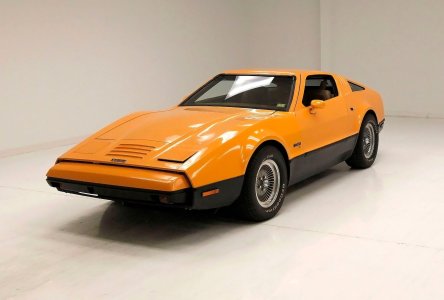
In that scenario, the police would drive up close behind the fleeing vehicle, launch the bean bag which would attach to the steel bodywork. (But don’t use this method on a Corvette or an old Bricklin SV-1.) 😁

This seems like a safer option, if allowing the felon to leave sight is not an issue.

Bricklin SV-1 (too many Corvette models to reference):

1763930651860.jpg
 
My vision of policing crappy drivers ( I’ve driven over 1.5 million miles for work) is that every driver has DNA based paintball guns on turrets on vehicle roofs. As soon as your vehicle has had a certain number of strikes by other drivers, your license is permanently revoked.
 
Wow, @Packard your age is showing ;) A whole lot of people have never even heard of Bricklin. They were only made for a few years, in the mid 70s. They were expensive/exotic, in a time of fuel concerns, and didn't sell well.
The father of a couple of my school friends had one. It was a '75 I think? mostly a garage queen, I only remember him driving it a few times. They lived just around the block.

Funny you mentioned police chases. I ran across one on YouTube a few months ago, purely at random. I recognized the streets! so I kept watching. This guy drove around aimlessly, obviously not familiar with the neighborhood. He ended up going down my road, right past my house. This was last summer, while the city still had the road trenched, replacing water lines. He went right through the single lane choke point, blowing dust everywhere. He finally got caught, buy missing a turn that would have let him run onto the Interstate. They had him trapped at that point.
I had no idea that this happened, until over a year from the incident.
 
Wow, @Packard your age is showing ;) A whole lot of people have never even heard of Bricklin. They were only made for a few years, in the mid 70s. They were expensive/exotic, in a time of fuel concerns, and didn't sell well.
The father of a couple of my school friends had one. It was a '75 I think? mostly a garage queen, I only remember him driving it a few times. They lived just around the block.

Funny you mentioned police chases. I ran across one on YouTube a few months ago, purely at random. I recognized the streets! so I kept watching. This guy drove around aimlessly, obviously not familiar with the neighborhood. He ended up going down my road, right past my house. This was last summer, while the city still had the road trenched, replacing water lines. He went right through the single lane choke point, blowing dust everywhere. He finally got caught, buy missing a turn that would have let him run onto the Interstate. They had him trapped at that point.
I had no idea that this happened, until over a year from the incident.
I’ve never seen one up close, only photos. Even stranger (to me) is that I not only remember “Bricklin” but also his first name “Malcolm”.

Bricklin wanted to produce the body panels by injection molding. He not only had to make the tooling, he had to develop the process. Apparently he burned through much of his capital doing so. At the time, his choice of body panel process was largely blamed for his business failure.

Finish work on exposed stainless steel body panels is extremely expensive. It would not surprise me if Tesla was forced to go to regular steel and paint for that reason.

The cost of the bodywork on the stainless steel DeLorean was partially the blame for that car’s failure.

The costs involved in developing a new car do not allow for a lot of mistakes. Adding new process development to the mix can make a mountain too high to scale.
 
Last edited:
My vision of policing crappy drivers ( I’ve driven over 1.5 million miles for work) is that every driver has DNA based paintball guns on turrets on vehicle roofs. As soon as your vehicle has had a certain number of strikes by other drivers, your license is permanently revoked.
That sounds like the sort of legislation I could get behind, and then promptly get every car in front of and around me! ;-)

Since Covid, bad driving has gotten very noticeably worse!
 
Rudeness in general has gotten really typical, Tailgating really frosts my numbies. I always drove Ford 3/4 ton vans, with a step bumper you could tow with and huge brakes that would give you whiplash. I would brake check the idiots and watch in the mirror as the rear end of their vehicle came up and eyes became pancakes. I loved those vans, 302, automatic tranny carring well over a ton of gear. There are some really twisty, windy roads in PA coal country. I could really embarrass sport cars
 
Since Covid, bad driving has gotten very noticeably worse!

To quote George Carlin:
Have you ever noticed that anybody driving slower than you is an idiot, and anyone going faster than you is a maniac?


BTW, the expression "Cut to the chase" is from the early days of silent movies. Directors would complain to their editors that a movie was dragging on and being boring - and that the audience was really there just to see the chase scenes anyway.
 
When I lived on Long Island, a home to debilitating traffic, I was one of these rude morons.

After just a few weeks living upstate, away from those crowds and traffic changed me. It turned out that I am one of those people who can’t cope with crowds and heavy traffic.

That does not excuse my previous behavior, but it goes a long way to explain it.

I do wonder if statistics would back that up.

In any case, some people (myself included) should not live in densely populated areas.

I wonder if there is a personality test that can tell us where best to live.
 
Back
Top