Mitered box question

MTbassbone

Member
Joined
Oct 24, 2016
Messages
80
Hi, I am making a speaker box and would like to use mitered joints to hide the edges of the plywood. My plan is to use the track saw and MFT. After making the initial 45 degree cut I would need to rotate the piece 180 degrees to but miter on the other end. Will this compromise the squareness of the cut since I will be referencing a different edge against the fence? I plan on ripping long pieces of the plywood with parallel guides but still. have to wonder if this would cause an issue.
 
FWIW...I'd consider going with a lock mitre joint, it's what JBL has been using for the last 50 years and is acoustically preferred because of the additional glue surfaces. The additional glue surfaces prevent material separation and prevent potential resonance issues.
 
FWIW...I'd consider going with a lock mitre joint, it's what JBL has been using for the last 50 years and is acoustically preferred because of the additional glue surfaces. The additional glue surfaces prevent material separation and prevent potential resonance issues.
I think Totem Acoustics does that too. I have an OF1010 router but have not invested or made a router table yet. Maybe next go around. I am just going to use dominos and glue this go around.
 
Well carry on...it will be very interesting to hear about your results. Obviously, manufacturing methods have changed over the years and it will be interesting if the Domino method will be equal/superior to the lock mitre method for speaker enclosures. I have no dog in this fight. :) And thinking about this a little bit more, maybe it's a combination of glue choice along with construction choice that renders the lock mitre obsolete. 🤷‍♂️
 
First.

Check your miter angle.

The way to do this is to cut your miter on both sides of an approximately 12” x 12” board. Then cut the board into 3” wide strips. Then lay the strips so the miter cut is face down on a smooth table and tape all the miters tightly together. Fold up into a rectangle.

Are all the miters tight? If not, adjust the angle and repeat the test.

If the miter is only very slightly open at the outside, you can correct that after the glue dries by rubbing a smooth round steel shaft (screw driver shaft works) gently over the opening to close the miter.

Second,

I have a 40+ year old Radio Shack speaker that is about 24” tall and 12” wide. It is made from particle board and has a nice walnut veneer. There appears to be nothing but glue holding the miters together.

Third,

MDF appears to be the preferred material for speakers nowadays. Apparently due to its lack of resonance.

When I glue MDF, which will absorb huge amounts of glue, I paint a light coating of glue on both surfaces and then a third heavier coating on one surface prior to clamping.

For the speaker, I would use the “fold up” method for assembly.

Note, in the video they use “blue tape”. I always use heavy duty clear packing tape and clamp the corners with small miter clamps.


(Spell checker changed “due to” to “Kate”. How does that make sense?)

Note: There was a speaker manufacturer next door to the factory where I worked for 26 years. They used to get huge deliveries of MDF which I could see being off loaded on occasion.
 
First.

Check your miter angle.

The way to do this is to cut your miter on both sides of an approximately 12” x 12” board. Then cut the board into 3” wide strips. Then lay the strips so the miter cut is face down on a smooth table and tape all the miters tightly together. Fold up into a rectangle.

Are all the miters tight? If not, adjust the angle and repeat the test.

If the miter is only very slightly open at the outside, you can correct that after the glue dries by rubbing a smooth round steel shaft (screw driver shaft works) gently over the opening to close the miter.

For the speaker, I would use the “fold up” method for assembly.

Note, in the video they use “blue tape”. I always use heavy duty clear packing tape and clamp the corners with small miter clamps.
IMNSHO, if your angles are going to be "slightly off" make it toward the inside, but don't accept more than a hair.
100% agreed on not using painter's tape. Not only is the adhesion too weak for that, the paper may not be up to larger boxes. A decently thick packing tape with some stretch is best. Tape across the joints, near the edges, and a few more depending on width. Then along the joint, covering it completely.
Pre-coating the miters with glue is preferred, slightly diluting that first coat can be beneficial.
 
IMNSHO, if your angles are going to be "slightly off" make it toward the inside, but don't accept more than a hair.
100% agreed on not using painter's tape. Not only is the adhesion too weak for that, the paper may not be up to larger boxes. A decently thick packing tape with some stretch is best. Tape across the joints, near the edges, and a few more depending on width. Then along the joint, covering it completely.
Pre-coating the miters with glue is preferred, slightly diluting that first coat can be beneficial.
The other problem with the paper-based tape, is if the glue bleeds out it will stick to the paper and the tape will not remove cleanly. I have not had that problem with clear packing tape. I do recommend heavy duty tape. Not only is is stronger, it is much, much easier to handle. When I was still working, I could get the light gage stuff for free from the factory floor. But it was so difficult to handle and so easily damaged that I always bought my own.

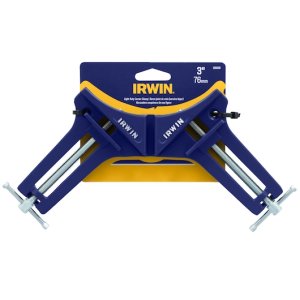
And I add these corner clamps. I probably have a dozen or more of these so I put them on each corner on both sides. But that is more than you need. Four is fine. I’m showing Irwin because they had the best image.

1775243915506.jpg

One on each side of one corner and one on each side of the diagonal corner. I always check diagonal dimensions but they are always on the mark with this technique. No need to buy premium clamps. Even the cheap ones work fine. I’m sure Pony and Bessey clamps are great, but the bargain ones from Harbor Freight or Amazon work fine too.

I would note that if you were planning on adding the wood veneer after assembly, you can use butt joints. But make sure all screw holes are filled with putty and sanded smooth first.

I would also note that my old Radio Shack boxes were made from pre-veneered boards.
 
Last edited:
I have never gotten along with corner clamps for boxes (vertical use) they are fine for frames though.
I have gone whole hog into Bessey parallel clamps, but they are quite heavy and generally overkill for casual users.
As long as your joinery is tight, without a lot of pressure, even light duty aluminum bar clamps will do fine.
Veneering is a subject unto itself.
 
Back
Top