Oak batten board

makpacman

Member
Joined
Mar 21, 2023
Messages
80
Hello all. I've received some great feedback recently so thought I'd see what the woodworking savants have to say about batten board.

I have a request that may require me to make some white oak batten board. The project consists of a few vanities 30" tall and the client would like vertical oak battens. There are in bathrooms that presumably have lots of moisture, SO, should I go with rift or since these are relatively short sections, will quarter sawn stock be fine? Each batten will be approx 1x1/2 inch.

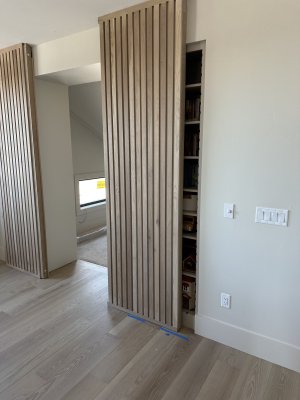
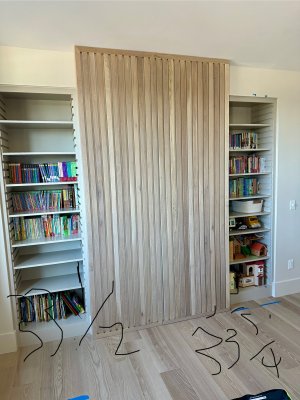
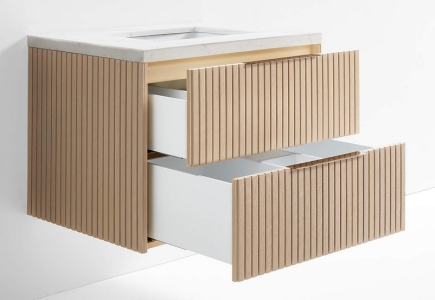
This pic is similar to what the client is envisioning, but with a rounded corners on the sides and perhaps using slightly wider battens.
Screenshot from 2025-11-14 19-03-22.png
 
Were you planning on attaching narrow strips to a backer? Or were you planning on cutting shallow dados in 3/4” stock? Or prefabricated batten panels?


No advice, but curious on your plan. I would note that most of the pre-fabricated panels are acoustical tiles, and would not be suited for this application.
 
I don’t recall doing a slated cabinet. We do make slatted panels for field installation. What you’re doing is pretty easy with careful layout.

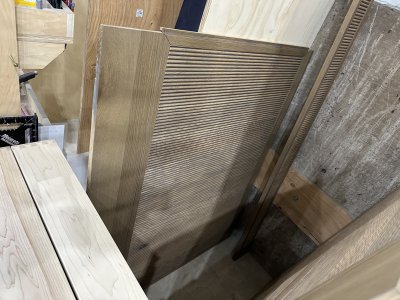
We have been doing a lot of reeded lately. We machine the reeding in house.
 

Attachments

  • IMG_1371.jpeg
    IMG_1371.jpeg
    2.2 MB · Views: 16
  • IMG_1035.jpeg
    IMG_1035.jpeg
    2 MB · Views: 12
  • IMG_2074.jpeg
    IMG_2074.jpeg
    2.2 MB · Views: 11
  • IMG_2076.jpeg
    IMG_2076.jpeg
    2 MB · Views: 12
  • IMG_1717.jpeg
    IMG_1717.jpeg
    1.5 MB · Views: 15
  • IMG_1712.jpeg
    IMG_1712.jpeg
    899.8 KB · Views: 13
Battens had me lost there, for a second, til I saw the pic. I would not call those battens, that is much more like tambor, which would be a far better way to cover a radius around the front corners. However, making them wider does defeat the point of the shape. It would be more of a stop sign, than circle.
It could be done with solid hardwood pieces. It just depends upon how you intend to get the material. If you are making the strips yourself, it's not that big of a deal. If you are buying some pre-made sticks, the options might change a bit.
As Tom said above, stick with RSWO (rift) it will give you far more consistent appearance, in the grain. It will flow better that way. QSWO could very well get you medullary ray markings, and while strikingly beautiful, they look better in wider panels. Those rays generally work their way across the board, so they look choppy/busy on narrow stock, especially in closely-placed vertical ribs.
 
Were you planning on attaching narrow strips to a backer? Or were you planning on cutting shallow dados in 3/4” stock? Or prefabricated batten panels?


No advice, but curious on your plan. I would note that most of the pre-fabricated panels are acoustical tiles, and would not be suited for this application.
The plan is to mill strips and attach to a backer. There are many options to consider, even with this much determined. i.e. Use tongue and groove or simple slats and spacers.

Milling grooves in solid paneling would create a very interesting aesthetic. I may have to consider that a bit more.
 
Last edited:
Battens had me lost there, for a second, til I saw the pic. I would not call those battens, that is much more like tambor, which would be a far better way to cover a radius around the front corners. However, making them wider does defeat the point of the shape. It would be more of a stop sign, than circle.
It could be done with solid hardwood pieces. It just depends upon how you intend to get the material. If you are making the strips yourself, it's not that big of a deal. If you are buying some pre-made sticks, the options might change a bit.
As Tom said above, stick with RSWO (rift) it will give you far more consistent appearance, in the grain. It will flow better that way. QSWO could very well get you medullary ray markings, and while strikingly beautiful, they look better in wider panels. Those rays generally work their way across the board, so they look choppy/busy on narrow stock, especially in closely-placed vertical ribs.
Yes, like tambor. I had planned to build the corner out of solid stock but you have given me an interesting idea to run slats right around the corner. I have some larger diameter radiused router bits that could conceivably round over a fluted corner just as well as a solid wood corner. I'll have to think about that construction a bit because the cabinet has already been built to about 1" under the final size in each dimension.

Concerning RSWO, I had loosly planned to buy 5/4 inch stock and cut that on the tablesaw into 1/2" strips. In other words, I'd be using the edge of the RSWO as the face of the slats. Does that make sense?

Continuiing on with my "loose" plan. I then imagine glueing those strips and similarly made spacers to 1/2' oak plywood slightly oversized for each side of the cabinet. I can use 23ga stainless pins here but which glue would work best for moisture resistance?

Once glued up, the plywood edges should receive some edge treatment. Is there any problem with cutting back the plywood a 16th or so after the panel is put together and ironing edgebanding to it? I realize I won't be able to access the "inside" edge of this edgebanding to sand it easily but using a thicker strip of rift for this particular edge, which would occur on the top bottom and sides of each drawer may detract from the look.

An option to avoid all that work is to use solid glued up 1/2 oak for the panels for the backer but then there is a fair abount of endgrain which makes me wonder about stability. Planing the solid wood panels down to 3/8" would allow the 1/2" thick, 1" wide vertical strips to coutner any instability(warpage) in the panel and still allow enough meat for the pins to bit into, correct? Does anyone know if that sort of a cross-laminate is viable for longevity considering 23ga pins and glue are the only thing holding it together?

Thanks for sharing your wisdom.
 
Last edited:
Craftsman used to make a fixed dado-like blade (high speed steel) that would cut about an inch in width at a time. It worked like a shaper blade, but with the blade spinning like a dado blade. The theory was you moved the fence 1” and repeated the cut.

I have not seen one of these since the early 1980s though.

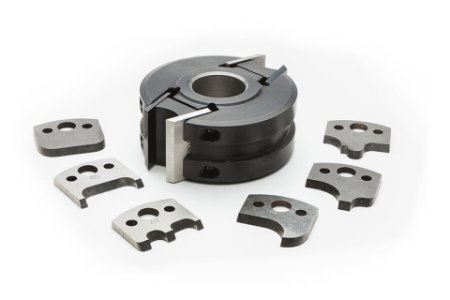
I believe CMT makes a blade that will cut one bead at a time. I will take a look.

Addendum:

There are more options for fluting than for reeding, but some options exist:


They don’t mention what machine this is designed to fit, but it resembles the unit that Sears used to sell. Rangate will, apparently, make custom cutters. But this is a pricey piece (over $500.00). The old Sears piece was probably under $25.00.


1763325744964.jpg
 
Last edited:
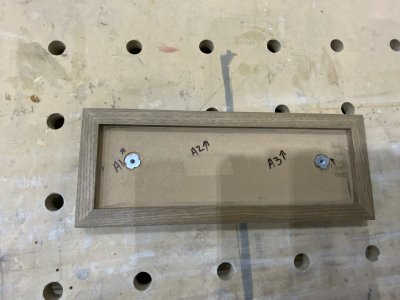
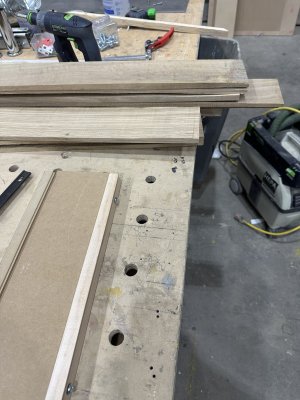
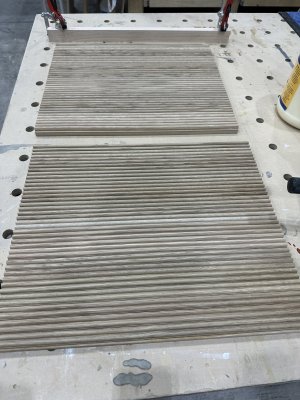
3/4 stock re-sawed to 3/8, fixture to hold blank to run through molder.
IMG_2067.jpeg

Blank in fixture.

IMG_2069.jpeg

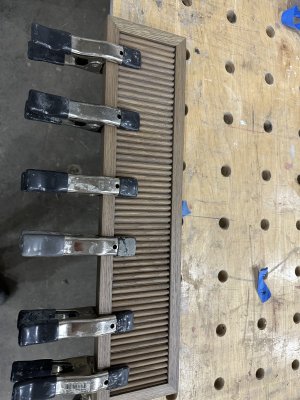
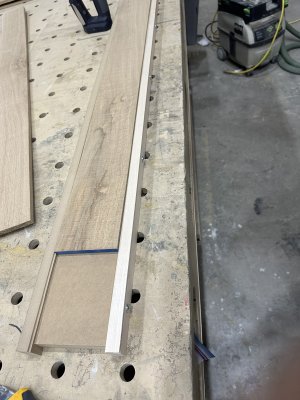
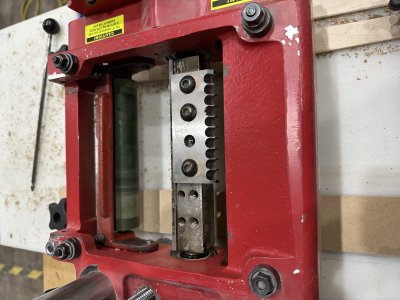
Molder knives.

IMG_2070.jpeg

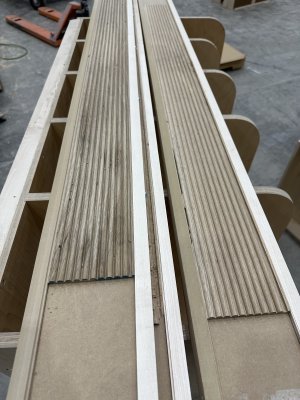
Blanks molded.

IMG_2071.jpeg

Tom
 
3/4 stock re-sawed to 3/8, fixture to hold blank to run through molder.
View attachment 379359

Blank in fixture.

View attachment 379360

Molder knives.

View attachment 379361

Blanks molded.

View attachment 379362

Tom
If you have the equipment, that is definitely the way to produce the panels. But if this is for a one-time project, then purchasing the panels makes more sense. I see fluted panels more than reeded panels.

(And CMT makes a cutter similar to the one I posted earlier for less money, but with a 1” bore, I’m not sure what machine if fits.)

Also, if the budget is tight, they make oak post wraps that give a similar appearance. Very inexpensive.


3/4 stock re-sawed to 3/8, fixture to hold blank to run through molder.
View attachment 379359

Blank in fixture.

View attachment 379360

Molder knives.

View attachment 379361

Blanks molded.

View attachment 379362

Tom
Interesting. Is it correct that you resaw on the bandsaw and then put that piece straight into the molder without any need for sanding or planing in between? In effect allowing the molder to take care of producing the finished shape out of the rough material.
 
Interesting. Is it correct that you resaw on the bandsaw and then put that piece straight into the molder without any need for sanding or planing in between? In effect allowing the molder to take care of producing the finished shape out of the rough material.
Correct, no work on the piece except clamping it in the fixture to run the pieces through the molder. .

Tom

tom
 
If you are going to cut 3/8" strips from a wider 5/4 board, don't waste your money on Quater or Rift sawn stock. You are going to turn it 90 degrees, which changes the orientation.
 
Back
Top