Paulk-like Workbench with integrated CSC SYS 50

Joined
Jan 9, 2026
Messages
4
Hello community,
I'm about to design/build a mobile workbench that I can move between my small shop at home and the construction sites.

I decided that something similar to what you see in the image, is what I need.
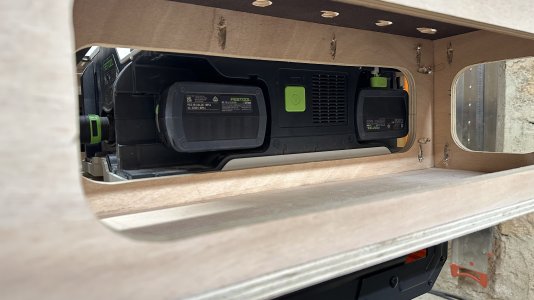
With one exception: I want to properly integrate my CSC SYS 50 inside the table (front left side). Because of its weight (stability/precision) and also because I use it all the time.
I'm just wondering why I can't find any examples of this saw integrated into workbenches. Is it due to the slide that makes the slot more complicated to build?


Happy to receive any inspiration before I beging this job.

All the best from the South of France.

Ben

Bildschirmfoto 2026-01-09 um 12.17.47.png
 
I'm just wondering why I can't find any examples of this saw integrated into workbenches. Is it due to the slide that makes the slot more complicated to build?
The slide is a feature to design around. Shouldn't be much more difficult than accommodating miter slots.

I suspect though that the reason you haven't seen anything on YouTube like this is because most people building these kinds of workbenches are using cheaper-priced saws - and the SYS50 is anything but cheap.

Thinking about it a little, if you were to mount the SYS50 on the end like this DeWalt in your image (and I think Paulk puts his CTS on the end as well), I'd want the slide to have full motion so I might make a cut out in the bench to accommodate the range of the slide. And if I needed to use it with longer material then I'd want to make sure the surface of the bench would allow the workpiece on the slider to be able to glide as smoothly and friction-free as possible. Maybe laminate a top surface? Or wax polish the plywood?

Outside of that, I think I also recall Paulk mounting his CTS on an outrigger. If you didn't want to have a cutout in the bench then an outrigger for the SYS50 that allowed the slider to ride beyond the edge of the bench and alongside the long edge might be an easier way to go.

Be sure to post a pic of whatever you come up with!
 
I built something similar to that, it could be used on supports in the back of the van so it half slid out and I could use 'modules' like the mitre saw, pillar drill, router, overhead milling, table saw, MFT top, etc., stood up behind the van... and then I'd need to pick something big up from a supplier, so it would have to be taken out and put to the side somewhere...

On the job site, set up on trestles, it initially proved handy, but then I'd need to cut something larger and what ever I had set up in the 'module' would need to be taken out so I could use the whole work surface. I even built a roll around module holder for all the different options I had built for it!

In the end I just found it 'clunky' - it ended up being thrown out.

Of course others may have had more benefit out of theirs than I did.
 
Just build the Paulk-style bench to the same height as the SYS50 on its stand. More modular to use.
Good point!
I only see one problem with this solution. On site (and even in my own shop) the floor is often not perfectly flat.
That's mainly why I would like to have it in one piece.
 
Hello community,
I'm about to design/build a mobile workbench that I can move between my small shop at home and the construction sites.

I decided that something similar to what you see in the image, is what I need.
With one exception: I want to properly integrate my CSC SYS 50 inside the table (front left side). Because of its weight (stability/precision) and also because I use it all the time.
I'm just wondering why I can't find any examples of this saw integrated into workbenches. Is it due to the slide that makes the slot more complicated to build?
...
The reason is simple.

Ron Paulk took DECADES to design and optimise his benches concept. Decades.

The CSC 50, both as a concept and as a product, is only a few years old. Just no one got to it ... yet.


Do take time to check out all the RECENT /post 2020+/ Ron Paulk Youtube videos on his benches and, especially, the Paulk Smart Station. Do buy his plans - even if you do not intend to follow them to the letter. There is huge amount of experience embedded in them with practical details you would waste countless hours and materials to 'wheel-reinvent'.

Do watch those videos not only for the description of how to make "his" benches, but for the reasoning which he includes in his videos on why he did/changed things.

Then think on how you can integrate the CSC into the PSS and/or the PSB designs/concepts. It should be trivial given they are designed to handle saws with multiples of the weight a CSC has..


Hope helps.
 
It’s worth a shot to ask Ron Paulk that question.

He’s touched and seen the CSC 50 at a Tool Store.

Also from his previous BIG shop many years ago, Ron has used a slider.
 
Just build the Paulk-style bench to the same height as the SYS50 on its stand. More modular to use.
I'd go with the modular approach, too, for flexibility and simplicity. The uneven floor problem is not hard to overcome with adjustable castors or legs.
 
Good point!
I only see one problem with this solution. On site (and even in my own shop) the floor is often not perfectly flat.
That's mainly why I would like to have it in one piece.
I've been looking into this with the CSC as well. The problem I've ran into is three fold: room for the slider to operate, access to the batteries, and access to the rear for dust port and blade guard/ riving knife changes. If you're also trying to orient the CSC relative to the bench to provide outfeed support, you're even more constrained.

The three options I boiled down to were:
A) Leave the top left or bottom right corner of the bench as an open bay, where the CSC drops in, blade parrallel to the long side of the bench, and the slider overhangs the front/ back face of the bench.
B) Hang the CSC off the side of the bench, just like your photo, but off-center to give the slider clearance.
C) Some trade-off where you're either losing the bench as outfeed support or losing the CSC slider function.

The first two designs feel clumsy to me; the third option negates the value of the CSC or the point of integration. And to your point, none of the options are really fully integrated. At that point, I feel it's just a cleaner solution to have a separate stand for the CSC. I think that's as big of a reason as any why you're not finding many people who have opted for the integration you're looking for.

I hope you find a solution you like. I'll be interested to see where you land.
 
First of all, I want to say how impressed I am with your responses. Truly thoughtful and without the patronizing tone I'm used to from other forums. I guess wood working people make for better regulated nervous systems :)

I still have a hard time letting the idea go, of having it all in one piece. Especially because my workshop at home is really small, the bench itself pretty much fills the space, therefor it would be just perfect to have it integrated.
I understand why the separate stand solution feels clearly the best solution for most people, and why its not for me (besides the space problem). In summer I like to work outside rather than in my cell. And the floor there is loose gravel, or an uneven natural ground. I don't live in a city. That's why the saw has to be directly attached to or in the bench.

@WillettBarrel 's summary touches on all the concerns I had too. Right now I tend towards option B. But the saw centered and with recess for the slide (I don't like the idea of having it hang so far off-center that the slider moves outside of the bench).
Saw dust extraction and accessibility of the batteries are still issues to figure out.

I will get Paulk's plans (thank you @mino, you're right) and meditate on it further.
I'll share my progress.


Greetings from the South of France — Ben
 
First of all, I want to say how impressed I am with your responses. Truly thoughtful and without the patronizing tone I'm used to from other forums. I guess wood working people make for better regulated nervous systems :)

I still have a hard time letting the idea go, of having it all in one piece. Especially because my workshop at home is really small, the bench itself pretty much fills the space, therefor it would be just perfect to have it integrated.
I understand why the separate stand solution feels clearly the best solution for most people, and why its not for me (besides the space problem). In summer I like to work outside rather than in my cell. And the floor there is loose gravel, or an uneven natural ground. I don't live in a city. That's why the saw has to be directly attached to or in the bench.

@WillettBarrel 's summary touches on all the concerns I had too. Right now I tend towards option B. But the saw centered and with recess for the slide (I don't like the idea of having it hang so far off-center that the slider moves outside of the bench).
Saw dust extraction and accessibility of the batteries are still issues to figure out.

I will get Paulk's plans (thank you @mino, you're right) and meditate on it further.
I'll share my progress.


Greetings from the South of France — Ben
Some addl. comments, based on my own personal musings when drafting my own custom stuff:

1) Do not get too attached to the height of the Paulk benches he recommends/uses. His bench height /not height at which the bench top is, I mean the height/thickness of the torsion box/ is limited by his need/expectation the bench/station being maximally compact for regular transport. A hobby shop user is not constrained on this. A higher torsion box also makes putting away tools like a tracksaw more convenient.

Meaning, you can e.g. make the torsion box the height of the CSC, allowing you to then "simply" place it into it from the top. such its top is same height as his "extensions" when installed. You would need to reinforce the box a bit to account for the slide cutout, but not by too much.

2) Do consider including full-function side-clamping and hence putting dog holes also on the sides. Needs a bit wider "stiles" but not by too much. This is a game changer for a hobby user as it allows you to use the LR32 system for doing dowel mortices with a router into the side of a board .. etc.

3) Lastly, if you already did your bench and it is too big /my mistake too/ do not shy from doing another one. The cost in materials is negligible and you can easily sell-on your "too big" bench to someone with more space.
 
Thanks for adding these thoughts @mino
That's what I'm also considering now. Why not just make the torsion box high enough for the CSC (it's only 23cm). The added weight shouldn't be the problem.
The details of the slide cutout, accessibility, and dust extraction can all be figured out, I'm sure.

Awesome. Thanks for thinking this through with me.
 
@mino I agree - that's an important detail to point out. When I was working on my aux bench in the Paulk style, I made sure the torsion was tall enough to set my CXS12 under the worktop standing up. The workshop-based woodworker has that greater flexibility.
 
Do consider including full-function side-clamping and hence putting dog holes also on the sides. Needs a bit wider "stiles" but not by too much. This is a game changer for a hobby user as it allows you to use the LR32 system for doing dowel mortices with a router into the side of a board

This is a new method to me. When you have time, explain more please.

I’ve only used the LR32 kit for the normal shelf-pin holes in cabinet walls.
 
This is a new method to me. When you have time, explain more please.

I’ve only used the LR32 kit for the normal shelf-pin holes in cabinet walls.
The suggestion is to add holes for clamps to the aprons of the Paulk bench. This makes clamping stock to the sides more convenient so you can do the below…

If you want to put a series of holes (in 32mm increments or multiples) in the edge of a board, clamp it to the front face of the Paulk bench (or any bench where the side is square to the top) so that the edge of the board is flush with the top. Then you set the holy guide rail the appropriate distance back from the front, adjust the lateral position so the holes are where you want them relative to the corner of the board, and proceed to drill holes.

You could do this with an MFT, maybe. I don’t think the rail is perfectly square to the top surface but shimming could fix that.
 
Back
Top