Pivot bookcase

No worries. I am quite busy with the renovation of the new house, so this project won't start for at least 2 months anyway. Probably, it will take even longer. All the best with the surgery! Wish you a speedy recovery.
 
The attached PDF shows the location of the pivots and pillow bearings. This is not to show how to build the bookcase, just critical numbers to make what you build work. There are many labels as "varies", these need to be adjusted for best fit for the size of what you are building.

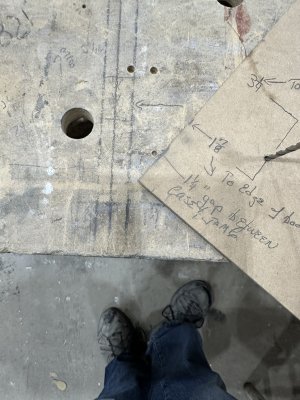
The case to jamb on the pivot side must be 1-1/4" for the other numbers to work. This picture shows how close I run these.

IMG_2189.jpeg

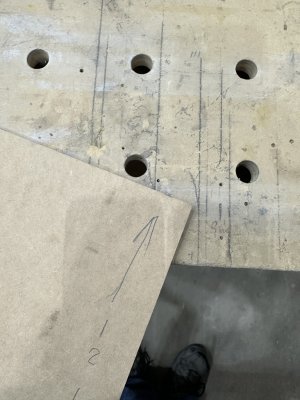
The free side clearance depends on the depth of the bookcase. For a 12" deep bookcase there must be at least 3" of gap between the case side and the jamb, a 9" deep bookcase requires a minimum gap of 2-1/4". This pictures of a 12" bookcase how close I run this.

IMG_2188.jpeg

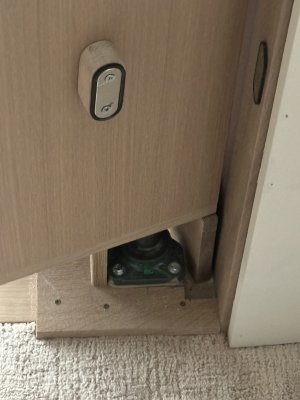
The bottom jamb must be shaped to allow the lower trim to swing into. The lower jamb has also been cut off in this picture, this is why I show a courtesy cut.

IMG_2175.jpeg

The top case to top jamb space I leave 4", I find this a comfortable space to get my hands in and mount the upper bearing assembly. The bottom space varies by the height of the trim around the bookcase, 7-1/4" tall baseboard is common here. The magnets shown Precision magnetic catches. You can see a vertical piece of wood to the left of the pillow block, there are 2 adjustable furniture feet with felt installed in the top edge. They are adjusted to contact the steel plate to prevent ghosting of the bookcase.

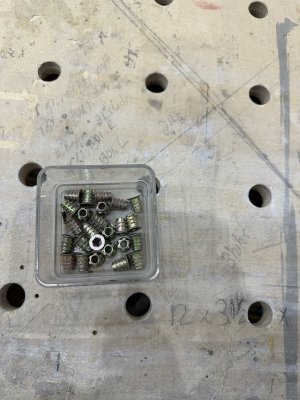
I did not show any fastener sizes, these can be Imperial or metric. I use 5/16-18 flat head screws for the pivots and 1/4-20 bolts for the other hardware. I use threaded inserts for all bolts that go into wood.

IMG_2191.jpeg

Tom
 

Attachments

Thanks ever so much for taking the time!

Just to make sure I understand correctly:

The (in the photo) vertical lines on the worktop represent the jambs and the pieces of MDF the pivoting bookcase? If so, then that is indeed "close". Very nice though. I gather this way you won't need angled pieces to make the turn?

What is a "courtesy cut"?

With preventing "ghosting" do you mean preventing scratching of the floor, which would be a giveaway there's a hidden door?

I was so focused on the sides of the case, that I had underestimated the importance of the base and I certainly would not have thought to make sure there would be enough space on the top side. It would be just like me to forget about that and only realise when it would be too late.

I think I can have a local metalworker make the hinge parts for me, so don't expect there will be no problem on that part.

Seeing this, I suspect it might be a good idea to first design the whole thing in BricsCAD to make sure everything will actually move and fit as intended.

Thanks again!

 
Thanks ever so much for taking the time!

Just to make sure I understand correctly:

The (in the photo) vertical lines on the worktop represent the jambs and the pieces of MDF the pivoting bookcase? If so, then that is indeed "close". Very nice though. I gather this way you won't need angled pieces to make the turn?

What is a "courtesy cut"?

With preventing "ghosting" do you mean preventing scratching of the floor, which would be a giveaway there's a hidden door?

I was so focused on the sides of the case, that I had underestimated the importance of the base and I certainly would not have thought to make sure there would be enough space on the top side. It would be just like me to forget about that and only realise when it would be too late.

I think I can have a local metalworker make the hinge parts for me, so don't expect there will be no problem on that part.

Seeing this, I suspect it might be a good idea to first design the whole thing in BricsCAD to make sure everything will actually move and fit as intended.

Thanks again!
Yes, jambs sides are represented by the lines, the MDF piece represents the case. They run close but do clear.

A courtesy cut is when you cut the bottom of the board about 50% of the depth of the board across its full width. After the assembly is installed you can cut through the upper 50% of the board without fear of damaging the surface below. I forgot to mention, the side of the bottom jamb you’ll be removing pocket hole screw it to the side jamb for easy access to the screws.

A “ghosting” door is when they swing slowly on their own. Your install is at the mercy of the framing. If the framing is not dead plumb these bearings are so smooth the door will move in its own. The felt feet allows you to apply a little friction to the metal plate preventing the door from ghosting.

You need to be able to install the top bearing and axle assembly once the case is installed in the jamb. It helps to have a few people to set the case in the installed jamb.

CAD is your friend.

The bearings I use.

IMG_2195.jpeg

Tom
 
Good luck Tom, hoping you have a great recovery
Thank you. The surgery went well, the recovery will suck, I have no clue how to handle two weeks of no work then two weeks of light duty.

Tom
 
Thanks ever so much for taking the time!

Just to make sure I understand correctly:

The (in the photo) vertical lines on the worktop represent the jambs and the pieces of MDF the pivoting bookcase? If so, then that is indeed "close". Very nice though. I gather this way you won't need angled pieces to make the turn?

What is a "courtesy cut"?

With preventing "ghosting" do you mean preventing scratching of the floor, which would be a giveaway there's a hidden door?

I was so focused on the sides of the case, that I had underestimated the importance of the base and I certainly would not have thought to make sure there would be enough space on the top side. It would be just like me to forget about that and only realise when it would be too late.

I think I can have a local metalworker make the hinge parts for me, so don't expect there will be no problem on that part.

Seeing this, I suspect it might be a good idea to first design the whole thing in BricsCAD to make sure everything will actually move and fit as intended.

Thanks again!
I quoted you again because I thought of other things that may help.

On the plans, Fusion rounded up 1.875 to 1.88, on another page it rounded it down to 1.87, 1.875 (1-7/8”) is the correct number.

The bearing bore is 1.000 +/- 0.0005, I entered the diameter of the stub on the axle as.1.000 (oops), it needs to be 0.998 +0.000/-0.001. You want a slip fit.

I have the top bearing assembly as an exact fit, in my head I know I will be making it 1/8” short of the actual fit.

In your CAD program if you put the bearings and axles exactly where I have them everything will line up. These numbers came from when I did my first one and tested it in Fusion 360.

If there is a metal supplier in your area they should be able to shear you plate, then you drill the holes. For those in the U.S. Metal Supermart is a great supplier for this type of stuff.

If you do not own a metal lathe you’ll need to find a machine shop to turn them. Have them center drill and tap them while they’re in the lathe.

The reason the plate is held back 1/2”, is so the front lower toe cover tucks back and clears the fixed trim (in this design the fixed trim is on the left side. The front lower valance is held on with magnets. I’ll pull the detail and post the PDF.

Tom
 
Very useful all this!

Thanks for the clarifications on ghosting and courtesy cuts. Learned some new terms from that.

As a non-US person I work in metric, so I will have to convert all dimensions anyway. But the good thing about proper CAD software is that it can also do dynamics. I suspect I will be making extensive use of that feature in BricsCAD to make sure my conversion will actually work. To me, it is all the details to think of that are most valuable in your posts. The information you provided on those details is very enlightening to me. It will certainly help when I design something like this for my new house. Much appreciated!

P.S. I once tripped on an edge of the tatami during a competition. Ruptured my hamstring because of that and had to take it easy for almost 6 weeks. After a few days I went up the walls. I just can't sit still for so long. In the end I started a course on digital forensics just to have something to do. My wife still thanks me for that. :giggle:I hope it is easier on you.
 
Back
Top