Re-Gluing Formica and Replacing Faces?

onocoffee

Member
Joined
Sep 23, 2024
Messages
1,349
Location
Baltimore, Maryland, USA
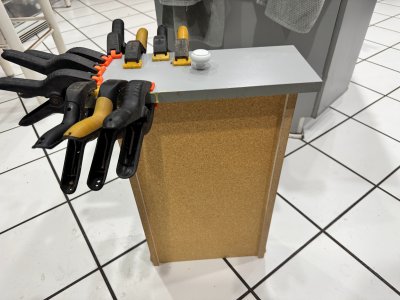
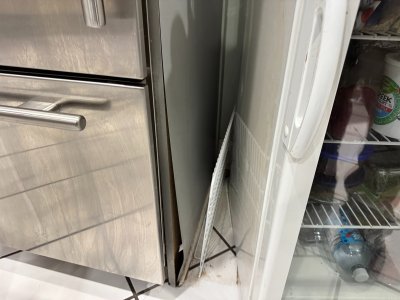
My mom's 34 year old kitchen cabinets are slowly getting into a state of disrepair. Some of the laminates have been delaminating and she's asked me to help "fix" them. So, I've been squeezing in TitebondII and clamping them back together. I've done it a couple times and those have held up well this past year, but it is a continuing project. The delamination on the cabinet doors have been relatively easy but the refrigerator panel is much larger and anchored to the wall so I'm not sure the best way to reattach it - any suggestions?

I am a bit surprised/disappointed that it's all particle board. The house and kitchen were build in 1988/89 so I thought they would have used ply but certainly not.

She mentioned that she heard about services that will replace the doors and surfaces of your kitchen. Do you know anything about that, how they price it and if it's worth it? This is all outside my area of experience, so I don't know what to advise her.

Thanks!
 

Attachments

  • IMG_0712.JPG
    IMG_0712.JPG
    2.5 MB · Views: 23
  • IMG_0713.JPG
    IMG_0713.JPG
    2.5 MB · Views: 23
If the cabinet boxes are in decent shape you could either spend a few thousand re-facing or for somewhat more money, get a new kitchen from Ikea.

Particle board is a much better substrate for HPL than plywood. Pretty standard.
 
Google shows a few resurfaces in your area.

What I entered in the search bar: cabinet resurfacing baltimore md

Tom
 
I made that repair on our office kitchen when I still worked. I squirt some Woodworker’s 3 between the laminate and the substrate.

I put a stack of Thomas’s Register to weight it down overnight. I did the same with the edge banding, but used masking tape instead of weight.

The repair was at least ten years old when I retired and was still solid. I used WW3 for the extended open time. The repair took about 1 hour. I did the edge banding the following day.

 
Sometimes it is possible to reactivate the contact adhesive using a heat gun and immediately rolling. Same method can be used in many cases to remove plastic laminate (putty knife obviously instead of roller).

Peter
 
Sometimes it is possible to reactivate the contact adhesive using a heat gun and immediately rolling. Same method can be used in many cases to remove plastic laminate (putty knife obviously instead of roller).

Peter
Or use a laundry iron and use a pressure block of wood to follow up as it cools. I could not get that to work on the office kitchen. Perhaps it had aged out, but with a try.
 
Any of above, but that big panel is tough.

I've had some luck reactivating glue with a hot iron and pressure. Hot iron + original Tite Bond method is my go-to for adhering new wood veneers, but likely you are dealing with some sort of failed contact adhesive.

Given the surface area and panel orientation, hot iron might be worth a try.

Maybe work down in sections starting where laminate is still adhered to the substrate? I like putting a scrap of tee shirt cloth underneath the iron.
Looks like the whole bottom section of the laminate has come loose?? You might be able to carefully peel it back and apply some spray adhesive to both surfaces if heat fails.
 
Direct heat can cause the top melamine face of the laminate to de-bond from its phenolic substrate. I’d be more inclined to lift up the sheet and slather some new contact cement with a brush while keeping the faces separated until dry. 3M spray glue can get messy if you aren’t used to using it.
 
Thank you all. I will be giving these a try tonight.

P_K's thought seems the likely culprit since that panel houses a big fridge within it and a smaller, external fridge next to it. I can see the heat generated by the smaller fridge warming the inch between them causing the delamination. I will grab my iron and try that first. I also have some Super77 spray adhesive and the aforementioned TB2.

To Packard - this was not a refacing. These are the original cabinets from 1988/9.

I will try the heat gun that Peter and VSD suggested as well. As I was gluing one of the failing edge bands, I noticed what looked like old, yellowed double-sided tape that would not come off with a scraper readily. I tried gluing it but didn't think it would adhere. If it didn't, I'll try the heat.

Thanks Tom, I'll try that search as well. However, I am trying to discourage my mom from going out and spending money. Anything I should look for when considering a resurfacing company?
 
Is the refrigerator panel skin still tight anywhere? Looks like it might have come loose at some point and is bowed/sagging from it’s own weight.
I would investigate the possibility of pulling the skin all the way off and straightening it. Looks like spring clamps could secure the front edge.

If that appliance? to the right can be made stationary maybe you could use air wedges between it and the refrigerator to apply pressure to the skin.
 
You could consider replacing the existing panel with a wood panel, finished to your mother’s preference and applied with construction adhesive.

I’m not sure I would use contact adhesive. It can be difficult to spread in tight quarters. I have used partially inflated party balloons as packing for picture frames, and as a clamping element for glue ups. In your case you could simply wedge the balloons between the wall and the panel. I buy 15” balloons and inflate them to 8” to 10”. The better ones are pretty durable and they can apply sufficient pressure for glue ups. (They work great for shipping picture frames.)

When the glue is dry, use a long, sharp pointed object (a wood dowel in a pencil sharpener works fine) and puncture the balloons. Then sweep them away. In any case, a wood panel might please your mother and it would be easier to install (probably).
 
Back
Top