Small table, new inspiration

Crazyraceguy

Festool Moderator
Festool Moderator
Member
Joined
Oct 16, 2015
Messages
5,812
Other than a couple of cabinets, that I built for a workbench, for my bike area, I haven't been really made anything lately.
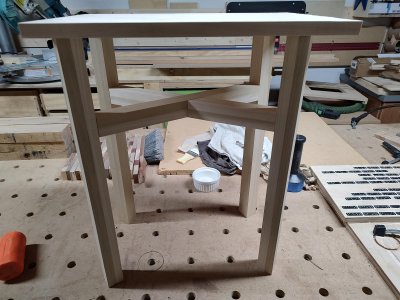
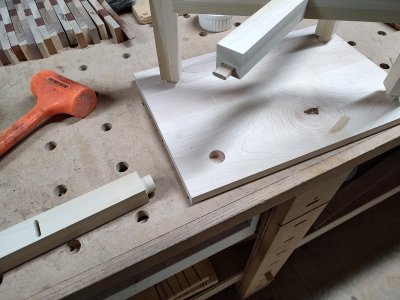
Yesterday, this X pattern for the stretchers, occurred to me. Integral round tenons, Dominos on the X.
I'm not so sure about the thickness of the legs from the front, because of the rotation. Other than the half-lap on the X itself, it is not glued, so I can still taper them, maybe three inner sides? They are just Poplar, so painted, at least in the prototype stage. I might use it again on something else. Maple top. Pic is a little dark, sorry.
 

Attachments

  • X table joints.jpg
    X table joints.jpg
    373.8 KB · Views: 65
  • X table legs.jpg
    X table legs.jpg
    404 KB · Views: 66
Please consider my comments for what they are not worth:

The shades on the photo made it look like the legs were not rectangular at the first look and I liked it ... which leads me to a suggestion:

How about a routed chamfer of each edge of the legs, creating a regular octagonal leg profile at the ground with the top inside being just a partial hexagon as the internal edges chamfer would start about 1/2" below the cross joint and top being square as the chamfer would start 1/2" from top ?

Can also be concave "chamfer" but that would be tricky .. a simple deep chamfer has the advantage of making the soft poplar edges more robust when painted too.

Just mumbling .. but definitely asks for some "decoration".
 
Last edited:
Please consider my comments for what they are not worth:

The shades on the photo made it look like the legs were not rectangular at the first look and I liked it ... which leads me to a suggestion:

How about a routed chamfer of each edge of the legs, creating a regular octagonal leg profile at the ground with the top inside being just a partial hexagon as the internal edges chamfer would start about 1/2" below the cross joint and top being square as the chamfer would start 1/2" from top ?

Can also be concave "chamfer" but that would be tricky .. a simple deep chamfer has the advantage of making the soft poplar edges more robust when painted too.

Just mumbling .. but definitely asks for some "decoration".
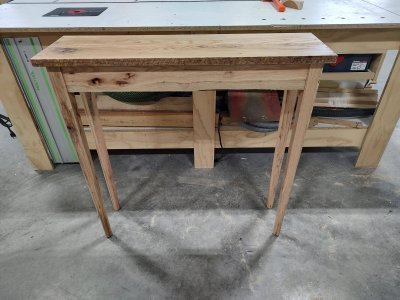
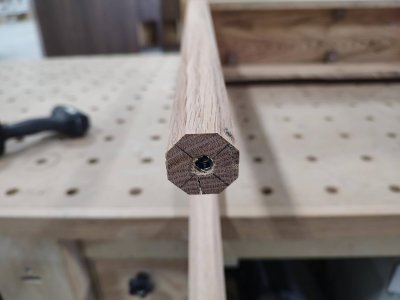
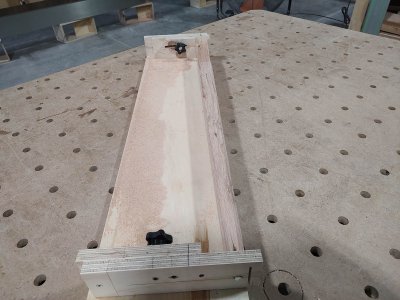
It may be back far enough that you missed it or simply forgot, but I did a narrow entry table for myself with an octagon variation. They are much longer legs, but they taper, on all sides, from square on top to equal sided octagon at the bottom.
I definitely agree it needs something. I even have an idea for leg bottoms, but I'm not sure it's right for this one?
 

Attachments

  • TableOct7.jpg
    TableOct7.jpg
    370.6 KB · Views: 16
  • TableOct2.jpg
    TableOct2.jpg
    126.4 KB · Views: 13
  • TableOctjig.jpg
    TableOctjig.jpg
    417.7 KB · Views: 13
It may be back far enough that you missed it or simply forgot, but I did a narrow entry table for myself with an octagon variation. They are much longer legs, but they taper, on all sides, from square on top to equal sided octagon at the bottom.
I definitely agree it needs something. I even have an idea for leg bottoms, but I'm not sure it's right for this one?
I would vote against gradual taper. Taper works excellent for making a sleek look in a high piece. This needs something more pronounced, hence my comment of an even chamfer ended before the top. The ending of the chamfer being a decorative feature on its own. But that is not really it for your use case anyway. I can feel you are "conditioned" in your design thinking more into the utilitarian shapes you were making professionally as that is what interior designers push these days. You need to think aesthetics, not "technique". Draft it with a pen and paper, not on a computer.

I am not a pro, but being an engineering guy I fall into this thinking by default too and struggle to avoid it. The thing is that stuff which would look kitsch in a library may fit perfectly in a home setting. And stuff that may look super-cool in a shop or a kitchen setting may create an uncomfortable, super-cold, atmosphere in the bedroom. I now try designing the piece to fit the setting, not forcing the setting to fit the piece. Not succeed often. But I do try. :)

To me, the first question to ask is: What atmosphere I want at the place I expect this piece to reside? Once that question is answered, things often become just obvious..

/end contemplations
 
Last edited:
To add to the discussion about aesthetics: I find it very useful to make a scaled down model of a design, using foam board and/or card board. Eg a table model done in scale 1 to 10 can be held in place to see how it relates to the environment, you can turn it around, look at it from simulated viewpoints, et cetera.
Making a model this way is easy when you have a drawing at scale. I use needles and tape to put the model together and when I have it down fix it with glue. After alternations I measure the model and change the design for execution.

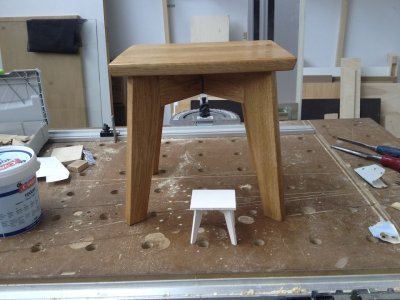
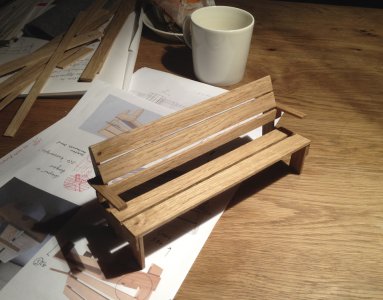
I found an example in my photo library of a foam board model and the result. And a model of a bench I made using wood processed to scale.

Stool+Model.jpeg

HidebrandBench.jpg
 
Last edited:
Back
Top