The Drated Yellow Glove

Cheese

Member
Joined
Jan 16, 2015
Messages
12,873
Location
Land of 11,842 Lakes
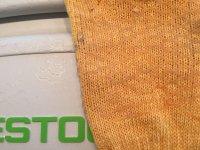
Well I've been busy totally updating the bathroom and I needed to get a good grip on a small pipe that I didn't want to put a pipe wrench on. So, I grabbed one of those yellow grippy gloves that have a rubbery substance placed across the palm in a pattern for better grip. After using it, I placed it on top of my LS 130 Systainer. Today, (a week later) I decided to take the LS 130  Systainer downstairs and removed the glove. This is what I found:

[attachthumb=1]
The pattern of the glove etched itself into the Systainer. The entire area covered by the glove was fairly soft as if you had placed a towel with acetone or zylol on it. I could remove small amounts of the Systainer with just my fingernail. Obviously, the glove was out-gassing something that attacked the cover.

[attachthumb=2]
Here you can see the pattern in the cover and the pattern of the glove. Who'd have thunk? [eek]

 

Attachments

  • image.jpg
    image.jpg
    1.4 MB · Views: 554
  • image.jpg
    image.jpg
    849.2 KB · Views: 494
Looks like the old plastic worms and tacklebox phenomenon. I think the systainer will firm back up now that the glove is off it but the fingerprints will stay. [mad]
 
From what I understand this is a process where the plasticizers from one compound cause an adjacent compound to replasticize. The same thing can happen to a waterborne finish when a plastic or painted placemat is left on a table.
 
[member=22]greg mann[/member]
greg mann said:
Looks like the old plastic worms and tacklebox phenomenon. I think the systainer will firm back up now that the glove is off it but the fingerprints will stay. [mad]

Ya, I don't know, I'm just an average guy trying to update my house and the gloves melted into the Systainer. I was shocked.

So what's the story about the plastic worms and the tackle box?
 
Cheese said:
[member=22]greg mann[/member]
greg mann said:
Looks like the old plastic worms and tacklebox phenomenon. I think the systainer will firm back up now that the glove is off it but the fingerprints will stay. [mad]

Ya, I don't know, I'm just an average guy trying to update my house and the gloves melted into the Systainer. I was shocked.

So what's the story about the plastic worms and the tackle box?

The plastic worms seem to melt into the tackle box leaving their profile where they lay FOREVER!!!  [scared]
 
Heck, you should see what a leaky can of acetone can do to a limited edition Festool green mini systainer when it accumulates in the handle well.  Can we say plastic welding.  Then having to cut it open to get to the contents only added to the moment.

Yes - I can laugh at myself!

Peter
 
[member=7493]Sparktrician[/member]
Thanks...
Sparktrician said:
The plastic worms seem to melt into the tackle box leaving their profile where they lay FOREVER!!!  [scared]

That's interesting, because the grippy material on the glove is very similar (if not the same thing) as the plastic worms. I wonder what it out-gasses?
 
Peter Halle said:
Then having to cut it open to get to the contents only added to the moment.

Peter

That's funny...first of all having to trash a limited edition Systainer, and then being careful cutting the Systainer so as to not damage the contents.  [jawdrop]
 
i believe that the grippy material on the glove is PVC and it will interact with the ABS plastic that the systainer is made out of.  PVC is notorious for outgassing the toxic additives in it.  Yet it is up there as one of the most used plastics.

and like peter found out the hard way the acetone will dissolve the ABS.  you can use that to your advantage if you're trying to shape your own plastic.
 
[member=2205]teocaf[/member]
You're correct, I just Googled "Criss Cross Grippy Glove" and it uses PVC to enhance the traction.  [not worthy]
 
Interesting observation. What you experienced can sometimes happen with rubberized grip gloves that contain plasticizers or certain processing oils. When these materials sit in contact with plastics for a long time, especially in warm environments, small amounts of those additives can migrate out of the rubber and react with the plastic surface.
Some plastics are particularly sensitive to solvents or plasticizers, which can cause softening or surface imprinting like the pattern you noticed. It’s one of the reasons elastomer and plastic compatibility is carefully considered in industrial applications.

Usually keeping rubber products separated from plastic storage boxes or tools prevents this kind of reaction.
 
As far as I have learned John Broomall is correct. Plastics containing large amounts of plasticizer can indeed leech them onto other surfaces causing those plastics to weaken (become more flexible) as well.

When I was working in a hospital (in the late '80s and early '90s) we were taught not to stack the bloodbags because that would cause them to deteriorate exactly because of this leeching. We always had to put a sheet of some special paper between them to prevent that from happening.
 
As far as I have learned John Broomall is correct. Plastics containing large amounts of plasticizer can indeed leech them onto other surfaces causing those plastics to weaken (become more flexible) as well.

When I was working in a hospital (in the late '80s and early '90s) we were taught not to stack the bloodbags because that would cause them to deteriorate exactly because of this leeching. We always had to put a sheet of some special paper between them to prevent that from happening.
Sheesh!
What they leak gets into your blood the same it melts other stuff.

That type of a bag would be illegal over here, like, ever.
We had glass bottles used for infusion in hospitals until relatively recently /I had them in late 1990s/ for that very reason. Non-leaking stable plastics were just not available and/or affordable I presume.

What you describe is just plain insane, assuming your interpretation is correct.
 
I came across a similar situation with plastic parts resting on other plastic parts that had a plasticizer blended in. I was not knowledgeable about plastics, but many of my customers were major injection molding companies and they had smart people working for them. They blamed the plasticizers.

I suspect, but have no evidence, that migration and not outgassing is the culprit. At any rate, continued use of these plasticizers does not bode well for the younger generation as there are associated health issues. Us oldies will have had far less exposure over the years than the upcoming generation.

This from Google A.I.:

Plasticizers can damage other plastics through a process called migration,
where they leach out of the original material and cause softening, deformation, or cracking in adjacent, less-compatible plastics. This chemical transfer often results in "sticky" surfaces, increased brittleness in the donor plastic, and reduced structural integrity in the recipient material


I also see that plasticizers are being blamed for health issues, described in the linked article below.

This article from the National Institute of Health sounds alarming. Unfortunately, there seems to be no way to reasonably avoid these compounds. I have quoted the first several paragraphs of that article.


Over the last several decades, plasticizers have seamlessly integrated themselves into our daily routines, permeating a vast array of commonly encountered products such as food containers, toys, medicines, building materials, electronic devices, cosmetics, perfumes, and personal care items [1,2]. However, recent scientific research has generated growing concerns about the potential health risks associated with these omnipresent substances.

Plasticizers, including phthalates, bisphenols, and their substitutes, have experienced global utilization on an unprecedented scale. Unfortunately, this prevalence has resulted in a worrisome surge in human exposure to these compounds. Studies have unequivocally demonstrated that specific plasticizers possess the capacity to disrupt both animal and human endocrine systems [2,3], leading esteemed scientists and governments in the United States and the European Union to classify them as endocrine-disrupting chemicals (EDCs).

Moreover, emerging evidence derived from mechanistic and epidemiological studies further bolsters the notion that prolonged and low-dose exposure to plasticizers may have deleterious effects on the endocrine, reproductive, and neurological systems, potentially engendering the onset of chronic diseases [4,5,6]. These findings carry profound implications for the health and well-being of diverse populations worldwide.
 
What they leak gets into your blood the same it melts other stuff.

That type of a bag would be illegal over here, like, ever.

Well, you need to remember this was more than 35 years ago. Maybe it was not known at that time what the effect on the blood was? Later those bags were indeed replaced with another type (still plastic though). I think we have quite strict regulations around here (The Netherlands) when it comes to medical devices, but it seems they didn't have the knowledge we have now (understandably so). Also, plastic on plastic contact is not the same as plastic on blood contact. That might have a significant impact on the amount of leeching. I am no chemist, so I don't know. I just know what we were instructed to do.
 
Last edited:
I had to look up "drated" :) I figured it was supposed to be dreaded, but turns out "drate" is a word that could sort of apply!

Seth
I had to look it up too.

“Drite” appears to be the present tense of the word. “Drate” appears to be the past tense. I could not find “drated”, so maybe “drate” was the right form.

In any case, Scottish, archaic according to Google A.I., so perhaps our ignorance can be excused. But I enjoy being kept on my toes and expanding my knowledge base.

Here is Google’s definition:

"Drite" is an archaic or dialectal (Scots) verb meaning to defecate, originating from Old English drītan. It is rarely used in modern standard English but appears in historical contexts, sometimes spelled as dryte or dret. In Norwegian, drite is a common, vulgar verb with the same meaning
 
From Dictionary.com:

Dratted​

adjective​

  1. damned; confounded (used as a mild oath).
Yes. When spelled with two “T”s. And no doubt Seth (and I also) would not have questioned “Dratted”.

So, likely all the word confusion was a result of a typo, though my computer wants to change “drated” to “states”, apparently someone has programmed the letter positions on the keyboard into the AI spell checker.

So the letter “d” is adjacent to the letter “s”; the letter “r” is adjacent to the letter “t”, and the final letter “d” is adjacent to the letter “s”. So my spell checker assumed that I had shifted my hand position to mispell “states” as “drated”.

I was not aware that spell checkers were analyzing for typos as well as comparing typed words to the dictionary.
 
Back
Top