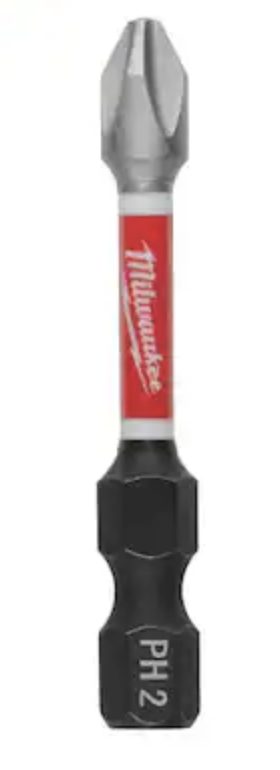
Top 3 makers of impact driver bits (If you believe Slash Gear)

The Robertson does not cam out as EASILY as the Phillips does. I have had Robertson bits cam out on me when I'm not careful, especially when using stainless screws as the stainless is relatively soft. And when a Robertson cams out, they can become almost impossible to remove.

That's the reason I've pretty much switched over to Torx for everything when that's possible.
I don’t know if there is an intentional difference between R2 and S2 bits (nominally the same) but some hold much better than others. Same with “square drive screws”. The ones I find most annoying are the combination Phillips/square from McFeely’s. The fit with a good bit is sloppy and they even can out occasionally.

Yes, soft stainless is worse. Depending on the use/wood I might treat the screw as if it was brass and drill a pilot hole or use a harder steel screw first to make seat.
 
Phillips bits are intended to cam-out, it's a feature, not a bug. They were part of the original assembly line process, where self-centering was needed, because of power drivers, but they would slip before overdriving.

People have been saying this for years, but if you go back and look at the original patent documents, no such capability is mentioned.

I think this is a case of Mandela Effect where people are so used to cam out they believe it must have been a design feature rather than an artifact.
 
People have been saying this for years, but if you go back and look at the original patent documents, no such capability is mentioned.

I think this is a case of Mandela Effect where people are so used to cam out they believe it must have been a design feature rather than an artifact.
Patents do not mention every feature of an invention.

For anyone who ever saw the geometry it is slam dunk that Philips is a cam-out design. There is nothing to discuss so not surprising someone would even mention it in a patent.. The primary invention was the self-centering aspect of it which none of the other standard heads possess.
 
Patents do not mention every feature of an invention.

For anyone who ever saw the geometry it is slam dunk that Philips is a cam-out design. There is nothing to discuss so not surprising someone would even mention it in a patent.. The primary invention was the self-centering aspect of it which none of the other standard heads possess.
It’s a very frustrating surprise when holding the driver as far as you can reach and the bit just won’t find the seat.
 
A little Google research yielded this:


(…). The Phillips screwdriver design has a tendency to cam out during operation due to angled contact surfaces, which create an axial force pushing the driver out of the recess as torque is applied. Despite popular belief, there is no clear evidence that this was a deliberate design feature. When the original patent application was filed in 1933, the inventors described the key objectives as providing a screw head recess that (a) may be produced by a simple punching operation and which (b) is adapted for firm engagement with a driving tool with "no tendency of the driver to cam out".

Nevertheless, the tendency of the Phillips screw to easily cam out was found to be an advantage when driven by power tools of that time which had relatively unreliable torque limiter clutches, as cam-out protected the screw, threads, and driving bit from damage due to excessive torque. (…)
 
(a) may be produced by a simple punching operation and which (b) is adapted for firm engagement with a driving tool with "no tendency of the driver to cam out".
...
Pretty sure that text references to the slotted head screws it replaced .. and thus the self-centering behaviour of an X slot keeping the driver inside it /as long as pressure is applied/. Not to POZI or Robertson.
 
Back
Top