Would I clog a CT 26 / MIDI with layers of paint from kitchen cabinets

That one made me literally laugh.

You're right about the item name. Many of the Bosch tools are sold as some kind of name, that you can pronounce, rather than a list of numbers/letters. Those numbers probably mean something (as far as a descriptive code) but you would have to be familiar with the lingo.
Sadly, many things are "dumbed down" (I wanted to say "for Americans", but that is probably too harsh, maybe just a more modern thing?)(In the western world anyway)
[...]

It's pretty much the same as with Festool. In this case GBH = Gewerbliche BorhHammer. The 5 refers to it's weight class (in kg) (despite it being 6.8 kg, but that is pretty much with all "5 kg class" machines). The 40 refers to supposed maximum drill bit diameter (in mm). Then my guess would be the D is the grip shape, the C is the 'constant rpm' elektronics and the E is for adjustable speed. But it's not done consequently with all tools..

No names for Bosch tools here. That's mainly an American / Australian thing for them. I like the German naming better. All the mitre saws have their blade diameter in the name for example.
 
Last edited:
It's pretty much the same as with Festool. In this case GBH = Gewerbliche BorhHammer. The 5 refers to it's weight class (in kg) (despite it being 6.8 kg, but that is pretty much with all "5 kg class" machines. The 40 refers to supposed maximum drill bit diameter (in mm). Then my guess would be the D is the grip shape, the C is the 'constant rpm' elektronics and the E is for adjustable speed. But it's not done consequently with all tools..

No names for Bosch tools here. That's mainly an American / Australian thing for them. I like the German naming better. All the mitre saws have their blade diameter in the name for example.
That's what I figured, thanks for the explanation.
Most guys that I run into are lost with the Festool numbering system. However, they do some with names too. The number is still part of it, but Domino, Capex, Carvex, Rotex, etc follow the name thing, it's pretty inconsistent though. Many of them use the wattage as part of the number, but sanders do it by disc diameter, saws by depth of cut. I just keep them straight by memory, since the German lettering is beyond me.
 
I recently had to strip a lot of paint and found that Dumond Smart Strip was very effective and odor-free. They sell a test kit with tests of three different formulations— currently 25 buck on Amazon.
 
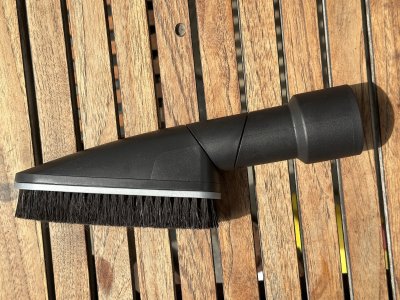
You’ll need a better brush for the vac to get ready to paint. I like this Miele Universal Brush because it has fine bristles that get down into the pores of the wood to knock dust out. I like this Norton Micro Fiber Cloth for final cleaning because it doesn’t get hung up on surface fibers as much as the hairy micro fiber cloths and it doesn’t leave any of it’s own fibers behind.
Also a big fan of the Miele brush as it has boar hair bristles which are finer snd softer than the usual plastic bristles that Festool uses.

@Michael Kellough did you use the Norton microfiber cloth as an actual tack cloth? If so, how does it compare to the normal ones that are cheese cloth with some tacky substance?
 

Attachments

  • 13425.jpg
    13425.jpg
    1.2 MB · Views: 2
Also a big fan of the Miele brush as it has boar hair bristles which are finer snd softer than the usual plastic bristles that Festool uses.

@Michael Kellough did you use the Norton microfiber cloth as an actual tack cloth? If so, how does it compare to the normal ones that are cheese cloth with some tacky substance?
Yes, I follow the Miele brush with that Norton cloth. And I follow that with a swipe of my nitrile gloves hand. That static charged glove sometimes pulls a little more super fine dust from the surface. This process works well enough for me with clear finishes. I never got on well with the sticky tack clothes.
 
You can also check around on Facebook Marketplace and Craigslist for someone selling off used heat guns, like an older Master Appliance version. About the RO125, I, and others, find it a bit squirrely to use compared to the RO 90 and big RO150, in Rotex mode. Go to a local Festool dealer if at all possible, bring one of your doors. Play around with the sanders so you see what you like or don't like.
RO90 will certainly handle the Face frame sanding as it will involve narrow frames and wider pieces, like others have noted, your Kitchen being a Built-in on site back in the day. For the wider flat surfaces, I've actually had great results with ETS EC Sanders and coarse grit Granat Paper. Like Michael noted, remove as much paint heating and scraping, then sand that last layer that's still strongly adhered to the wood. Wed link for Master Appliance heat Guns- the older ones like I have are all metal, very tough, and last for years, so maybe one used is the way to go for your project.

 
I might have missed any comment on lead, but if I did, it is probably worth re-mentioning.

Older paint can contain lead. White paint in particular would have. But by 1950, I think most of the lead pigmented whites would have been abandoned. Just looked it up on Google. I thought white paint would more likely have lead as a pigment, but Google says any paint color prior to 1976 is suspect.


Testing is cheap (less than $10.00) and easy and highly recommended.


If it comes back as positive for lead, then consider having the doors at least, dip stripped.

Here is some information on that:


NOTE: Even if you wear a mask, airborne lead would contaminate the entire shop. So you, and everyone else who used the shop, would have to wear masks forever going forward.
 
Back
Top