3D Printing Fun

Translucent wont cut it, my wife’s birthstone is diamond, she definitely knows what they should look like.

Tom
 
My understanding is that you will not know that static is a problem until it is.

Airborne saw dust (or dust of any kind, think “grain silos”) really behaves like a volatile gas. The airborne particles, which individually are all combustible, become explode when surrounded by abundant oxygen (read “air”). When those conditions are met, you can, but frequently won’t, have an explosion.

“Mythbusters” did a TV segment on this set of conditions that lead to an explosion. I suggest that doubters watch it. They explain the science and demonstrate the effect.

I recall it being instructional. I have not watched it in several years.


And if you want to watch actual grain silos exploding, there are many examples. Surprisingly many are caught on video.


The potential for airborne dust to ignite and explode is very real - especially for silos and very large scale woodworking operations.

However, there has been zero documented incidents of home or small woodworking shops exploding due to dust. These kinds of operations simply do not generate the volume of dust that would facilitate such an event.

What is more probable is your dust collection system catching on fire due to errant CNC operations that could ignite embers of wood that get sucked into the system, get lodged somewhere along the piping where the continuous rush of air stokes the embers and ignites a fire. I think it was Jonathan Katz-Moses who made a video about this very thing happening to his shop. The ember was lodged in the piping and since they didn't have an easy way to access cleanout points, it got far worse than it would have otherwise.

In coffee roasting we deal with this potential on a regular basis. Which is why proper operations use double-walled sealed piping to contain the fire when it occurs - and as we say in coffee: it's not a matter of "if", but "when."
 
If you have an MFT, I created parts for a brace that I posted here


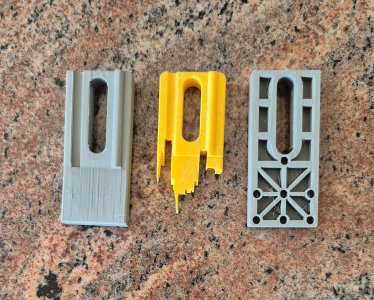
I started with them on one side and ended up putting them both front and back. Each set uses two pieces or 1/2 inch metal conduit 23 inches long. I printed them in ABS and PETG both with 50% infill, probably overkill for everything but the clips, but since I printed all the pieces at once, that was easiest. I am very happy with the design, but let me know if you find improvements.
 
“Mythbusters” did a TV segment on this set of conditions that lead to an explosion. I suggest that doubters watch it.

I am sorry, but what they did does in no way represent any situation that will realistically happen in your workshop. I know this discussion about dust explosions in the workshop (especially with PVC ducting) has been beaten to death by now, but it still seems to persist.

You probably won't believe my word for it, but I suspect you will trust Bill Pentz a bit more? Every time this discussion comes up he likes to refer to a paper written by Rod Cole to debunk it. Search the internet for "Grounding PVC and Other Dust Collection Myths" and "Rod Cole".
 
As far as I can tell, all the past dust explosion cases in Canada have happened in industrial or commerical settings. That said, Goolge AI offers this advice for home workshops:


Regardless of any risk of fine dust explosions, I use dust extraction and collection for my health protection. My last chest X-ray gave me a clean bill of lung health.
 
Last edited:
As far as I can tell, all the past dust explosion cases in Canada have happened in industrial or commerical settings. That said, Goolge AI offers this advice for home workshops:


Regardless of any risk of fine dust explosions, I use dust extraction and collection for my health protection. My last chest X-ray gave me a clean bill of lung health.
I added dust collection after my home heating oil vendor, which whom I have a maintenance contract, threatened to to cancel my contract because the dust was screwing up the ignition system. I was annoyed at the time, but I am glad they made me do it.

At any rate, reduced home oil burner issues is another reason to get a dust collection system. I have a big Grizzly 2-bag unit that sits in the corner of my basement. I have added a cyclone system to reduce the frequency of emptying the bag.

I also added some 1/4” square welded chicken wire to the intake duct on my table saw just in case I ever drop the blade nut and it gets lost in the saw dust. I have not dropped the nut since I have installed the mesh. It does not intruder with the dust collection and the nut cannot pass through the 1/4” square openings. So a good (and cheap) system that was easily implemented. If you have a table saw and dust collection, I recommend it.
 
Last edited:
Thanks for sharing, but newbie here (Bambu P1S Combo. Plate 256mm 256 x 256)). A few questions for your help:

Is the plate large enough?

What do you mean by "Recommend printing with 4-5 perimeters?"

And there're two files (a & b). Which file do I use? Or do I print both of them?
 
Yes, print both parts. They nest together at the center bolt location. Your plate is plenty large enough, as these parts are about 186mm each. You'd need a very big printer to make this in a single piece (351mm).

Changing perimeters is how many passes the printer lays down on walls before doing infill. I use Prusaslicer, but this is a common setting in any slicer software, so just look up how to find it on your slicer. I change this pretty often on parts I want to be a little stronger. With regards to this throat plate, I didn't want exposed infill on the wall once you do the cut, so extra perimeters provides more wall thickness to cut into.
 
Yes, print both parts. They nest together at the center bolt location. Your plate is plenty large enough, as these parts are about 186mm each. You'd need a very big printer to make this in a single piece (351mm).

Changing perimeters is how many passes the printer lays down on walls before doing infill. I use Prusaslicer, but this is a common setting in any slicer software, so just look up how to find it on your slicer. I change this pretty often on parts I want to be a little stronger. With regards to this throat plate, I didn't want exposed infill on the wall once you do the cut, so extra perimeters provides more wall thickness to cut into.
Thank you for your detailed explanation.

I'll see if I can figure out how to print it from Printables (In Project, it kept saying my material hadn't been selected).
 
As far as I can tell, all the past dust explosion cases in Canada have happened in industrial or commerical settings. That said, Goolge AI offers this advice for home workshops:


Regardless of any risk of fine dust explosions, I use dust extraction and collection for my health protection. My last chest X-ray gave me a clean bill of lung health.

Just about every hobby workshop and Men's Sheds with a ducted extraction system in Oz uses PVC and there has been no explosions. I sold a lot of those systems so I would have knowledge of any problems and very few have earthing systems because you can't earth an insulator which PVC is.
 
Just about every hobby workshop and Men's Sheds with a ducted extraction system in Oz uses PVC and there has been no explosions. I sold a lot of those systems so I would have knowledge of any problems and very few have earthing systems because you can't earth an insulator which PVC is.
A Google search on the topic seems to show that the “explosions” in home workshops is basically an urban myth (possibly encouraged by vendors of the grounding/earthing kits).

The kits included a long piece of uninsulated copper wire that you snaked through the ducting to deal with the fact that PVC is an insulator.

Here is my search:

 
That copper wire inside a PVC pipe is almost useless, because it will only conduct electricity away from the PVC in the places where it touches that PVC. A single mm next to that it will do nothing. So, it will only help for a very very small part of the total inside circumference of the pipe. Air is also an insulator, so it won't help for the air moving inside the pipe either.
 
That copper wire inside a PVC pipe is almost useless, because it will only conduct electricity away from the PVC in the places where it touches that PVC. A single mm next to that it will do nothing. So, it will only help for a very very small part of the total inside circumference of the pipe. Air is also an insulator, so it won't help for the air moving inside the pipe either.
So, most likely these “explosions” are urban legends? They did scare me into buying the grounding kit.
 
So, most likely these “explosions” are urban legends? They did scare me into buying the grounding kit.

I vaguely recall there were discussions some time back about the risk of large scale static electricity affecting the control boards of CT's with a cyclone attached, and the earthing wire was to reduce the risk of damage to the CT's?
 
I really wouldn't need this (domino joiner dock - Esty asking for $42 to $60)...but I couldn't resist the temptation.

🤭

1000115395.jpg
 
Back
Top