Bike infrastructure

Crazyraceguy

Festool Moderator
Festool Moderator
Member
Joined
Oct 16, 2015
Messages
5,665
As an avid cyclist, I would be the last one to limit such things. I'm always ready to participate. This city has a fairly good network of dedicated trials, some share small sections of city streets to connect them. It is better as you go north-south, since Columbus is essentially split east-west by a river, actually a couple of them converge near downtown. Crossing east to west is not as bad to the north, but south of there, only 3 crossings/bridges exist. One of them is not even legal for bicycles. It's over 10 miles south, before you reach another bridge.
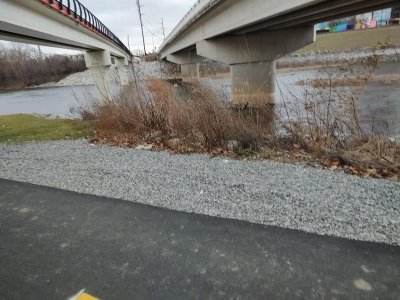
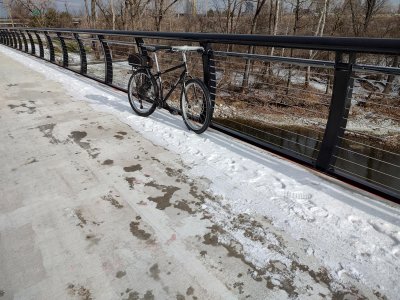
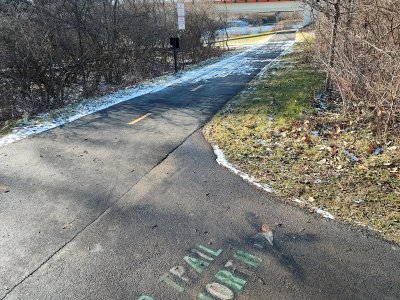
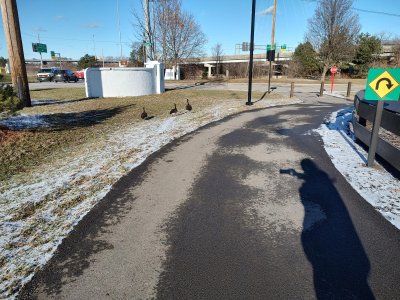
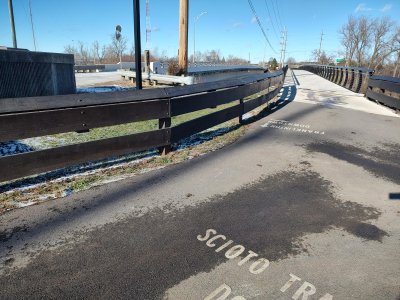
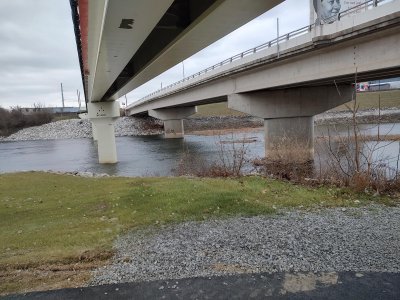
All that to say....Wow, did they waste a lot of money on this thing. The pics below show a small bike bridge, on the near west side of town. It crosses over a feeder, that heads toward that downtown river. It's a thing of beauty; wide, pretty rails, etc. but, it is only a couple of hundred feet long and only 50 ft or so, from a regular street bridge. The street has crossed this tributary, since before I was born. I have used it as a connector/entry point to the trails, for years. On each end of the street bridge, is a part of the trail. As you head north, the near side of the bridge, you can go east. Cross the bridge, and the trail loops under and heads west.
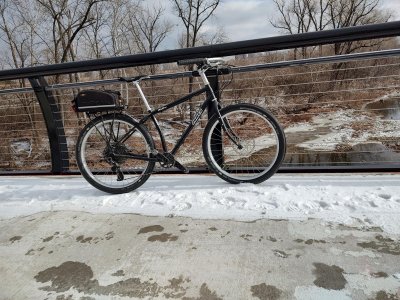
This brand-new bike bridge, does exactly the same thing! I just don't see why this is where they chose to spend this much money? There are plenty of other things that could have been done. You can see part of the trail, through the railing, of the last pic. That goes under, to where I was standing for the other pics, and heads west.
 

Attachments

  • IMG_20260102_130721682_HDR.jpg
    IMG_20260102_130721682_HDR.jpg
    767.9 KB · Views: 36
  • IMG_20260111_115711903_HDR.jpg
    IMG_20260111_115711903_HDR.jpg
    583.1 KB · Views: 33
  • IMG_20260111_115734812_HDR.jpg
    IMG_20260111_115734812_HDR.jpg
    472.3 KB · Views: 34
  • IMG_20260102_130711280_HDR.jpg
    IMG_20260102_130711280_HDR.jpg
    715.1 KB · Views: 35
Given it seems all gov departments struggle to spend tax money judiciously on projects, I have less of an issue of the waste for a dedicated pedestrian/cyclist bridge, especially if it means increased safety for them. If our gov was to build that, it would come in 3 years overdue, with a 500% cost blowout, and no I'm not exaggerating!

Our local gov in an effort to control the rampant knife/machete crimes, recently spent $13M on a dozen or so metal boxes (identical to used goods drop off boxes) to encourage people to dispose of knives and blades with them.

Needless to say that was $13M wasted, but that pales compared to other just as useless projects.
 
The thing which I wish would be done is that it would be standardized that infrastructure would be run underneath cycle paths when they parallel sidewalks and roads --- then, if maintenance needs to be done and the cycle path is dug up, cyclists, for that short section and temporary timeframe may instead divert to their choice of road or sidewalk as they deem appropriate.
 
The thing which I wish would be done is that it would be standardized that infrastructure would be run underneath cycle paths when they parallel sidewalks and roads --- then, if maintenance needs to be done and the cycle path is dug up, cyclists, for that short section and temporary timeframe may instead divert to their choice of road or sidewalk as they deem appropriate.
I think this is the most intelligent statement to come from the bicycle community in years. (y)
In the Twin Cities the city leaders would love to pave a bicycle path all the way to Anchorage...and have the local snow crews be responsible for keeping it clean. 😵‍💫 😵‍💫 😵‍💫

I'm not into bicycles but burying major utilities below the road surface has become a major issue in the last couple of years with the climate changes. When a whoops happens, the street is closed down for anywhere from 2 days to a week. If the sidewalks are shut down, cars can still negotiate the streets as can the residents. When the streets are shut down...nothing moves either in or out.
 
Our bike infrastructure is far better than "bike lanes" on the streets. We have some of that too, especially in the last 5 years, but the majority of it is actually made of good short-cuts. There are paths across the city that are nowhere near a road. This bridge happens to be right near where two of them cross, N-S vs E-W.
I took some better pics today, from the ends, at the road surface.
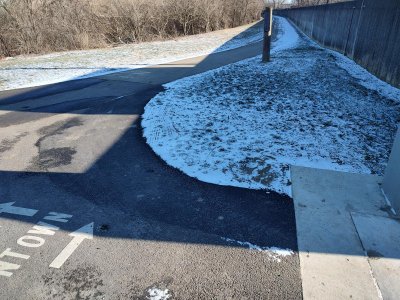
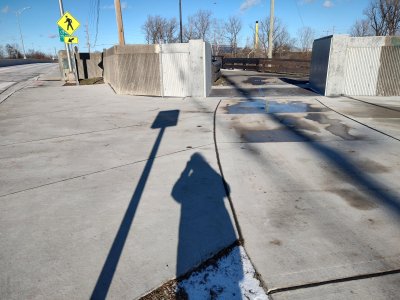
1) They cut a hole in the Flood Wall! This is the high point anyway. The wall ends just to the left, we used to turn right there. The trail is just around the corner, to the right. (to go east)
2)That new curved section ties the hole in the wall to the trail
3)This is crossing the bridge, rather than the right turn. See how close the road sits, to the left.
4)Crossing the bridge, on the street, you make a right turn, just past that white structure. Then there is a ramp up onto the trail, which parallels the road. 1500 feet or so, ahead, it turns left and goes north.
5) This is the turn that runs back under the bridge(s) and heads west.

That is a lot of money. I didn't even notice the cut in the wall, until today, which makes it worse! They cut a gap into a wall, engineered a lifting door, to block water again, all to go through......rather than 30 feet, to go around, as it was.
 

Attachments

  • IMG_20260115_151537440_HDR.jpg
    IMG_20260115_151537440_HDR.jpg
    1.2 MB · Views: 20
  • IMG_20260115_151352750_HDR.jpg
    IMG_20260115_151352750_HDR.jpg
    843.4 KB · Views: 19
  • IMG_20260115_151135858_HDR.jpg
    IMG_20260115_151135858_HDR.jpg
    710.8 KB · Views: 18
  • IMG_20260115_151044520_HDR.jpg
    IMG_20260115_151044520_HDR.jpg
    869.7 KB · Views: 18
  • IMG_20260115_151027695_HDR.jpg
    IMG_20260115_151027695_HDR.jpg
    475.4 KB · Views: 20
This is quite simple and sad at the same time.

Most bike roads are designed and funded by people who do not bike /or walk, for that matter/. At a best, they do bike for fun but do not use or see bicycle as a transport tool. They universally view it as a "leisure activity" complicating road traffic. Yes, this is the same folks who preach the "jaywalking" (sic) trope in the US.

It is important to understand that in the view of such people, the primary objective of "cycling infrastructure" is NOT to enable cycling. It is to remove cyclists from "their" roads. The /unspoken/ motivation for such a bridge would be to enable banning of cyclists from the existing road bridge.

For anyone seeing my comment as political, it is not. It is borne out of observing this field for decades and seeing that almost universally a political move to "enable cyclists" actually just wastes money and commonly makes the situation worse than before the "effort" was expended.

The biggest troublemakers in Europe are the "metres of cycle paths" metrics which result in literally dangerous paths made when - before - there was no danger. Just to "make the metric" for next election. Sadly, even cyclists fall for this as few understand dangerous versus safe road infrastructure just by seeing it on a photo/video. If they do not ride that particular trek themselves to know first-hand, even they are easily fooled.

---
The only places where the roads infrastructure is done well /not meaning lots of money, meaning sane use of it/ is where also the public servants and politicians are generally cyclists and/or their family members are. As in Holland & Co. Anywhere else, it is mess. And counterintuitively, the more a mess it is the more the politicians are forced to "care" for cyclists for PR/election reasons.

Yes, my home town was known as "small China" as everyone cycled given the size/flatness of it. It was completely safe. Was. Now lots of cycling paths were made and it is no longer safe to ride around the town on a bicycle - about 2/3 of the new "paths" was done in a way that makes riding them more dangerous than before when no dedicated paths existed. Yes, most of those paths were made to enable additional parking where there was no parking /for good reasons/ before. Yeah. Welcome to the party.


... They cut a gap into a wall, engineered a lifting door, to block water again, all to go through......rather than 30 feet, to go around, as it was.
To be fair here, I would bet the reason is the wall is to be extended "in future", so the respective 'management authority' /whoever it is/ demanded such a solution.
 
Last edited:
This is quite simple and sad at the same time.

Most bike roads are designed and funded by people who do not bike /or walk, for that matter/. At a best, they do bike for fun but do not use or see bicycle as a transport tool. They universally view it as a "leisure activity" complicating road traffic. Yes, this is the same folks who preach the "jaywalking" (sic) trope in the US.

It is important to understand that in the view of such people, the primary objective of "cycling infrastructure" is NOT to enable cycling. It is to remove cyclists from "their" roads. The /unspoken/ motivation for such a bridge would be to enable banning of cyclists from the existing road bridge.
So true for us here in Melb Oz anyway. We have numerous half heartedly installed bike paths that spawn out of thin air and after a distance just stop at a dead end. Funding for stuff like that is pretty sporadic though, it's usually done when the pollies are trying to appeal to specific groups leading up to an election.

We do have split lanes on a large number of metro/inner city roads with a narrow section along the left designated a bike lane, but for safety quite often cyclists run 3-4 wide taking up the car lane as well, which as annoying as it is I can understand, cars are pretty aggressive towards bikes over here.
 
Bike roads are a double edged sword. As a general principle, I am opposed to them as a real risk to the concept of bicycling for commuting, or for even a leisure activity.

The problem arises when there is a road with a dedicated bike lane in the same direction you wish to travel and parallel, but 5 miles north or south or east or west of your point of origin or destination.

So you take the main thoroughfare, as using the dedicated bike road would entail an extra 10 miles of travel.

If you get in an accident that was entirely the car driver’s fault, everything goes to hell in a hand basket. This was a big deal when I was riding. The driver sued the cyclist because he said that cyclist chose to ride on the road that did not have a bike lane.

I stopped following these stories, but there were many of them.

It is my belief that once a significant number of roads have bike lanes, then some “wise” legislators will, in the interest of cyclists’ safety, limit bicycling to those roads that have a bike lane.

So, in my opinion, a bad idea.

And bicycle commuting will never catch on in the USA until two things are instituted.

1. Lockable “garages” for the bikes at the destination.

2. Shower facilities at the workplace.

In most workplaces in the USA, sweaty employees would not be welcome.

So without the added infrastructure at the workplaces, bike commuting will never catch on. And dedicated roadways for bikes will prove to limit the ability to travel on routes that make the most sense.
 
...
And bicycle commuting will never catch on in the USA until two things are instituted.

1. Lockable “garages” for the bikes at the destination.

2. Shower facilities at the workplace.

In most workplaces in the USA, sweaty employees would not be welcome.

So without the added infrastructure at the workplaces, bike commuting will never catch on. And dedicated roadways for bikes will prove to limit the ability to travel on routes that make the most sense.
1) That is not a "biking" issue, but a general rule-of-law issue. Unrelated topic but still a valid point. And it is not about an area being rich/poor from my experience either.

2) That is no longer the case. With the rise of cheap e-bikes it is possible to ride around almost effortlessly even in hilly towns. That was why I got my ebike about ten years ago. It paid itself on saved gas/taxis within a year AND the saved time from no parking search needed. Distance: 3.5 miles, a valley between home and work hills, making normal bike ride a sweaty affair.


In general, I believe the difference between where biking to school/work is "normal" and places where it is not /and the distances are suitable, 1-5 miles is the sweet spot for cycling/ is not about the infrastructure. It is about the culture of a society.

If a society is mutually hostile, non-cooperative, atomised, cycling is generally dangerous /and avoided/ as there are simply too many drivers and politicians trying to "get rid of the nuisance". Yes, this does includes drivers intentionally driving into cyclists and abusing laws to get away with it.

If society is mutually friendly, cooperative, cycling is mostly not dangerous /and thus practiced where practical/. Dedicated infrastructure notwithstanding.


The characteristics of a hostile non-cooperative society are: helmet mandates, mandatory use of bike lanes /irrespective if suitable/, banning cyclists from bridges where there is no alternative /very common in some places in US from what I gather/. Etc. But those are only symptoms of the internal hostility. SAME hostile actions are employed usually against pedestrians and, in general, against ANYONE perceived weaker, without the power to defend oneself, in such a society.

In a friendly society, two things change: Most regulations are general, not specific. BOTH the powerful /especially trucks and buses/ respect the weaker ones AND the weaker ones /cyclists, pedestrians, motorbikes/ respect the cars by a way of giving way wherever practical. ALL consider this an "automatic" behaviour, not something special.


-----
My point being, you cannot make cycling/walking or any other activity where you are not protected by a steel 'armour' safe/comfortable without the whole mindset of the society changing into the cooperative direction. This is the same like abolishing gun carry. It happens by itself as/if a society becomes safer. Instituting it only causes more of a divide and violence finds other means /see UK example/.

Yes, this is actually about the collectivist versus individualist philosophical divide. The thing is that the reason a random driver, who is situationally stronger while sitting in his machine, would be accommodating to a cyclist is not because of his immediate benefit, or any moral reason. He would be doing so as part of a wider social contract so that his kids/wife/friends would be similarly accommodated by other drivers. Further supported by the fact that those who use a bicycle do not take up additional road space /this is a big argument in dense cities and super weak one in US/. If he believes no one else will care for his comfort in other situation, then he will not see the cause to be accommodating.

To revert to the original topic, as in, what can be done to bring sanity into the madness?

@Crazyraceguy
Given you are retired now, if you feel like wasting some of your rare energy for the benefit of the community, the way here is get involved. Sadly, most of the cycling advocacy groups are fanatics/bigots who cannot see the forest for the trees. Any sane person around who disrupts their one-dimensional thinking is a benefit. There are usually many, many opportunities on how the city can be accommodating to cyclists without major investments and all it takes is finding at least those which will ALSO benefit car drivers /as those are likely the only to be supported eventually/. Lastly, it helps being an old fella who can think a bit like a crook. If some infra item is easy to embezzle funds, it is very likely to garner support, so do propose some of those too, even if super-costly as long as the solve an issue, as part of any wider push. Politicians hate too-efficient proposals that leave little room to loot... they just torpedo them silently.
 
Last edited:
For my part, I've always felt that driving tests should include a requirement that a certain number of miles be travelled on a bicycle for drivers who don't get a medical exemption, and that they be tested on understanding hand signals.

Similarly, it should be a tradition on the first day of school in a district that police officers ride along all reasonable routes for a bicycle, and that this be repeated on random days throughout the school year --- plainclothes would be fine --- just include it as a part of transportation safety for school children.
 
Nice Jones!
Thank you very much. Very few people have ever even heard of them, much less ever see one in person.
It is the second bike I ever built, starting with a bare frame. The first one was a Surly Ice Cream Truck. That came about because of the number of parts I had left over from modifying my first ICT. My local bike shop got me a NOS frame/fork that was a few years old. I essentially bought the frame to sell off the old parts, which would have very little value alone. That worked out so well, that it financed the Jones.
Mine is one of the American made frames, since the assembled bikes are made in Tiwan. I don't know if he still does, but back in '19, Jeff Jones hand welded all of the bare frame/fork units. It has a Chric King rear hub and a Jones front, since CK doesn't make a front that wide. (it's actually a fat bike 15 x 150) Sram GX 12sp with TRP G-Tech brakes. That's waay overkill, high-end downhill racing brakes with 203mm rotors. :cool: My pet project. The whole thing is kind of odd around here. The wheels were built by Sugar Wheelworks in Portland Or. and Jones isn't far from there either. I basically road ride it, with some gravel and fire roads, but they are really intended to be a mountain bike.

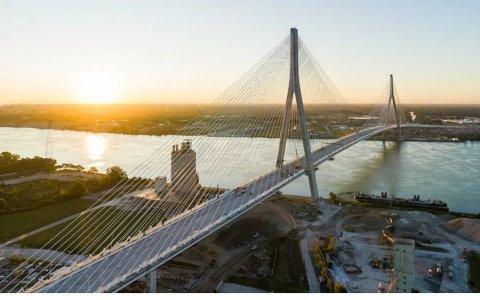
@Steve1 I would love to ride across that. I've been somewhat of a bridge nerd for a long time. My favorite, of the ones I have been over, is the Sunshine Skyway. The Chesapeake Bay Bridge/tunnel is quite an experience, but not as spectacular to look at.

@Packard Columbus is pretty fortunate to have a decent network of trails/paths that are bike/walk/run only. Even better, the places where you do have to ride on the road to connect them are in low-traffic areas. Over-all, it just depends on where you are, in the city, some places are very bike friendly, sadly some are just as much the other way.
Here in Ohio, the official policy (and law) is "every lane is a bike lane" (with the exception of interstate highways)
That is totally "not smart", is some places, cars will ignore it. They are definitely wrong, but they win. I have been hit once and put down twice, as well as assaulted by a driver. Still kicking
My commute was easy, before the fire. It was 7 miles, the short way, bike sat in my work area, there was a shower upstairs. On the way home, a similar route again 7 miles, but often extended to 13, on the bike paths. Most days were 20 round trip, unless the weather was opposing. The move to the new shop, made for a 21 mile one-way. That was the beginning of my cutting back on riding, but I'm coming back.

@mino I am already somewhat familiar with some of the "in the know" people. I just haven't had much contact with them lately. There are a couple of big advocacy groups here in town and now that I have time, I will get more involved.
I have always felt like it wasn't fair to complain, without doing something about it. I've been a volunteer with some mountain bike trail work/cleanup, but never had the time for the road stuff. It's way more "official"


@WillAdams I have said that for decades. Every brand-new driver (regardless of age) should have to ride around, for a specific amount of hours, in a semi-truck, and on a motorcycle. They absolutely need to see what cars do around both of those types of vehicles. This was long before I ever had ant experience with bicycles on the road. Back when I started driving, it wasn't really a thing. There were neighborhood kids, I was one of them, but they/we weren't out in the "real roads"
Back in my peak, I was riding 800 to 1000 miles a month, in the decent weather and about 30% of that over winter. I plan on getting back into it as best as I can. I'll have more time, and less concern about getting somewhere specific.
 
[snip]
This brand-new bike bridge, does exactly the same thing! I just don't see why this is where they chose to spend this much money? There are plenty of other things that could have been done. You can see part of the trail, through the railing, of the last pic. That goes under, to where I was standing for the other pics, and heads west.

Apparently not everyone shared your opinion. The article that I found suggested this $3.7mil expenditure was to improve the flow of two foot or two wheel traffic into downtown. Remember that famous line from Field of Dreams?

Akron recently received $500k to build a 10-ft wide multi-use trail along one mile of Akron-Peninsula Road that will allow residential areas (~5,800 people) better access to local businesses and to the Towpath Trail. Currently there are no curbs or sidewalks along this stretch of road, so hopefully whatever the plan looks like includes physical barriers to keep motor vehicles off the new multi-use trail.
 
Last edited:
[snip]
Most bike roads are designed and funded by people who do not bike /or walk, for that matter/. At a best, they do bike for fun but do not use or see bicycle as a transport tool. They universally view it as a "leisure activity" complicating road traffic. Yes, this is the same folks who preach the "jaywalking" (sic) trope in the US.
It is important to understand that in the view of such people, the primary objective of "cycling infrastructure" is NOT to enable cycling. It is to remove cyclists from "their" roads. The /unspoken/ motivation for such a bridge would be to enable banning of cyclists from the existing road bridge.
[snip]

This is quite evident in the design of the new Middlebury Road extension in Kent.

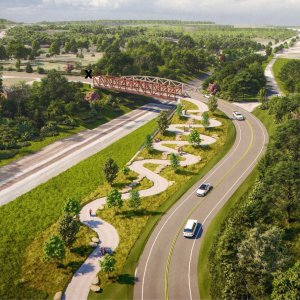
In the first photo: the Freedom Trail ends near the "X" to the left of the proposed bridge. In the past cyclists would have to travel on Middlebury Road to connect with the Portage Hike & Bike Trail, which begins outside the lower left corner of this rendering. The rendering is much prettier than the current condition of Middlebury Road and does not show the elevation change or the traffic volume.

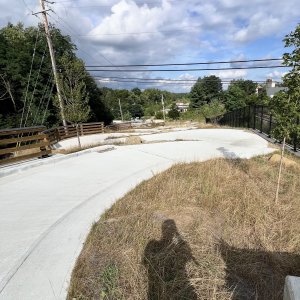
In the second photo: I am standing at the top of the switchbacks near the new bridge and looking downhill as another (unknown) cyclist approaches. The actual switchbacks are so tight that my gravel bike could not easily turn the corners, so I was on the brakes the whole time when going down and in the lowest gear when going up. I suspect that either the Americans with Disabilities Act or another building code dictated the final layout of the switchbacks.

Middlebury-Connection-1.jpgMiddlebury-Connection-2.jpg
 
... I suspect that either the Americans with Disabilities Act or another building code dictated the final layout of the switchbacks.

Thanks, a very, very apt example. Sadly, your reasoning would be accepting the formal excuse for the abomination.

What dictated the final design was that NO ONE cared if it can be used/ridden. Actually, they spent money to ensure it CANNOT be safely ridden. Those boulders are there to prevent actually riding over the mess they created.

There are ways to make such passes rideable. There should have been a separate stepped path for pedestrians and a parallel /steep but rideable/ single "S" path for cyclists, crossing the pedestrian path in the middle on a short flat section. It would not be more expensive. But that would require someone caring. Instead, this was explicitly /and intentionally/ designed with zero care for the cyclists, or pedestrians for that matter. It would not surprise me if the architect or investor went for it out of spite, would not be the first time.
 
I would imagine that BMX bike riding kids would like that abomination. It looks too steep for skateboarding. It might be worth driving up there to ride the thing, for no other reason than to make fun of it.
I just looked it up on Google maps. This appears to be a trailhead? Near the intersection of 261, correct?
That is about 2 hours from my house. I see a spring trip north in my future.

@RustE Do you happen to know how far it is to the trailhead, on the other end? The website doesn't say. It mentions a total of 70 miles of connected trails, but not the railtrail section. It also seems to have "hours", like it is not freely open, at all times?
Around here the greenway trails are 24/7/365

It appears you found the right one. It's called Souder Ave connector, but it seriously doesn't do anything that didn't already exist.....50 feet away. I could find way better uses for 3.7 million dollars.
 
Last edited:
[snip]
It appears you found the right one. It's called Souder Ave connector, but it seriously doesn't do anything that didn't already exist.....50 feet away. I could find way better uses for 3.7 million dollars.
Was not too hard to figure out. Any project of that size would have some sort of publicity.

You are correct about the intersection of Middlebury Road and Rt. 261 having two trailheads in this area. The larger parking lot was built for the Freedom Trail and there is a smaller gravel parking area near the start of the Portage Hike & Bike Trail.

To the east: I have not spent a lot of time on the Portage Hike & Bike Trail. It is not all connected in a loop and I am not certain how the total miles would be counted. Last time I was on it, I got to John Brown Tannery Park and the signs about where to go next confused me, so I turned around.

To the west: Current length of the Freedom Trail is around 8 miles. Eventually it is supposed to go through downtown Akron and connect with the Ohio & Erie Canal Towpath Trail; which is somewhere in the range of 90-100 miles. There are sections of the Freedom Trail under construction until late summer 2026 that will provide access near The University of Akron campus, and from there you could ride 0.5 mile or so through downtown Akron to Canal Park where the Ohio & Erie Canal Towpath Trail passes.

There are no physical barriers to keep people off the trail systems mentioned above. My guess is the 'open hours' are the same as used for the parks and a means to enforcing a civilized society.

Some other interesting tidbits:
- Roughly 1/2-hour drive from the Hartville Hardware retail store.
- Also close to the Summit Metro Parks Bike & Hike Trail (~30 miles) that connects with the Cleveland Metroparks Bike & Hike Trail (~100 miles); here again there are branches to the trail systems and I am not certain how total miles would be counted.
- There are dedicated mountain bike trails around here too, which have trail monitors and are physically closed-off when the conditions dictate.
 
@RustE I wasn't trying to hide it, I just didn't realize anyone would bother to look. :)
It great that Hartville is so close. I have been there before and would like to go back. I also have a friend, former co-worker, who lives a little closer to the lake. Once the weather gets better, I'll definitely make a trip up there.
The rendering makes it look like you could short-cut the corners, over the rocks, on a mountain bike. Your reality shots say that's a no go.


"Technically" a few sections of our trail system are closed from dusk til dawn, but they are isolated "parks" that are not yet connected. That status goes away once they become a path, rather than destination.(end of the line) The rest of them are wide open all the time. There are places where you have to ride city streets, to connect sections of the trails. Most of those will never change, because of the location and surrounding property.
Some of ours do have physical barriers, though they are all removable or flexible. The solid posts and bollards can be unbolted or unlocked, for emergency vehicle access. It is quite a shock to round a blind corner, only to face a police car. A few can just be driven over, not the best deterrent for scofflaws, but it stops accidental entry. We had a fairly notorious one a few years ago, where a semi-truck driver mistook a very large trail crossing as an interstate entrance ramp. Oddly, he went nearly 1/2 a mile, before hitting a low bridge!

The Ohio to Erie trail goes through this area, essentially right at the mid-point. That, in itself is the biggest problem, for me to ride it. Getting to either end, with my bike, and back to the center after completion, is quite a challenge.

There are a couple of mountain bike trails fairly close. Chestnut Ridge is just across the county line to the east, and somehow, it counts as part of the Columbus Recreation & Parks Department? It's 10 miles outside the I-270 Outerbelt and in the next county. I've been there a few times, but my shoulder is not a fan.
Alum Creek is to the north, as part of a state park. It is a much bigger project, in two separate areas. I have never been to it, since I hear it is way more intense.
I much prefer John Bryan State Park, but it is over 50 miles away. It's more like singletrack trail riding, nothing intense enough to even be rated.
They all close for wet weather, none are smooth enough to groom, for snow riding.
I would much rather ride the greenway trails or fire roads, in the southern part of the state.
There really isn't much gravel riding close, that I know about anyway. The one down south is a lot of climbing.
 
Back
Top