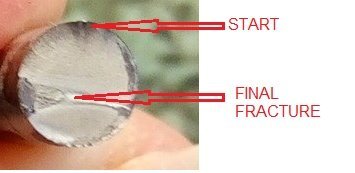
Broken router cutter

bobtskutter

Member
Joined
Jun 5, 2021
Messages
465
Location
UK, England, Humberside.
Why did I break this router cutter?
It's 1/4" diameter 73mm long (3" long").
I was cutting 6mm deep into plywood and moving the router pretty fast, using the OF1400.
The chips were actual chips, not dust, so the cutter wasn't burning. It was vibrating.
When it broke the cutter was hot and there appear to be "burn" marks on the length that was jammed in the collet where the collet clamped on to the bit.
The collet wasn't tight into the router after the bit had broken - this surprised me because it was definitely tight with I put the cutter into the router!!

I think I was being far too aggressive with the cutter (I was rushing) and was cutting too deep and moving too fast. The vibration from the machine should probably have given me a clue.
Am I right in my thought process?? Being too aggressive?
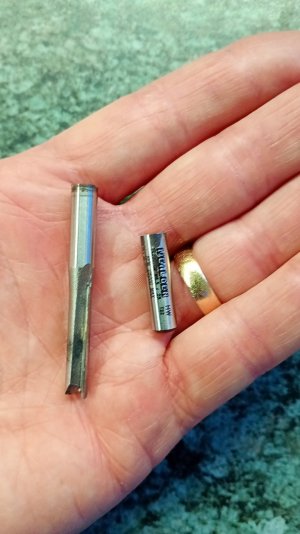
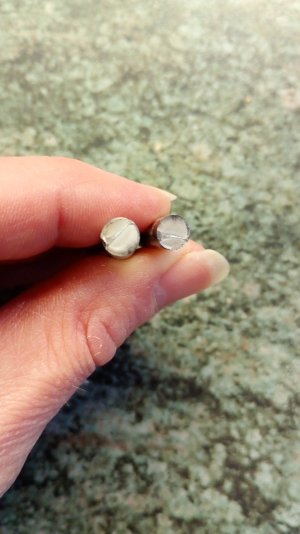
IMG_20260405_164429.jpgIMG_20260405_164441.jpg

Bob
 
I think your supposition is correct...this has happened to me on 2 separate occasions when I was machining aluminum 8020 profiles. When I finished the bit was so loose that it actually fell out of the router and landed on the patio which surprised me because I know I tightened the collet when I started.

In my case, I think moving too aggressively (and possibly also not using the correct router bit speed) in aluminum can start a small harmonic vibration that increases in intensity and that will loosen the collet and or break the router bit...both have happened to me. The router bit that broke was a Whiteside O-flute bit that was designed to machine aluminum.
 
I think your supposition is correct...this has happened to me on 2 separate occasions when I was machining aluminum 8020 profiles. When I finished the bit was so loose that it actually fell out of the router and landed on the patio which surprised me because I know I tightened the collet when I started.

In my case, I think moving too aggressively (and possibly also not using the correct router bit speed) in aluminum can start a small harmonic vibration that increases in intensity and that will loosen the collet and or break the router bit...both have happened to me. The router bit that broke was a Whiteside O-flute bit that was designed to machine aluminum.
It’s happened to me on the drill press while milling aluminum.
 
This is how I lose most cutters on the CNC. They're pushed to the limit until swarf starts binding the cutter, and/or it heats up, and then the deflection just becomes too much and snap!
 
And this is also the reason that when machining steel/metal surfaces using a knee mill, taking heavy cuts can necessitate the use of a solid carbide end mill. The carbide end mill shaft is significantly stiffer than a tool steel shaft and will deflect less allowing for more aggressive feed rates. The down side is the brittleness, In this situation it's best to use a machine that is capable of progressing the milling cutter into the material at a consistent rate...,hand feeding is questionable.
 
@Cheese I've got power feed on the X and Y axis on my knee mill, and it makes all the difference in the world.

Cutters last way longer I've found as you don't get the chattering as bad.
 
@Cheese I've got power feed on the X and Y axis on my knee mill, and it makes all the difference in the world.

Cutters last way longer I've found as you don't get the chattering as bad.
A consistent feed rate is one of the most important factors in achieving long tooling life and is the one thing that is not obtainable when hand feeding tooling. Machine tools and the tool bits they mount will continue to perform extremely well when the speeds & feeds are maintained within certain parameters which can only be achieved through automated feed advancement. The herky-jerky tool advancement of hand-held machines really decimates tooling not only at the destruction level but also at the re-sharpening level. That's the reason why a CNC machine can produce hundreds/thousands of feet of machined material without the need for swapping out tooling
 
Last edited:
One of the toolmakers at work was stretching out jobs so he could get overtime. He did this by taking 0.005” deep cuts on the milling machine, when 0.010” deep was still a conservative cut. The tool room manager called him out on it.

So a few minutes later he (apparently) took a too deep cut and he broke a very expensive carbide bit.

“Now, look what you made me do!”

We eliminated this issue by banning all overtime. If we were getting behind, our engineer would send a print to another machine shop and we would purchase parts until we caught up.

In any case, taking too deep a cut or running too fast will break carbide bits. Luckily carbide bits are not nearly as expensive now, as they were in the early 1980s.
 
Back
Top