DIY cnc

estley

Member
Joined
Jun 2, 2011
Messages
147
I’m starting to plan/design a cnc. It’s more of a “I want to build one” than a “I need one”, so have a rough idea of what I want, what I’m short on is resources and advice. Has anyone here taken on something like this?

The first challenge I’m up against, is the ball screws, I’ve found a bunch or places to buy the, and I have no idea which way to look, McMaster had some, but I’m going to guess there’s some specialized places that will have better options and prices. I’ve been browsing thru jlcmc.com and they have a bunch of stuff, and I’ve even downloaded some models to drop into my fusion36p model, wether or not I’ve chosen the correct stuff is an entirely different idea.

Anyways, any help will be appreciated as usual, thanks!
 
Oh boy, building a CNC is probably the very worst rabbit hole you could go down.

I'd keep it as simple as possible, define if you want a moving gantry or a moving table. A moving table is far easier to achieve than a moving gantry design as there's a lot less engineering involved, and it's easier to work with clearances.

What do you want to do with it, this will drive the size steppers and rails/ballscrews you'll need.

I'm going to assume you're looking at timber/plastic routing, so 12mm-20mm round ideally supported, or unsupported rails if physical size isn't too big, and 16mm ballscrews. These items are so much cheaper now so it;'s not a huge outlay.

Generally speaking if it's a work area under 300mm x 300mm NEMA 17 steppers will do fine, over that NEMA 23, with 2.3mH-3.2mH inductance being the optimal depending on the drivers PSU requirements.

Then look at drivers, if you can spring for a Gecko G540 this will give you the most reliable bang for buck, and by far the simplest wiring up.

This is just for starters, some more details of what you'd like to achieve will be helpful to add further info.
 
Last edited:
I’m starting to plan/design a cnc. It’s more of a “I want to build one” than a “I need one”, so have a rough idea of what I want, what I’m short on is resources and advice. Has anyone here taken on something like this?

The first challenge I’m up against, is the ball screws, I’ve found a bunch or places to buy the, and I have no idea which way to look, McMaster had some, but I’m going to guess there’s some specialized places that will have better options and prices. I’ve been browsing thru jlcmc.com and they have a bunch of stuff, and I’ve even downloaded some models to drop into my fusion36p model, wether or not I’ve chosen the correct stuff is an entirely different idea.

Anyways, any help will be appreciated as usual, thanks!
I predict you will learn a lot. And one of the things you will learn is that it would have been cheaper to buy one.
How about buying a used one? That seems like something of a compromise.
You could do upgrades to get some of the hands-on learning.
BTW - you can thank me and the other naysayers anytime.
 
As of right now, the idea is moving gantry, 48*24-ish cutting capacity, I’m looking at the masso controller, and I’m also considering servos instead of steppers, now, none of those things have any hard logic, and there is no deadline for this. This whole endeavor is to keep myself entertained during slow business periods. Here’s the twist, cutting aluminum would almost instantly turn this thing from passion project to actual business case. Also, there’s a very fine line between a cnc and motion control systems for cinematography (I’m in the video business), so from that perspective the building vs buying makes a teeny tiny bit of sense to me…. For all I know a couple of months from now I’ll be wishing I never even had the thought to begin with,….
 
Ok a cutting area of 48" x 24" AND wanting to cut aluminium automatically increases the degree of difficulty in making the whole system rigid enough. Even my 300-350kg cast iron machine cutting aluminium screams like a banshee, a lesser mass machine will be far worse even if you can make it rigid enough.

Some of the smaller and/or light duty machines use belts and gears, but using servos and that sized cutting area pretty much means linear toothed rails and gears. You'll also need to be tight on the tolerances as you'll likely need to slave the 2 Y axis motors together to drive the gantry.

As Duckler said, a decent kit or machine would be the better option, prices have come down considerably over time, so this would get you up and running immediately.

But to build your own, can you weld? You'll need to do a fair bit of fabrication, and the parts cost alone will be quite surprising. It's all very doable, but it's a staggering amount of effort and time.

I'd check out cnczone firstly as you'll find numerous threads along this line, and how they were tackled.

I'm not trying to put you off, but it's a helluva project for anyone to tackle.
 
Point taken on all of the above, I started a rough design yesterday, and for the aluminum extrusions for the frame and gantry, I'm up to around $1K, so, a conservative estimate for a full machine sounds like $5-6K by the time I'm done.

Shopping around for used and new machines, I find that all the 2*4-ish have the gantry on the long side, I'm assuming that's to be able to slide in a 4*8 sheet in sections. Is there any commercial machine that has the short side be the gantry?

Also a quick search on FB marketplace came up with a 4*8 shopbot in my area for $6K, i think it said no computer and it was not assembled. and a ton of smaller, sub-$600 machines that didnt look to confidence inspiring. I also looked at the Onefinity, Shapeoko, and the AltMill, all look interesting.

I guess if i were to look at my other "tool journeys", table saw for example, I started with a $150 benchtop craftsman, then moved up to a used contractors craftsman, and now I have a cabinet sawstop. So I get starting small and moving up as you go, that said, it would be interesting for once to cut the line and go straight to the sawstop, and I get that it's not a straight line of clear choices getting there. I already have a shaper origin, which is a great machine, so , I'm guessing it all boils down to "what do you want to do with it?", and the answer is "I dont really know as of right now"
 
I'm guessing it all boils down to "what do you want to do with it?", and the answer is "I dont really know as of right now"
I would not attempt to design and build a machine when I didn't know the purpose I'd put it to. You have no way to evaluate design compromises. My recommendation is to buy a used CNC from someone who's upgrading and see what you use it for.

Since you already own a Shaper Origin, what are you doing that the SO doesn't do? Small work? Metals? 3D parts? The SO, particularly with Bench Pilot, can do a lot of what a CNC does, at least with regards to woodworking, so I'd think about what I couldn't do today that a CNC could to help me decide.
 
I'm far from an "expert" but I do own the small Carbide 3D Nomad 3, which can mill fist sized hunks of non-ferrous metal.

I've read lots of observations like from luvmytools saying ordinary construction cnc systems aren't stiff enough for metalwork, except for thin sheets. I also have the Shaper origin which too is limited to thin non-ferrous stock and agree with smorgasbord that Bench Pilot is going to greatly reduce the size limitations I've occasionally felt thus far.

I used to work in special effects and watching what seemed to be the relative ease of programming motion control systems on site inspired me to consider making some kind of cnc system, but I got over it. I did make a simple 2 axis camera mover but nothing like you're considering.

If I really wanted something larger now I'd simply buy something from Carbide 3D. I don't have the patience to trouble shoot something I don't fully understand.
 
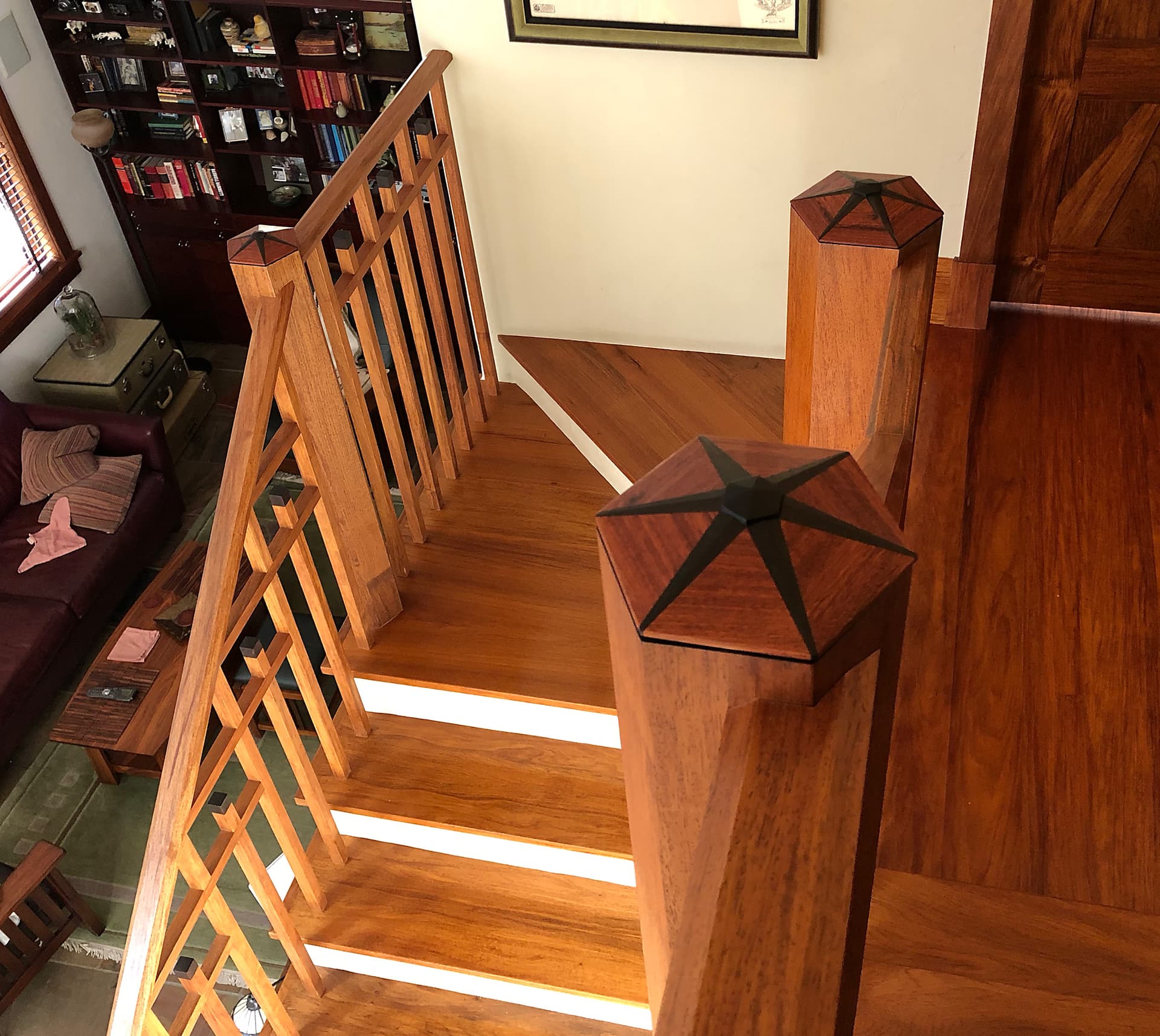
Note that, unless I'm wrong, even with Bench Pilot, you're not getting true Z-axis manipulation while cutting with the Shaper Origin. That doesn't matter for a lot of things, like engraving, inlays, cutting out sheet goods, even most joints. My first CNC project was a staircase newell topper, which my design was a hexagon (which are the best-agons), that was pyramidal, and built of two contrasting woods. I do not think that is still today possible on a Shaper Origin.

img_4040-jpg.365332


572333f27d59a1a746c24fc831dc6f70a65afb08.jpeg
 
Point taken on all of the above, I started a rough design yesterday, and for the aluminum extrusions for the frame and gantry, I'm up to around $1K, so, a conservative estimate for a full machine sounds like $5-6K by the time I'm done.

Shopping around for used and new machines, I find that all the 2*4-ish have the gantry on the long side, I'm assuming that's to be able to slide in a 4*8 sheet in sections. Is there any commercial machine that has the short side be the gantry?

Also a quick search on FB marketplace came up with a 4*8 shopbot in my area for $6K, i think it said no computer and it was not assembled. and a ton of smaller, sub-$600 machines that didnt look to confidence inspiring. I also looked at the Onefinity, Shapeoko, and the AltMill, all look interesting.

I guess if i were to look at my other "tool journeys", table saw for example, I started with a $150 benchtop craftsman, then moved up to a used contractors craftsman, and now I have a cabinet sawstop. So I get starting small and moving up as you go, that said, it would be interesting for once to cut the line and go straight to the sawstop, and I get that it's not a straight line of clear choices getting there. I already have a shaper origin, which is a great machine, so , I'm guessing it all boils down to "what do you want to do with it?", and the answer is "I dont really know as of right now"
If you want to do occasional aluminum, you can do it with a CNC router. Aluminum sheet or ACM is no problem with the correct cutter, configuration and misting/cooling.

If you want to do larger aluminum blocks or plate regularly, consider a CNC Mill.

For CNC control, I recommend Centroid Acorn.

For steppers/servos, check out ClearPath SDSK series. These would work on ball/screws or Rack & Pinion. For 4' I would recommend R&P.

Invest in a decent VFD spindle, I recommend automatic tool changing (ATC) capability with ISO30 tool holders. Check out CNC Depot for options.

If you're not quite sure what to do with it yet, I recommend getting a used system and upgrade it to new controllers. Then move up to a more specific machine once you find your niche use.

Avid CNC can adjust their stock designs to your specific dimensions.
 
So I get starting small and moving up as you go, that said, it would be interesting for once to cut the line and go straight to the sawstop, and I get that it's not a straight line of clear choices getting there. I already have a shaper origin, which is a great machine, so , I'm guessing it all boils down to "what do you want to do with it?", and the answer is "I dont really know as of right now"
A few of my observations of the last couple decades in the CNC area are:

1 - You will find uses for a CNC and come to use it in ways you never would have thought you would, they literally open up a whole new avenue of woodworking/metalworking and enhance any project greatly.
2 - I don't believe any other tool or machine field has such a high disappointment range because people thought they'd start off small, and then immediately find they underbought, leading to expensive upgrades.
3- Whatever machine you buy/build, buy/build it for the needs you expect, don't instead expect to alter an existing one to suit your needs, as it will still be sitting there 10 years later in its original condition.

Number 2 is partially why I have 6 CNC machines but only really use one. CNC's are probably the best ROI you'll ever get, so it's worth really planning ahead and buy/build appropriately. My 6090 is around 15 or so years old and just on the weekend when I was machining pockets in a charcuterie board, I was having a coffee and marvelling at just how reliable and a constant worker it's been.
 
Last edited:
A few of my observations of the last couple decades in the CNC area are:

1 - You will find uses for a CNC and come to use it in ways you never would have thought you would, they literally open up a whole new avenue of woodworking/metalworking and enhance any project greatly.
2 - I don't believe any other tool or machine field has such a high disappointment range because people thought they'd start off small, and then immediately find they underbought, leading to expensive upgrades.
3- Whatever machine you buy/build, buy/build it for the needs you expect, don't instead expect to alter an existing one to suit your needs, as it will still be sitting there 10 years later in its original condition.

Number 2 is partially why I have 6 CNC machines but only really use one. CNC's are probably the best ROI you'll ever get, so it's worth really planning ahead and buy/build appropriately. My 6090 is around 15 or so years old and just on the weekend when I was machining pockets in a charcuterie board, I was having a coffee and marvelling at just how reliable and a constant worker it's been.
I've experienced #1 many times... with my Domino machines, my first 3D printer (which i outgrew quickly), home automation stuff and so on. #2 is the primary reason I want to stay away from the OneFinity/Shapeoko/Altmill, while they look like great machines, I get the feeling that you outgrow them pretty fast. I think i'm going to shelve the idea until i can come up with a solid use case other than "I want to get into it", thanks for all the feedback!
 
Shelving it for now while pondering the needs is a good idea. I've lost a lot of money in CNC ventures over the years by failing to fully plan ahead.
 
Back
Top