Domino Face Mortising Jig - Any Interest?

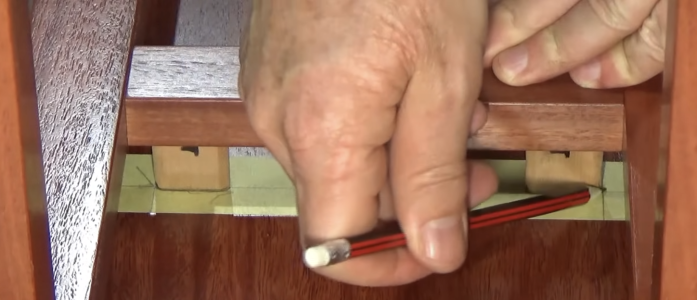
Here's a new video from Darren Oats, cued up to where my transparent Face Mortising Jig would have been helpful. He's built a larger one out of MDF that's good for only one size domino:


(starts @30:09 in, jig shows up 50 seconds later)

One.png

Two.png

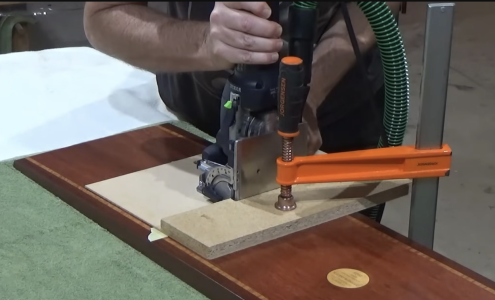
And his jig in use:
Screenshot 2025-11-30 at 1.40.17 PM.png

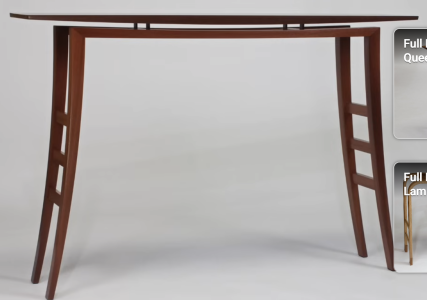
Table itself is very nice:
Screenshot 2025-11-30 at 1.38.26 PM.png

With my transparent jig, it'd be much faster and easier to align, and would work for multiple sizes of dominos. I note that he skips how he aligns his MDF jig up - I suspect it's a bit tedious and potentially nerve-wracking.
 
Last edited:
Once the interesecting lines are extended based on mortise marks on the tape or workpiece, we can align and position the machine in place to mill mortises in the vertical manner? Why would there be a need for a jig? Am I missing something?
 
This thing will add some guide lines to the existing mortise but they aren’t long enough help you get the machine in the right place like smorgasbord’s jig does.
Once the interesecting lines are marked for the mortises required, we can align and position the machine in place to mill each mortise in the veritcal posiiton. Why would there be a need for a jig? Am I missing somethin
I believe the FastCap domino version of the old-fashioned "dowel centers" will properly locate the center of the matching domino mortise. But, that's not enough on its own since the face/fence of the Domino is so big and opaque that they're hidden. Extending them is not something that can be done accurately just from those marks, and I believe that's necessary for all face mortising. And for the Murphy bed that led me to create the jig, those panels are so big that lining them up so that I can push/tap against the centers to leave marks would be very ungainly or require lots of guide boards clamped in place.

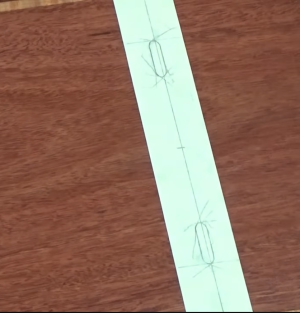
In Oats' case, he drew the "long" centerline of the two domino slots first (on masking tape), two lines in total. He used those lines to align the legs by centering some dominos sticking out on those lines and tracing them. He then has a simple opaque jig with a cut-out for the domino and a board to align the Domino base. He doesn't show it, but I suspect the same measurement/tools that he used to draw the two long centerlines was also used to align the jig's Z-axis rotation. When he sees the trace outline through the pre-cut cut-out, he can square the base of the jig and clamp it in place. Note that he doesn't show it, but he's apparently using shop-made custom dominos, in Jarrah, that are extra long to provide the spacing of the top from the leg assembly. They're visible structural elements.

My jig works similarly to Oats', but by being transparent alignment/location is easier. I haven't tried it, but tracing around a domino sticking out the other side of the joint may not always be practical, and is certainly slow. His leg assembly is light and easily carried, rested, etc.

If you have the extended centerlines (XY) of the domino, then my jig is easily aligned with those centerlines and it'll hold the domino in the right place.

I will note that since the underside of Oats' table is curved, those short vertical support dominos meet it at an angle (unspecified), and he sets his Domino fence to that angle. That's actually a bit tricky since the "face" where the domino cutter comes out does not tilt, so the angle the domino is cut at isn't the angle on the Domino's protractor. I can draw a picture, but if you have a Domino, set it's fence to 5º and put it fence down on the bench and look under it - you'll see a gap at the hinge.
 
I believe the FastCap domino version of the old-fashioned "dowel centers" will properly locate the center of the matching domino mortise. But, that's not enough on its own since the face/fence of the Domino is so big and opaque that they're hidden. Extending them is not something that can be done accurately just from those marks, and I believe that's necessary for all face mortising. And for the Murphy bed that led me to create the jig, those panels are so big that lining them up so that I can push/tap against the centers to leave marks would be very ungainly or require lots of guide boards clamped in place.

In Oats' case, he drew the "long" centerline of the two domino slots first (on masking tape), two lines in total. He used those lines to align the legs by centering some dominos sticking out on those lines and tracing them. He then has a simple opaque jig with a cut-out for the domino and a board to align the Domino base. He doesn't show it, but I suspect the same measurement/tools that he used to draw the two long centerlines was also used to align the jig's Z-axis rotation. When he sees the trace outline through the pre-cut cut-out, he can square the base of the jig and clamp it in place. Note that he doesn't show it, but he's apparently using shop-made custom dominos, in Jarrah, that are extra long to provide the spacing of the top from the leg assembly. They're visible structural elements.

My jig works similarly to Oats', but by being transparent alignment/location is easier. I haven't tried it, but tracing around a domino sticking out the other side of the joint may not always be practical, and is certainly slow. His leg assembly is light and easily carried, rested, etc.

If you have the extended centerlines (XY) of the domino, then my jig is easily aligned with those centerlines and it'll hold the domino in the right place.

I will note that since the underside of Oats' table is curved, those short vertical support dominos meet it at an angle (unspecified), and he sets his Domino fence to that angle. That's actually a bit tricky since the "face" where the domino cutter comes out does not tilt, so the angle the domino is cut at isn't the angle on the Domino's protractor. I can draw a picture, but if you have a Domino, set it's fence to 5º and put it fence down on the bench and look under it - you'll see a gap at the hinge.
"Extending them is not something that can be done accurately just from those marks"

I haven't had a chance to use the markers yet but I have done extending lines in several projects and do not anticipate problems in doing so with those marks and a ruler accurately. A bit of care is needed, of course.

If I remember correctly, the Fastcap product video shows the mortise marker inventor drawing/extending lines from the marks.

My comment is about laying out the lines, not how those mortises can be milled afterwards. I haven't watched the vid and have no idea how he went about it. The mortise markers offer an alternative to his marking with the dominoes inserted in the mortises.

P.S. I didn't see any vid on the product page. Here's one of the few found on YouTube:


Okay. I did find the product vid via a YouTube search:

 
Last edited:
The mortise markers offer an alternative to his marking with the dominoes inserted in the mortises.
Sure, there are lots of ways to skin this cat. Another option is to use marks on the actual pieces, transferring them from the sides of the support pieces to the underside of the table, with no dominos inserted. Remember, he's already got the "long" centerline marked on the top's underside, so he just needs the "short" centerline location.

I haven't had a chance to use the markers yet but I have done extending lines in several projects and do not anticipate problems in doing so with those marks and a ruler accurately. A bit of care is needed, of course.

If I remember correctly, the Fastcap product video shows the mortise marker inventor drawing/extending lines from the marks.

In the first video, the guy does extend the line manually, but then he doesn't actually use the "long" centerline extension, instead he measures down 2" from the actual mark, and then he uses a square to make the line he actually references for his hot-glued guide block. I note that for his real project, he transferred the extended long centerline to the sides of the newell post because the stock is narrower than the Domino and so he couldn't see for alignment - I guess he didn't quite trust his 2" offset guide block. (Note: It's actually 51mm (15 from the plate on the DF700 and 36mm of the foot itself). As for the short centerline, he's using a connector without a real domino, so there's some wiggle room there, but that placement isn't critical for his application.

And, a real-world application note: the staircase guy ended up with two marks slightly offset from each other - one from clamping and one from the mallet. For my Murphy bed, there's no way I could align a 5' long by 2' wide headboard vertically on the face of the 7' long side panel without the markers denting where they shouldn't - maybe even on an area visible in the final project. I'd still today use the marks I made on the headboard to mill those domino mortises, and transfer them to the side panel manually (a small square block worked well). And then, for me, the transparent face jig made it easy to not only ensure alignment, but to have something clamped down so the Domino didn't move as I plunged into the face.
 
It's pretty obvious the precision requirement and tolerance vary among projects. I'm pleased to find that this stair builder found that the mortise markers did the job for him. I'm surely confident that when I need to use the markers gifted to me, they'll too deliver the accuracy I demand. Question is, what near-future project can I use them?
 
Back
Top