Equally Space Dados with Router on Rail

TomInNC

Member
Joined
Sep 29, 2022
Messages
10
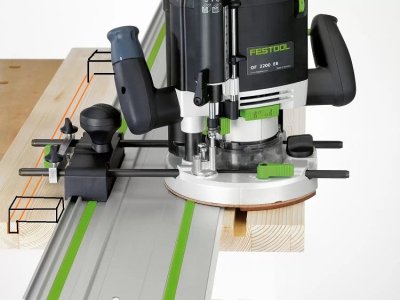
I just bought an MFT and the router-on-rails kit for the 2200. I am going to be making some cabinets that have cubbies, and I need to make several equally spaced dados to house the shelves. Are there any hacks for repeatable dado spacing with the router on rails? Specifically, I was trying to figure out how to replicate the functionality of the Rockler dado indexing jig linked below.

 
No experience, but a reasoned guess:

1. Clamp a straight edge to the work surface and press your track firmly against the straight edge.

2. Cut your first dado.

3. Add a spacer between the straight edge and the track.

4. Cut your second dado.


You can either prepare spacers in various widths to measure off your dadoes, or you can stack same-sized spacers to achieve the same result.

This sounds a bit tedious to me, but should work.

Alternatively, you could drill holes with incremental spacing and add dowels to do the same.

The accuracy of the above is dependent on the accuracy of the spacers or the incremental spacing of the drilled holes.
 
Depends on the spacing between the dadoes, but if it is greater than the width of the guide rail, I would make an "L" shaped spacer that fit in the dado and extended the proper distance to position my guide rail for the next cut.
 
The exact spacing is TBD. The shelves will be used for storing shoes, so probably some in the 9 inch range for standard shoes and others in the 12-18 inch range for boots. Good idea with the spacer. It should be straightforward to mill a runner out of scrap that will match the dado width. I can then attach the spacers and a brace to the runner at a right angle to serve as a square for the track. Thanks!
 
Measure and draw a line and clamp the track.

To assure that the left side vertical matches with the right side, cut the dadoes on double wide stock and rip to width. Since you will be cutting them at the same time on the same board, you are assured that the shelves will be level.

I think this is a case of over-thinking. Measure, mark, cut and assemble.

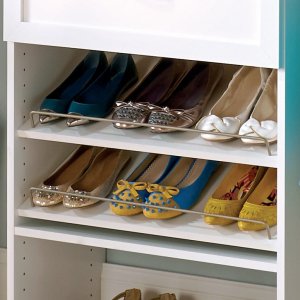
I would note though, that my shoe shelves are on an angle, lower in front than in the rear. A 3/4” x 3/4” strip runs horrizontally to catch the heels and prevent the shoes from falling out.

This example also angles the shelves, but uses a wire form to keep the shoes from migrating off the shelf. A piece of clear acrylic would also work.

The example below uses 8mm shelf holes on 32mm centers to accomplish this, and would be a versatile solution and easy to execute. You can also use those holes to make pullouts for the shoes. Also handy.

1768251255417.jpg

I thought, from the original post that you were making fluting.
 
Were you aware, that according to the link you posted, that isn't listed as compatible of the shelf with your Festool Router?


If your eyesight is good and depending on how many you have, the routers have a centerline on their bases. You possibly could lay out the centerlines on you workpieces and go that route.

Peter
 
@TomInNC It seems to me that you are complicating things, if you really intend to use that Rockler router plate.
First, it limits your spacing to just over 6 1/2 inches. That seems to be a problem already.
Second, it runs in the previously cut dado, so the only thing you need to obsess over is the placement of that first one.
Third, as Peter stated above. Be sure it fits the router you have.

Personally, I would work out the spacing exactly, before you do anything. Make a story-stick of those figures.
If at all possible, align your cabinet sides (in pairs) and cut them both together. If you do this with the front edge meeting, it greatly reduces the chance of tear out, moving it to the back. Of course, this assumes through-dados, since it wasn't mentioned otherwise. If they are stopped-dados, reverse the orientation, setting stops at the outer limits.
The MFT along with some dogs, can be useful to assure this alignment. Again, assuming no tilt to the shelves. That would change everything.
 
You could make a couple of spacer blocks that fit into the previous dado slot and then push the rail against the stops, as shown below.

But really, I wouldn't bother. I would work to pencil parks. If one shelf is .030" spacing more than the one above it, does it matter ?
What is important is that the right hand and left hand side plates of the shelf have the dados in the same position. So clamp the right hand and left hand side plates side by side, and rout them as a set.

Router Spacer Blocks.jpg
 
Last edited:
If Tom is going to go into production of shoe racks, then by all means, make a jig.

But if he is doing a one-off, then simply drawing the lines where the track should be clamped and aligning the track to those lines, would be the most efficient. I cannot imagine that there will be more than 6 to 9 dadoes.

And repeating my earlier remark, if the uprights are going to be from sheet goods, then I would start with a double-wide sheet and cut the dadoes first, and then rip the sheet down the middle to make two identical sides.

With the same caveat that CRG made in post #8:

Again, assuming no tilt to the shelves. That would change everything.
 
Were you aware, that according to the link you posted, that isn't listed as compatible of the shelf with your Festool Router?


If your eyesight is good and depending on how many you have, the routers have a centerline on their bases. You possibly could lay out the centerlines on you workpieces and go that route.

Peter
I should have been more clear in the original post. I am not looking to use the Rockler jig but rather replicate the index functionality using the Festool router-on-rails setup.
 
I was definitely planning on cutting the dados across the full sheets and then ripping them. Thanks for all of the suggestions. I am definitely going to use the spacer block jig idea. I don't have a total count of all the dados yet, but this is a part of a full walk-in closet buildout that will have a lot of shelves, so certainly worth the 15 minutes to build the jig.
 
I was definitely planning on cutting the dados across the full sheets and then ripping them. Thanks for all of the suggestions. I am definitely going to use the spacer block jig idea. I don't have a total count of all the dados yet, but this is a part of a full walk-in closet buildout that will have a lot of shelves, so certainly worth the 15 minutes to build the jig.
Or consider using a shelf pin hole jig and shelf pins. The jigs are accurate and quick to use, and the shelf pins allow easy adjustments if 9” turns out to be too big or too small. Or buy pre-drilled boards.
 
Back
Top