smorgasbord
Member
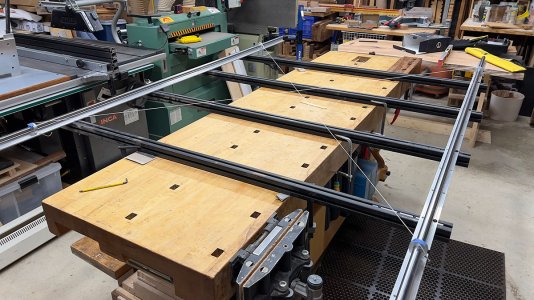
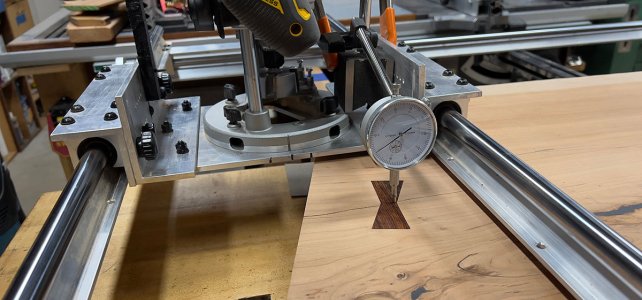
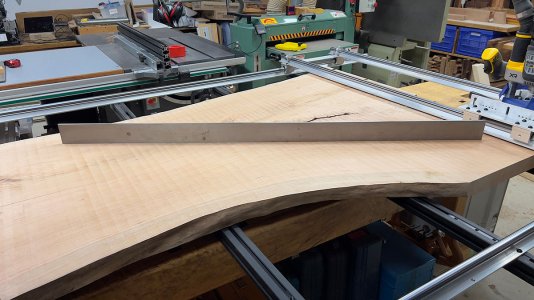
Finally finished my router sled and made a few passes:
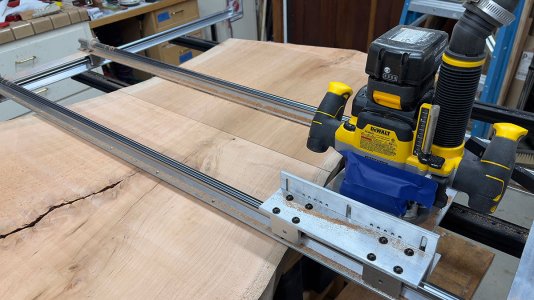
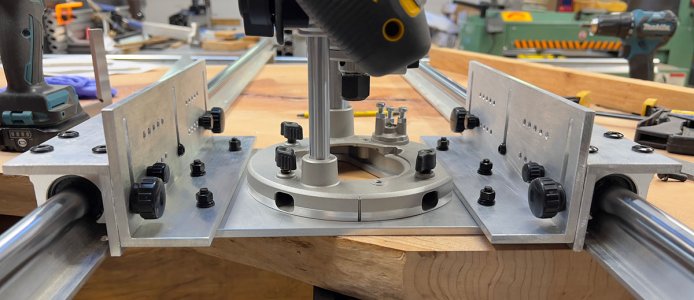
What's going on with the "L" extrusions is that due to use of the DeWalt router with the through the plunge rod dust collection, I didn't want the router base to be too far above the surface, so I devised a staged height adjustment mechanism that can be done in situ.
Here's the two halves apart:
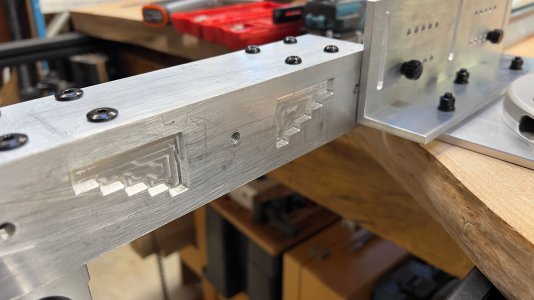
The piece at the left is attached to the cross-rail guides, the other piece is attached to the router base. The small knobs in the base angle index into the recess, and depending on which hole you choose, the height of the router base is set, then the larger knobs lock it in place. This is the piece attached to the router base.
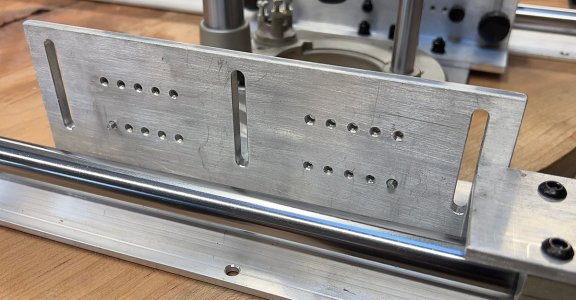
There's 45mm of height adjustment, in 5mm increments. I designed these parts in Fusion 360 and milled them on my Shapeoko CNC, including the router base itself, which is ¼" thick aluminum. Was satisfying to figure out the router attachment hole spacing and the oblong egg-shaped opening to facilitate dust collection.
$375 all in, excluding the router. But, more than a few days of time on this instead of my desk project.
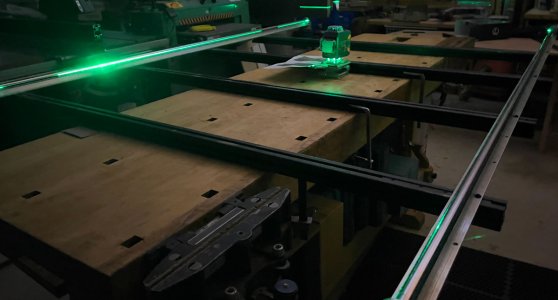
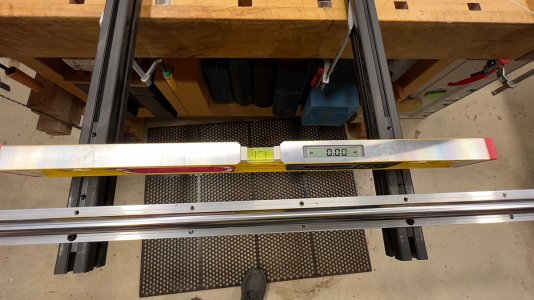
Surface is pretty flat - within ½ a millimeter across the surface, although clearly I need to do some tramming to align the router axis. I may do that for the final passes.
Dust collection works OK. I think all these sleds struggle at the edges, but keeping the router base close to the surface definitely helps in the middle parts with the DeWalt's dust extraction design. My router bit is too large for the top plastic cover, so I stuck some blue tape on to help keep the dust in and that works OK.
My goal here isn't to flatten the cherry slab, it's to thin it, hopefully without very much warping going on. I'm concerned since the other side is the good side and I don't want to take much of anything off of it, so I'll be unbalanced with my stock removal, but I don't have much choice at this point. I guess I could put in some C-Channel at some point, but I wonder how much that really helps - seems like a slab that wants to warp will easily pull out those threaded inserts. The slab is kiln dried and I've had it for months with no noticeable changes, and a second slab (the next one in the sequence) I ended up cutting apart to make the base and didn't see any warpage.
What's going on with the "L" extrusions is that due to use of the DeWalt router with the through the plunge rod dust collection, I didn't want the router base to be too far above the surface, so I devised a staged height adjustment mechanism that can be done in situ.
Here's the two halves apart:
The piece at the left is attached to the cross-rail guides, the other piece is attached to the router base. The small knobs in the base angle index into the recess, and depending on which hole you choose, the height of the router base is set, then the larger knobs lock it in place. This is the piece attached to the router base.
There's 45mm of height adjustment, in 5mm increments. I designed these parts in Fusion 360 and milled them on my Shapeoko CNC, including the router base itself, which is ¼" thick aluminum. Was satisfying to figure out the router attachment hole spacing and the oblong egg-shaped opening to facilitate dust collection.
$375 all in, excluding the router. But, more than a few days of time on this instead of my desk project.
Surface is pretty flat - within ½ a millimeter across the surface, although clearly I need to do some tramming to align the router axis. I may do that for the final passes.
Dust collection works OK. I think all these sleds struggle at the edges, but keeping the router base close to the surface definitely helps in the middle parts with the DeWalt's dust extraction design. My router bit is too large for the top plastic cover, so I stuck some blue tape on to help keep the dust in and that works OK.
My goal here isn't to flatten the cherry slab, it's to thin it, hopefully without very much warping going on. I'm concerned since the other side is the good side and I don't want to take much of anything off of it, so I'll be unbalanced with my stock removal, but I don't have much choice at this point. I guess I could put in some C-Channel at some point, but I wonder how much that really helps - seems like a slab that wants to warp will easily pull out those threaded inserts. The slab is kiln dried and I've had it for months with no noticeable changes, and a second slab (the next one in the sequence) I ended up cutting apart to make the base and didn't see any warpage.
Last edited: