Glue-up sequence opinions sought

ChuckS

Member
Joined
Sep 7, 2015
Messages
5,895
If you had to glue 4 thinner and narrow boards into one thicker and wider board (length unchanged at, say, 36"), would you (A) glue them to thickness first then to width, or (B), glue them to final width then to thickness? And why?

Thanks in advance for sharing your wdisom.

(I have about two dozen such glue-ups to do shortly and have used one of the methods described above in the past. I was wondering if you might do it differently for some reason.)
 
Last edited:
Thickness, saw/joint the edges, width.

Reasoning:
- easier /more reliable/ to clamp a narrow board when gluing up
- easy to ensure the secondary glueup surface is smooth by jointing it, much harder/risky/material-wasteful to do with a wider but thinner board
- for the initial glueup, when twice the pieces are involved, you can glue multiples, 2-3 sets, at the same time by gang-clamping, this is infeasible with side-gluing

ADD:
I would consider putting in some some tenons/dominoes for the final glueup too, both for alignment and strength.

There is also one scenario where you do it the other way - when you are staggering the boards, making sure there are overlaps. But then I think you really want a jig to do the glueup in a single step...
 
I basically agree with mino, but would ask a questions first.
Will the ends of the final product ever be seen?
Width to thickness ratio?
Do they "meet" equally like a + ? Do they have to?

Depending on the answers, the Dominos may not be necessary.
 
Yes, one end can be seen on its top, though the finished product is usually viewed in its horizontal plane.

The glue-up ratio is about 1 to 1 with a small part of it at 2 to 1.

They're over-sized blanks and will be cut on the bandsaw to a curved pattern and router trimmed.

Since they are basically edge joined, I am not using tenons, which will complicate things as I need to position them away from the pattern lines.
 
Thank you all for your responses and explanations.

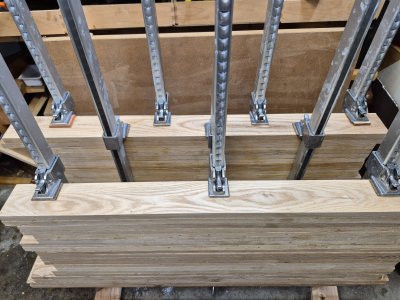
With such consensus on Method A (which happens to be my usual clamping approach), I went ahead with it and did the glue-ups (first photo).

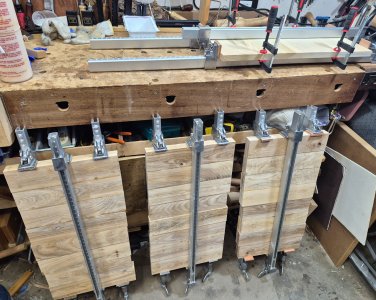
Previously, as shown in the second photo, I did try the Method B on some shorter pieces that also needed to be glued up (the ones on the bench top were to be glued with Method B; those on the floor were done with Method A). I was wondering if other woodworkers would prefer Method B and so I asked.
 

Attachments

  • 20260109_155510.jpg
    20260109_155510.jpg
    2.2 MB · Views: 20
  • 20260104_152247.jpg
    20260104_152247.jpg
    2.2 MB · Views: 19
Thank you all for your responses and explanations.

With such consensus on Method A (which happens to be my usual clamping approach), I went ahead with it and did the glue-ups (first photo).

Previously, as shown in the second photo, I did try the Method B on some shorter pieces that also needed to be glued up (the ones on the bench top were to be glued with Method B; those on the floor were done with Method A). I was wondering if other woodworkers would prefer Method B and so I asked.
Ah, you are using low-overhang edge clamps which cannot reach the middle of the boards. Now makes sense why you considered seriously the "option B".

Not sure what other clamps you got around, or how many, but the issue I see is the uneven clamping you got there with only one side of the boards clamped. Most my clamps are a variation of C-clamps, not having this limitation .. and instead allowing far less a force to be applied.

But it is easy to say, one needs to work with /the clamps/ one has..
 
@mino - I have half a dozen of 12" deep-throat clamps, bought from a welder, as well as two 8" deep-throat clamps, but the two wider boards shown in method B were pretty flat across and flush in the middle, and that was why I did not use any clamps in the middle. The rest on which I used method A were narrower boards.

"I see is the uneven clamping you got there with only one side of the boards clamped."

That glue-up started with even clamping, but after an hour, I removed some clamps from there to continue working on the rest. I actually have lots and lots of clamps, including the longer Dubuque ones, but my bench works best with the shorter ones.

On the whole, I wasn't too such concerned about flatness because the glue-ups are blanks to be shaped to long narrow curved pieces (as legs) and then sanded.

Once again, I appreciate all the exchanges.
 
Last edited:
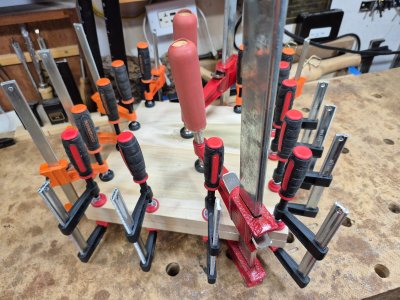
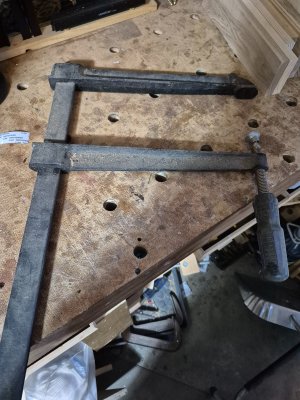
I did use two 8" deep throat clamps to apply pressure to the centre when clamping two boards to thickness (under Method B). The other pic shows one of the 12" deep throat clamps
 

Attachments

  • 20260105_152653.jpg
    20260105_152653.jpg
    1.9 MB · Views: 9
  • 20260102_151758.jpg
    20260102_151758.jpg
    2.4 MB · Views: 10
I have some sets of clamping cauls of two different lengths (packing tape in the middle), but have seldom used them now since I bought the DF500, which, if used, aligns the surfaces and edges well.
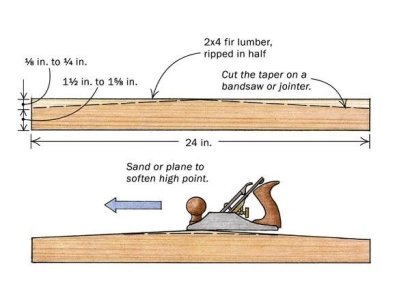
Cauls will help when the tension in the freshly cut lumber is let out and sometimes causes the wood to warp during glue-up and before the wood moisture reaches equilibrium. Dominos alone won't do that.
 
@Sparktrician

Yes, dominoes do alignments only and can't ensure the panel itself will be flat across.

A straight edge must be used to check if an edge glue-up is flat after clamping. If not, one way to fix it is to adjust the clamping pressure. (I can't find the video that illustrates such a simple technique. I thought it was Jonathan of KM Tools who did the clip*, but his YT library doesn't seem to have it. Maybe someone in this forum can recall where that video can be found.)

I was surprised when I saw this Fine Woodworking video that ends without checking the panel with a straight edge. There's no way you can clamp away a panel glue-up like that without checking.


But I agree that you should start the clamping force from the middle -- with or without cauls -- if the mating edges are not aligned with biscuits or dominoes. It is a lot easier to fix the alignments near the ends than in the middle sections. As a rule (I mean since owning the DF500), I use dominoes for large panel glue-ups to make life (clamping) easier.

(* The KM Tools videos I came across are long-winded, and if you're like me who just needs the 5 or 10 minute core messages or sections, download the ones you want to watch so you can skip the fillers.)
 
Last edited:
Back
Top