I Wish Festool Would Give A Little More Attention To Detail...

I order my sanding discs for my Bosch random orbital sander from Amazon. They arrive in a light duty blister pack. I would have assumed that Festool would have too. It is clear on all sides so you can read the numbers before opening the pack.

And it is a very inexpensive process to apply. For any number of reasons, I think it makes sense.
Inexpensive. Yes.
"Un-ecological" for stuff shipping in an insert systainer /double packaging/. Too.

Hence why it is not done.

Yes, it is ecological extremism. Yeah. Welcome to Germany. But it is not to save money. It is actually more expensive to ship the "free" paper in the systainer the way it is done as you cannot have this done automatically by a machine and a person needs to do it. Unlike with the blisters...
 
I agree with @mino on this. Festool’s values don’t center on creating an unboxing experience that feels special; their cases aren’t boutique display boxes, but functional tool containers. Festool simply isn’t focused on that kind of detail. A scratched piece of cardboard isn’t a defect if it still serves its intended purpose. The real value for the buyer comes from how the tools and accessories perform.
 
That also means Chinese production. Planned obsolescence. Limited options with only one "right way" to do stuff. Walled garden on interoperability. No spare parts availability. Severely limited to no repairability.

Careful what you wish for.
If wishes were horses beggars would ride.
IOW - Wishing is like having an opinion. In my opinion….
 
Is bitchery actually a word? If so...me likeee. (y)
I rather liked it too.
We all know what butchery means in reference to carving up a carcass (or carcase).
It just kind of wandered through my mind when the poster admitted he was involved in bitchin’
 
Call me skeptical.

I remember when most coffee shops would send you on your way with a cup of hot coffee in a styrofoam cup.

In the “interests of ecology” they changed to a paper cup. But laminated with a plastic film.

Consider that the foam cup was insulated (good), and easily recycled (excellent) and did not require heavy equipment to move logs down a river and then to a mill, it was a very smart choice.

Contrast with the paper cup which is almost impossible to recycle because of the lamination, requires logs moved down a river with heavy equipment, etc., etc. and you can see that “interests of ecology” were PR, and we are stuck with a less suitable coffee cup.

(Of course the inferior cups did drive people to invest in insulated mugs, so I guess that is an upside.)

The cellophane shrink wrap I referenced is also easily recycled. Quite possibly more ecological than a paper band to hold pieces together (logs, and rivers and paper mills, etc.), and so I remain skeptical.

I am not a fan of excessive packaging, but the cellophane does not seem to rise to that level.

(But, of course, I still prefer the styrofoam cups..)
 
Would any one of your accept a brand new car from a dealership when told there was a tiny scratch on the bumper or door?
The better comparison is one fingerprint on the steering wheel.

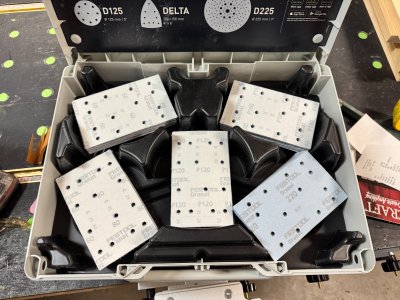
With abrasive side up looks nicer
With abrasive side up there is less scratching in total
With abrasive side up there is no (less, really) scratching of the inlay

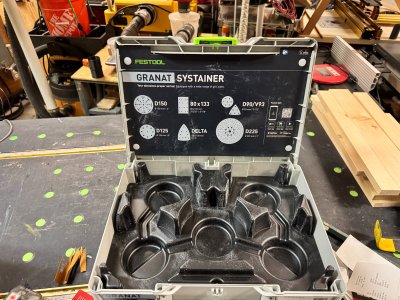
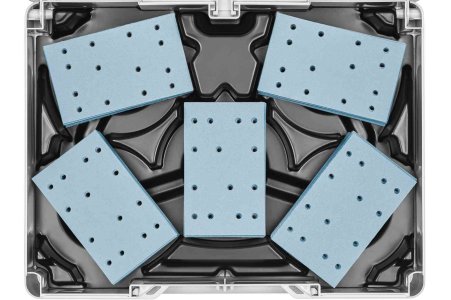
The Sys^3 inlay is stupid for 80x133. Only five stacks that bump into each other instead of six stacks that don't bump.
 
The better comparison is one fingerprint on the steering wheel.

With abrasive side up looks nicer
With abrasive side up there is less scratching in total
With abrasive side up there is no (less, really) scratching of the inlay

The Sys^3 inlay is stupid for 80x133. Only five stacks that bump into each other instead of six stacks that don't bump.
Would you expect a new car to be shipped without plastic film over the seats to protect them in transit? According to Google, these are the protective products that are used to ship a new car:

How to Transport Your Cars: Why a Protective Car Wrap Works
New cars are protected during transit using specialized, temporary materials designed to prevent scratches, paint chips, UV damage, and environmental contaminants. Common protections include white peel-off plastic wraps (Wrap-Guard), adhesive-backed paint protection films (PPF) on vulnerable areas, foam blocks on door edges, plastic covers for wheels and seats, and paper or plastic covering interior surfaces, dashboard, and carpets.
Key Protective Materials:
  • Transit Films (Wrap-Guard): White, adhesive-backed plastic films applied to horizontal surfaces like the hood, roof, and trunk to protect against scratches, bird droppings, and UV damage.
  • Paint Protection Film (PPF): Clear urethane-based, self-healing films applied to high-risk areas like bumpers, rocker panels, side mirrors, and door handle cups to guard against road debris.
  • Interior Protection: Plastic covers on seats, seatbelts, and carpets, along with protective foam on interior door panels to prevent scuffs during loading/unloading.
  • Wheel & Exterior Trim Protection: Specialized adhesive films specifically for alloy wheels to prevent scratches, along with protective plastic covers for lights and trim.
  • Foam Blocks & Covers: Foam spacers placed between car panels and on door edges to prevent damage when doors are opened during transport
 
The cellophane shrink wrap I referenced is also easily recycled. Quite possibly more ecological than a paper band to hold pieces together (logs, and rivers and paper mills, etc.), and so I remain skeptical.

Cellophane, produced via the viscose process (dissolving cellulose in chemicals like sodium hydroxide and carbon disulfide), is biodegradable but not recycled at scale. Cardboard shares similar cellulose-based biodegradability, degrading faster in home composting, while uncoated cellophane excels in industrial settings. Paper and cardboard, by contrast, are recycled at large scale, with quality suitable for packaging despite being subpar to virgin material.
 
I was reacting to someone who suggested Festool should "Think like Apple" and concisely pointed out that Apple is a maximum-profit public company while Festool is a private/family business with a completely different value system. Part of that value system being they value ecology, community /both employees and their home country/ above profit ... and that is relevant as it is being -indirectly- criticised in this thread as that is the cause for a different-than-Apple approach to such things.
"Think Like Apple" doesn't necessarily mean think like them in terms of profit and since my topic is about packaging, I would not have thought that I would necessarily need to delineate that difference. And yes, I do think that Festool could Think more like Apple to enhance the user experience. I find it difficult to believe, considering all of the conversations on this forum, that the users here don't find opening new Festool to be a moment of excitement. And I'm certainly not the only person here who has experienced a level of disappointment when finding that their newly delivered tool fell short of expectation.

- And, mainly, I am REFUTING your accusations that Festool "does not care about the details" as the exact opposite is the case here.
Perhaps there are some nuances that are difficult to navigate based our own native languages. My statements have not been about Festool "not caring about the details" but rather I would like them to have a greater level of "attention to detail." But perhaps our nuances are obfuscated as we translate.


Now, with all that said: I liked styrofoam cups better, laminated paper is a pain (non-laminated paper for coffee is even worse), the SYS3 80x133 is stupid and I prefer my cigars wrapped in cellophane.

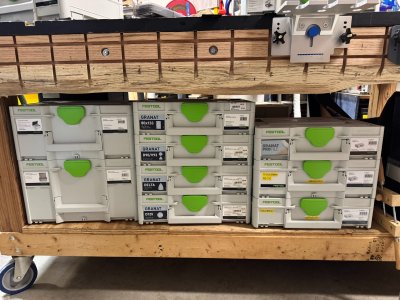
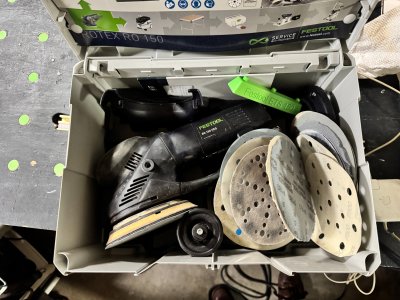
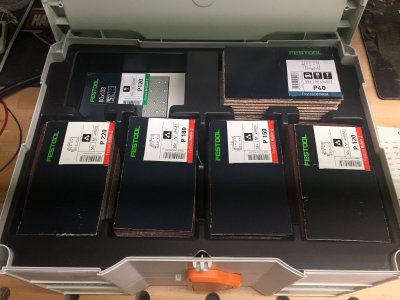
And now, after a bit of vacuuming and rearranging, I feel much better now that the 80x133 Abrasives Systainer can take its rightful place in The Pantheon of Abrasives.
 

Attachments

  • IMG_0573.JPG
    IMG_0573.JPG
    3.6 MB · Views: 12
  • IMG_0574.JPG
    IMG_0574.JPG
    3.5 MB · Views: 11
  • IMG_0575.JPG
    IMG_0575.JPG
    3.5 MB · Views: 12
For me the excitement of new tools has never waned over the decades, it's like xmas as a kid when I acquire a new item!

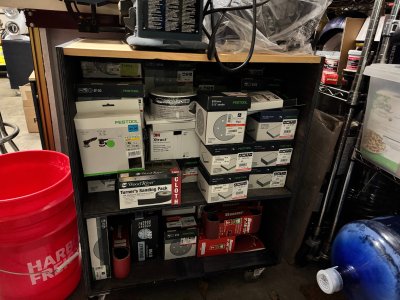
The funny thing for me is I find systainers really inefficient for storing sanding media as I buy the grits in 100 sheet boxes. So I just leave them in the original cardboard boxes stacked on a shelf.

I do though have a "working" pile of my most used grits handy nearby.
 
For me the excitement of new tools has never waned over the decades, it's like xmas as a kid when I acquire a new item!

The funny thing for me is I find systainers really inefficient for storing sanding media as I buy the grits in 100 sheet boxes. So I just leave them in the original cardboard boxes stacked on a shelf.

I do though have a "working" pile of my most used grits handy nearby.
I use the Systainers mainly as a "Ready Five" supply, so I don't to dig through stacks of boxes anytime I need a new one. I keep those in a separate cart and then whatever is being used, or partially used, in the Systainer with the tool.
 

Attachments

  • IMG_0579.JPG
    IMG_0579.JPG
    4 MB · Views: 10
  • IMG_0580.JPG
    IMG_0580.JPG
    3.3 MB · Views: 10
Call me skeptical.
I remember when most coffee shops would send you on your way with a cup of hot coffee in a styrofoam cup.
In the “interests of ecology” they changed to a paper cup. But laminated with a plastic film.
Consider that the foam cup was insulated (good), and easily recycled (excellent) and did not require heavy equipment to move logs down a river and then to a mill, it was a very smart choice.
...
With you here ... I consider lots of this 'stuff' to be bordering if not outright irrational.

The analogy here would be them asking you to bring your cup, not just changing the materials.


I just wanted to make very clear this approach is not from a "lack of caring", instead it is a case of too much care given, just in a different direction.

The thing is, you can 'shame' someone into "caring for a detail/experience" in case of a true neglect. It does not work when the "neglect" is no neglect but a case of a philosophical difference. Treating it as "neglect" then causes only frustration.

I mentioned briefly the women as this is very similar to a relationship dynamic. Pushing the SO to do/not do something because you *think* she is being careless while it is a case of her consciously choosing to act that way for some /initially unknown to you/ reason is just a recipe for frustration. The only /hard but workable/ way is to acknowledge her reasoning and try to argue it with respect. Dismissing and shaming her for "carelessness" would only trigger a defensive reaction .. nothing gets resolved and bitterness stays.
 
Last edited:
..
Perhaps there are some nuances that are difficult to navigate based our own native languages. My statements have not been about Festool "not caring about the details" but rather I would like them to have a greater level of "attention to detail." But perhaps our nuances are obfuscated as we translate.
..
I will admit English is not my native tongue. Though after 25 years of it being my main work and research/reading language, I do consider my proficiency fluency at it above my proficiency fluency in either of my native tongues at this point.

My beef was with "I wish Festool would give a little more attention to detail" and its breakdown to specifics. Which I interpret as you being of the opinion Festool does not care and/or chooses to not bother about the aspects/effects you observe and are annoyed with. I argue that they absolutely do care, possibly too much, but that their priorities/values - stated publicly and unchanged for decades - make them go with the choices they do. IOW, if Festool paid even more attention, they may up the paper count to 30pcs/grit, to make the systainer "fuller" and have stuff wiggle less during transport, but they would not flip the papers, nor add shims.

The only scenario where they would do so /with the shims, Coen explained why flipping around is a no-go/, is if they changed their philosophy .. and that is something I argue is the least we should wish. The issue being that there are way more obvious and profitable changes that would be enabled by such a philosophy swing. Most would relate to the availability and cost of spares, /non/reparability and, the most-obvious, of time-bombing products in the design stage, like every other competitor does. And THAT realization is what makes me pause hard.

I would rather Festool stays a band of ecological zealots and gives me my spares, my reparability and my 30-year lasting tools. I can deal with some scratches to get those.

EDIT: Fluency is a better word, I never took all that much care for /formal/ English grammar, never properly studied it and when did, considered it too ambiguous anyway.

 
Last edited:
Back
Top