Lost my brakes…

Packard

Member
Joined
Nov 6, 2020
Messages
5,460
Location
Hudson Valley, NY
The other day I watched on my DVD a made for TV movie and an assassin killed a driver by cutting his brake line. All the victim tried to do was repeatedly step on the brakes.

I lost my brakes going down a 4 mile long steep hill in Vermont in 1970. I was driving a new Chevrolet Caprice station wagon (company car) which had drum brakes all around. I was about 22 years old and not a highly experienced driver. I applied my brakes too continuously and they overheated and stopped working.

I had driven down this hill in the past, and I knew at the bottom of the hill, I could either turn left, or turn right, or drive into the lake across the road.

The car had already sped up to over 60 mph. I was in trouble.

But I did not repeatedly step on the brakes. Instead I shifted the transmission into “2” (second gear of a 3 speed transmission), which got me down to about 45 mph. Then I shifted into “L” (“Low”, first gear) which on the steeper grades got me to about 25 mph, but at the base it would be less steep.

My hope was if I did not touch the brakes until I got to the bottom, that they would have cooled enough to bring the car to a stop. As a last resort I could throw it into park, but at the risk of damaging the transmission.

I did manage to stop the car about 5 feet past the stop sign. I pulled over the the side of the road for about 15 minutes to allow the brakes to cool. Then drove a short distance to a coffee shop to take a longer break.

The brakes linings “glazed” from the heat but a few stops later the brakes wore off the glaze and they were fine.

This is unlikely in a more modern car, as they have disc brakes that don’t overheat as easily.

But if the bad guys are after you, down shifting in an automatic will help, but not as much as in 1970. My car’s transmission has 9 speeds and one “low”, which I imagine is about 4th or 5th gear, so less engine braking.

But the parking brake is independent and mechanical and will help at very low speeds. (Disc brakes do not make satisfactory parking brakes, so a small drum brake is usually fitted to the rear wheels for parking.)

A manual transmission will be more effective nowadays, but don’t try to go from 5th to 2nd, you would probably have to hit every gear down to 2nd.

As an aside, in old movies where the race car driver “down shifted to save his brakes”, he was not trying to avoid getting a new brake job, he was trying to keep the brakes cool so that they would work. Juan Fangio stuff.


In any case, if an assassin cuts your brake lines, you now have a tactic to deal with it.
 
This is unlikely in a more modern car, as they have disc brakes that don’t overheat as easily.
My wife can likely disprove you here. She can make pad slapping, pulsing disc brakes in no time. Destroyed multiple rotors on my F150 and (later) Tacoma and hitting brakes on her current VW is an exercise in stuttering.

I did find some Akebono ceramic pads for the Tacoma that she couldn't defeat.....
 
My dad preached, “Don’t watch the car in front of you; watch the car in front of him.

Even when you are watching the second car in front of you, the actions of the car in front of you will register just as well.

The advantage: I start to slow at the same time as the car in front of me. Usually that means lifting my foot off the gas earlier, which means less wear on the brakes. I got 109,000 miles on my Chrysler Pacifica’s first set of pads (mostly highway miles), but still very good.

Watching further ahead while driving, in my opinion is safer, improves brake wear, and fuel economy.
 
In an emergency situation using the old fashioned parking brake that is over on the left side near the firewall: That is definitely something that takes some practice.
Locking up the brakes by using the parking brake when the master cylinder has failed is a thrilling experience.
 
In any case, if an assassin cuts your brake lines, you now have a tactic to deal with it.
Thank you. It's surprising how often this comes up in my daily life.

Many moons ago, when I was a wee lad, I learned how to drive tour buses. Big, Greyhound-style buses. Prevost, MCI8, MCI9, 102-A3 - those were heady times! I learned then about the importance of preserving your brakes. Luckily, I never had any issues, but a couple other drivers did. They pumped their brakes too much. And on those buses, like tractor trailers, they use air to operate the brakes. And if you kept pumping them, the pressure would drop until they wouldn't work.

I had a great instructor so I learned to operate the bus without ever pumping the brakes. Learned how to use the gearing and Jacob's Brake to control speed - especially downhill. But the most important lesson he taught me was not to get on the gas - ever. Let up the brake and allow the bus to glide a little before applying the throttle.

This saved my ass one day when I was pulling the bus (an MCI9) through a tight alley in Waikiki (I lived in Honolulu then) - just barely enough space for the bus to fit. At the end of the alley was a perpendicular road and I had to stop. Hotels were on both sides of the alley and a walkway crossed the intersection. I looked carefully both ways - Right, then Left - and then pulled my foot off the brake as I started turning my head to the right again - and that's when she popped out from behind the right side mirror.

I didn't see her. I saw everyone else. That moment when I looked right, she must have just stepped behind the mirror. The bus hadn't really moved but I hit those air brakes with a hiss. Holy crap. Had I not be trained and been quick to jump the throttle, I could have easily rolled over this woman. Scared the crap out of me. I had to sit there for a few moments.

I drove tours through college. Thankfully, I never had an incident.
 
What scares the crap out of me, would be someone convincing me to make a baby crib.

All those “What ifs” scared me.

What if I spaced the slats too far apart.

What if a joint failed.

What if the side rail dropped when no one was around.

What if, what if, what if…

(I was asked to make a crib once. I declined.)
 
I lost my brakes one time. Brake line rusted and burst.
Fortunately, it was early Sunday morning, so very little traffic and I was moving not particularly quick. Just a block or two from home.
A couple of drivers surely noticed this crazy guy in a black car go right through a stop sign an pull a U turn in the intersection.

I thought the front and rear circuit were separate, so I should still have half my braking, but I had almost nothing.
 
The first time I lost brakes, I was driving a 1968 VW Camper that I'd only owned for 3 days in the early 1980's. I had my girlfriend seated next to me, later to be my wife. We were going down a largish hill in St Louis on a busy street. I hit the brakes, not a good feeling, hit them again, and pretty much nothing, the stop light with cars was approaching. I started to panic, explained what was happening, I yanked the Parking brake in a last ditch attempt, went through the gears to get into First for whatever engine braking we could muster, and slowly made my way over into the ONCOMING lane as there wasn't traffic yet there, so we had some room to try and aim for the Street Curb lane if we were lucky. Hit the emergency flashers as well and slowly came to a stop out of harm way. We were both sweating and nervous, way too close of a call.
Turned out a rear wheel cylinder had popped, losing fluid , and stopping power , in a hurry.
 
Last edited:
There is a popular, but entirely nonsensical, phrase that I hear too frequently: “Assume” makes an “ass” of “u” and “me”.

My example to refute this phrase goes like this:


You cannot make it through the first hour of your day without making dozens of assumptions.

You leave to go to work. You assume the company is still in business.

You assume your car will start.

You assume that when the traffic light turns green, cross traffic will stop.

You assume that when the traffic light turns red your brakes will work…


[Several more examples generally follow.]


It is still a nonsense phrase, even if you can’t count on your brakes working.
 
Working as a mechanic, through most of the 80s, I've driven more worn/damaged/abused vehicles than I care to remember. Brakes are one of the things that many drivers ignore, even when they start giving very clear warnings. Way back in the day, people respected motor vehicles as the tools that they were, requiring adjustment, maintenance, and care. Today, they are seen more as appliances, to be used as needed.
It is probably as much the manufacturer's fault, as the drivers. They simplify as requested and things get easier, which means easier to ignore. They even ignore the flashing lights and dash warnings. I have seen tape on dash clusters, covering an annoying light, rather than fixing the problem. :oops:
Disc brakes on the front took away some of that adjusting issue, since that was way more important to maintaining control of the steering. It is increasingly moving toward rear brakes too. Less and less adjusting and care, along with more warnings, but people still neglect.
 
There is a popular, but entirely nonsensical, phrase that I hear too frequently: “Assume” makes an “ass” of “u” and “me”.

My example to refute this phrase goes like this:


You cannot make it through the first hour of your day without making dozens of assumptions.

You leave to go to work. You assume the company is still in business.

You assume your car will start.

You assume that when the traffic light turns green, cross traffic will stop.

You assume that when the traffic light turns red your brakes will work…


[Several more examples generally follow.]


It is still a nonsense phrase, even if you can’t count on your brakes working.
I know it is somewhat semantics, but I see most of those as Trust, rather than assume, may even fall into expectations....😳 I'll go take a nap now
 
Working as a mechanic, through most of the 80s, I've driven more worn/damaged/abused vehicles than I care to remember. Brakes are one of the things that many drivers ignore, even when they start giving very clear warnings. Way back in the day, people respected motor vehicles as the tools that they were, requiring adjustment, maintenance, and care. Today, they are seen more as appliances, to be used as needed.
It is probably as much the manufacturer's fault, as the drivers. They simplify as requested and things get easier, which means easier to ignore. They even ignore the flashing lights and dash warnings. I have seen tape on dash clusters, covering an annoying light, rather than fixing the problem. :oops:
Disc brakes on the front took away some of that adjusting issue, since that was way more important to maintaining control of the steering. It is increasingly moving toward rear brakes too. Less and less adjusting and care, along with more warnings, but people still neglect.
Yes, the whole Ford/Firestone debacle that really drove the regulations to have Tire Pressure Monitoring on all vehicles here in the US after a certain model year, has been ignored by many motorists. Oh, my tire pressure warning light is on, yeah, it's been on for awhile....:rolleyes::rolleyes:
Some, do, to their credit, work with that light and system, keeping the tires filled as needed, but we in the Industry observed that many people treated the Unique Warning Symbol on the Cluster as one more warning light to ignore, like the Check Engine light.

Another part of it is that the sensors and system are real money when they go bad , or the battery in a sensor dies- compared to the simple rubber tire valve that used to be there, so for some owners it's a case of economics, they can't afford to fix 4 or 5 sensors if the spare tire has a sensor as well[ Yes, how many Spare Tires are actually still being offered....:ROFLMAO::ROFLMAO:]
I've also seen people just throw rubber tire valves on all 4 wheels and system and light be damned....
 
Back in the 1980s, I had a brake job done on my car.

A couple of days later I stepped hard on the brake pedal and hear a loud “sproing” and then the brakes would not work. I called my mechanic and he sent his tow truck to pick it up.

The following day I came by to pay my bill. The car was fixed. I asked what went wrong? He said, “You probably pulled too hard on the parking brake”.

To which I replied, “I have not used my parking brake since the winter of winter of 1969”.

To which he replied, “Oh. Then, no charge.”

He never told me what went wrong, but he clearly thought his mechanic was to blame. No charge for the towing, no charge for the repair.

[In the winter of 1969, I was in college at Syracuse University. We had a bitterly cold few days and water had frozen on my parking brake. I could not use the car for over a week until the weather had warmed up over freezing. I have not used a parking brake since that time.]

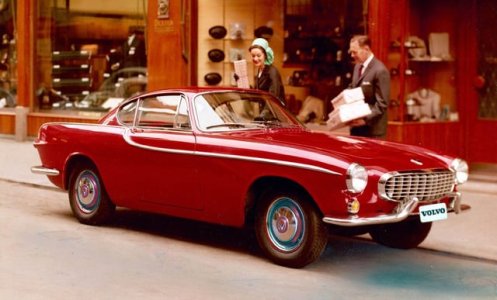
[As a second note, it was a 1964 Volvo P1800. A pretty car. But the least reliable car I have ever owned. I remember telling a friend, “I’ll be by six o’clock or I won’t make it at all.”]

1768925932512.jpg
 
There is a popular, but entirely nonsensical, phrase that I hear too frequently: “Assume” makes an “ass” of “u” and “me”.

My example to refute this phrase goes like this:


You cannot make it through the first hour of your day without making dozens of assumptions.

You leave to go to work. You assume the company is still in business.

You assume your car will start.

You assume that when the traffic light turns green, cross traffic will stop.

You assume that when the traffic light turns red your brakes will work…


[Several more examples generally follow.]


It is still a nonsense phrase, even if you can’t count on your brakes working.
This concept first made a big impression me when I was about 8 and my family was driving through the Appalachian hills to my grandparents house for Christmas. It was snowing and the car was slowly climbing a bridge. The slippery conditions and the snow made it dramatic so my interest was piqued. All I could see of the world was what was lit by the headlights, the bridge and the snowflakes. There was no visual indication that the bridge continued beyond the top. I just had to assume it did.
 
MK: There was no visual indication that the bridge continued beyond the top. I just had to assume it did.

My Doberman Pinscher amazed me at times.

I was letting him run free at a local beach.

There was a huge concrete culvert that drained further down to the water.

A dog was walking along the summit of the culvert, which would be difficult for us two-legged creatures, but apparently no problem at all for dogs.

The dog caught sight of my dog and jumped off the culvert vanishing from view. My dog ran towards the culvert, jumped over it with about two feet of air for clearance and vanished from view too.

I ran after him and found the two dogs having the time of their life chasing first one, then chasing the other.

What amazed me was that my dog jumped over that culvert and had no idea what was on the other side.

He had an amazing capacity to jump over fences. I went to pick him up at the boarding kennel once and he was so excited to see me that he easily cleared the 10 foot kennel fence with plenty of room to spare. But he did not have good sense to go along with that jumping ability. Luckily, he never got hurt jumping, but it was worrisome.
 
Years ago I was dropping down an off ramp into Williamsport, touched the brakes and no one was home. Quickly down shifted and holding the emergency brake handle out, eased on it. I drove than van two weeks like that doing door service as our new , ordered van didn’t come till then. Not possible in most vehicles now as the emergency is wired not mechanical, although my transit as well as the six the company I partime for are all mechanical
 
To which I replied, “I have not used my parking brake since the winter of winter of 1969”.
That was the fate of most automatic transmission cars. They never get used, rust and corrosion build up, until the one time, when someone does it.....then the thing will not release.

Ah, the check engine light. There is one that confuses people. While it is totally their own fault, they never bother to learn what it means. I would bet that a huge percentage of drivers have no idea that when it blinks, rather than just on steady, it is more serious. Needing immediate attention, where the steady light could wait.
 
Last edited:
Back
Top