My son is in BIG trouble!

Mike Goetzke

Member
Joined
Jul 12, 2008
Messages
1,217
My oldest son has a model building hobby. He and his wife have a 1-1/2 year old son and he is at that super active age. My son had a model on the dining room table and he said for the past few days his wife has been telling him to move it somewhere else. You probably already know what I'm going to say, his son took a small bottle of acetone and spilled it on their very expensive wood dining room table. He told his wife and she said she didn't even want to talk about it!

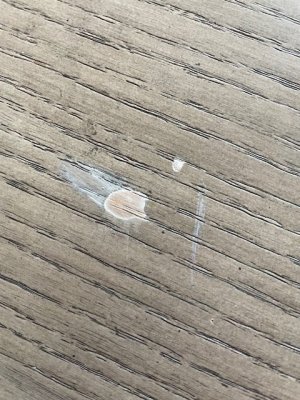
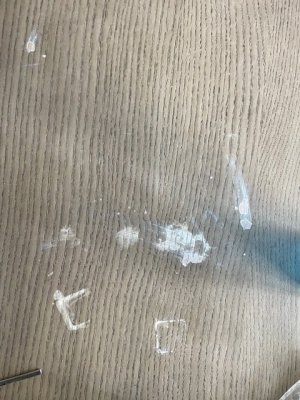
I googled a little and find he is not the only one with an acetone issue on a table. Seems there are even experts that do such repairs (he is in the western suburbs of Chicago so if anyone knows of a reliable repair company please let me know). At first I was thinking we could do the repair but then he sends me a couple of pictures - attached. Sure looks like it was painted white then gray and then possibly a black stain on top?

Any repair help appreciated.

IMG_6554.jpeg
IMG_6553.jpeg
.
 
Mike, I would avoid sanding the top as it will lose its patina. Instead, use a card scraper to remove the marks and smooth down the surface around the marks. Not a sanding pad, unless it has a hard surface, otherwise it will create indents. Then touch up - to do this, experiment with finishes. You will likely need a touch of colouring to match the existing tones.

Regards from Perth

D
 
If you want a restoration expert's opinon, try Tom Johnson of Thomas Johnson Antique Restoration who has a YT channel. There's no guarantee, but he replied to a couple of my email inquiries before.
 
That's probably very basic work for anybody that does furniture repair. You don't need to ship the table to Thomas Johnson.
Google "Furniture repair Chicago".

If that is a retail purchased table, in all likelihood the finish is lacquer. There are simple methods to test for finish type. Lacquer can be spot repaired, but the question is locally removing the damage, as @derekcohen pointed out.
 
Strip the remaining lacquer with acetone, carefully hand sand with 400 or and refinish with either Osmo or Rubio. Easier to fix any future issues that might arise. The original looks like a pickled finish, it’d be difficult to duplicate.

Might be a while before a repair person can get to it, no point in extending the pain….
 
That's probably very basic work for anybody that does furniture repair. You don't need to ship the table to Thomas Johnson.
Google "Furniture repair Chicago".

If that is a retail purchased table, in all likelihood the finish is lacquer. There are simple methods to test for finish type. Lacquer can be spot repaired, but the question is locally removing the damage, as @derekcohen pointed out.
You'd be in luck if he accepts your piece for repair. He has on many occasions told his YT viewers that he is not accepting any items as apparently he already has more outstanding orders than he can handle within a reasonable timeframe.

I also think these days his focus or interest is mostly on antique pieces.
 
I’m betting that any repair will look like a repair.

I would sand down to bare wood.

I would wipe on Seal Coat (acts as a primer)

I would wipe on 4 to 6 coats of oil based poly (gloss).

If it is too shiny for you, than use some 0000 steel wool and rub it out with either butchers’ wax or “wool oil”. The butchers was can make re-finishing difficult in the future, but looks and feels really nice.

The wool oil is not supposed to affect later applications of finish (I have not tested that claim).

I get a more uniform and nicer result applying wipe on finishes. But brush on or spray would be fine too. Only oil based finishes are suited to wipe on application.
 
Hard to tell for sure but:
• Looks like the acetone has already removed some of the patina/stain in spots (2nd photo).
• Hard to know what the finish is. Lacquer or polyurethane or any of the newer who-knows-what catalizing finishes?
• If the finish softens with alcohol (or lacquer thinner) then it's probably lacquer.
• Given the acetone has already removed some patina/stain, you're either trying to spot repair the color and then re-coat or remove all and totally refinish.

There are people who are really good at spot color matching. I'm not one of them.
 
No way I will be concerned about stains, dents and other signs of use on a dining table. My home is not a showroom, and if yours is, I feel sorry for ya.
This. That is why I love Tung oil for table and chair furniture. It is not the most resilient by far, but is infinitely repairable and will not poison anyone if they happen to eat it.

That said, once having such a table, I would shoot for a basic repair instead of a complete refinish. It is not the first nor the last stain their kids will cause. 20 years down the line they will fondly remember how that particular stain came to be ..
 
I’m betting that any repair will look like a repair.

I would sand down to bare wood.

I would wipe on Seal Coat (acts as a primer)

I would wipe on 4 to 6 coats of oil based poly (gloss).

If it is too shiny for you, than use some 0000 steel wool and rub it out with either butchers’ wax or “wool oil”. The butchers was can make re-finishing difficult in the future, but looks and feels really nice.

The wool oil is not supposed to affect later applications of finish (I have not tested that claim).

I get a more uniform and nicer result applying wipe on finishes. But brush on or spray would be fine too. Only oil based finishes are suited to wipe on application.
Was thinking of this at first but this top additionally has a fancy inlay around the perimeter. Might try to find out where they bought it and see if the company is of any help.
 
Back
Top