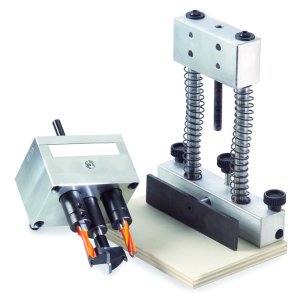
New "domino killer" dowel guide for drills

I have never used dust extraction when drilling in wood so I don't see the need here. It is all large debris and no fine dust and a broom will fix that.
I have a multi-hole dowel jig, different but not that far off.

Without an ongoing dust extraction the large debris clogs the hole as well as the mechanism and you have to manually vac it before doing the next hole set, else you will not be able to place the thing on an even surface.

I created a workflow for me to have the hose placed on the stock next to the jig to speed this up but it is still a PITA and vacuuming takes up like 2/3 the time of me using the jig.

The more holes it makes at the same time, the more critical this becomes as the debris has less space to "get away" and more mechanisms to get into.
 
I liked the Werner Herzog (not really him, I assume) narration :)

I don't think this will replace my Domino XL, or why this is better than all of the other dowel jigs.

Bob
It is better because you are only using the electric drill once to make 4 holes. I bought a line voltage DeWalt drill because it had 4,000 rpms even under load. Slow drilling on dowel joints for cabinets (where my spacing is 32 mm) tries my patience.

Other than the speed, I see no advantage.

I have a (useful) MileCraft Jointmate. Easy to use. Looks and feels cheap (all MileCraft jigs do) but works as designed (all MilesCraft products do).

But I would like it a whole lot more if I could choose one bushing size (I use 8mm mostly) for all three holes. And the holes were on 32mm spacing.

 
It is better because you are only using the electric drill once to make 4 holes. I bought a line voltage DeWalt drill because it had 4,000 rpms even under load. Slow drilling on dowel joints for cabinets (where my spacing is 32 mm) tries my patience.

Other than the speed, I see no advantage.

I have a (useful) MileCraft Jointmate. Easy to use. Looks and feels cheap (all MileCraft jigs do) but works as designed (all MilesCraft products do).

But I would like it a whole lot more if I could choose one bushing size (I use 8mm mostly) for all three holes. And the holes were on 32mm spacing.


You can probably drill three holes as fast or faster than the jig in the video.
 
The key difference between the real deal (DF500, etc.) and any mortising jig is that the latter can copy or do only one or some of the functions built-in with the former. So the question to anyone contemplating about buying a real deal boils down to one thing: Is the versatility of the real deal worth the kind of money it is asking.

I agree - Domino is a very versatile tool.
If I were a pro, I would likely buy the Domino. But there is almost always more than one way to accomplish a task. I still use loose tenons.
 
I'm certainly a fan of Inkleind products, I've purchased the Cork Rubber for wooden vise jaws on a Versa Vise and the machining on the Pica tri-lobe screw is exceptional.

However, I have no interest in this product and it's not because I own both sized Dominos, it's the functional aspects of this item that dismay me. I can't imagine how slow/difficult it'll be drilling 3 each 3/8" diameter holes into hard maple or Jatoba at the same time, especially on a repetitive basis.
You can check out the fit of the doweled pieces if you FF to the 6:00 minute mark. Neither the horizontal fit nor the vertical fit is what I would call snug, actually sloppy is the better word. This may be because of the lack of dust/chip removal or the lack of clamping the Trinity to the material...maybe a combination of both. 🤷‍♂️

And then finally...OMG...the video title and video drama is thick enough to cut with a knife.
 

Attachments

  • Inkleind Cork Rubber.png
    Inkleind Cork Rubber.png
    119.3 KB · Views: 8
  • Inkleind brass Pica.jpg
    Inkleind brass Pica.jpg
    139.4 KB · Views: 9
  • Inkleind Pica screw .jpg
    Inkleind Pica screw .jpg
    497.4 KB · Views: 9
Last edited:
I'm certainly a fan of Inkleind products, I've purchased the Cork Rubber for wooden vise jaws on a Versa Vise and the machining on the Pica tri-lobe screw is exceptional.

However, I have no interest in this product and it's not because I own both sized Dominos, it's the functional aspects of this item that dismay me. I can't imagine drilling 3 each 3/8" diameter holes into hard maple or Jatoba at the same time, especially on a repetitive basis.
You can check out the fit of the doweled pieces if you FF to the 6:00 minute mark. P This may be because of the lack of dust/chip removal or the lack of clamping the Trinity to the material...maybe a combination of both. 🤷‍♂️

And then finally...OMG...the video title and video drama is thick enough to cut with a knife.

I'm certainly a fan of Inkleind products, I've purchased the Cork Rubber for wooden vise jaws on a Versa Vise and the machining on the Pica tri-lobe screw is exceptional.

However, I have no interest in this product and it's not because I own both sized Dominos, it's the functional aspects of this item that dismay me. I can't imagine drilling 3 each 3/8" diameter holes into hard maple or Jatoba at the same time, especially on a repetitive basis.
You can check out the fit of the doweled pieces if you FF to the 6:00 minute mark. Neither the horizontal fit nor the vertical fit is what I would call snug, actually sloppy is the better word. This may be because of the lack of dust/chip removal or the lack of clamping the Trinity to the material...maybe a combination of both. 🤷‍♂️

And then finally...OMG...the video title and video drama is thick enough to cut with a knife.
Like luvmytools, I expect runout is excessive. Maybe that will be improved but the speed of drilling is way too slow.
I briefly owned a Mafell DDF 40 Duo Doweler. It only drills two holes and it was dismayingly slow, with brand new bits.
I think I only tested it in plywood so some of the slowness was from the end grain plys but still…
I was glad I had the excuse of a loose wire in the switch to send it back.
 
Like luvmytools, I expect runout is excessive. Maybe that will be improved but the speed of drilling is way too slow.
I briefly owned a Mafell DDF 40 Duo Doweler. It only drills two holes and it was dismayingly slow, with brand new bits.
I think I only tested it in plywood so some of the slowness was from the end grain plys but still…
I was glad I had the excuse of a loose wire in the switch to send it back.
The DDF40 is probably the only tool I can think of in recent times that I regret getting. My experience was pretty much the same as yours, but I bought mine second hand so returning it wasn't an option.

I'm hoping I may eventually find use for it with smaller dowels, as the larger ones are very painful to do.

As nice as the Trinity is, and the machining is exceptionally nice, I think it would be a similar experience to the DDF40 but with added slop.
 
Like luvmytools, I expect runout is excessive. Maybe that will be improved but the speed of drilling is way too slow.
...
Things like this need a 3000+ rpm under load drill + dust extraction to work well.

That and carbide router-style bits. A "normal" drill bit dulls too fast and then you get runout etc.


The main issue I see is the whole assembly is too small, making it unstable.
It should be bigger, have a 3D printed plastic shroud for dust extraction and should include carbide bits. Then it may work out.

I do like the idea of going for three holes. It is mechanically simple and solves the DD40 problem of "too few holes". But I do believe the maker decided to bit a bit too big of an engineering challenge.
They likely spent a lot of time on prototyping and are proud of the problems they solved .. but this type of a tool is not a "small problem to solve". IMO, at about double the price and a year plus of prototyping they can get there. But they are not there yet. This is a "beta" product to me. Not alpha, but not mass production ready either.
 
Wonder if a custom dowel maker accessory is in the works also?
You mean, make your own dowels? Probably not a leap for mankind.

Commercial dowels, especially the fluted versions, are compressed during manufacturing, and expand quite a bit when exposed to the water in most woodworking glues, resulting in tighter joints.

Also, I bought 1,000 1/4” dowels the last time I purchased them, and as I recall the price was very competitive.

I just checked, 1,000 1/4” x 1-1/4” fluted dowels @ $17.50 per thousand.

 
Last edited:
You mean, make your own dowels? Probably not a leap for mankind.

Commercial dowels, especially the fluted versions, are compressed during manufacturing, and expand quite a bit when exposed to the water in most woodworking glues, resulting in tighter joints.

Also, I bought 1,000 1/4” dowels the last time I purchased them, and as I recall the price was very competitive.

I just checked, 1,000 1/4” x 1-1/4” fluted dowels @ $17.50 per thousand.

For Artisanal Dowels 😁

Last time I ordered 8mm dowels I ended up with over 10,000 dowels. Guess I wasn't paying attention to how many bags of 1000 were in my cart.
 
I'm late to this thread, but I'm still trying to wrap my head around this "groin push" hang-up with the Domino. I assume it is like all the other made-up Domino problems on the interwebs by the haters. They will all become big fans of the clones after the patents expire, just like when DeWalt released their first track saw... everybody was convinced it would be much cheaper and so much better. It was $100 more, and the honest reviews were that it wasn't even close.

As for the doweler here, I didn't watch the video. But whenever I've made dowel joints with 1/4" Miller dowels, either the dowel is really tight and needs to be hammered (so much for dry fit) or it rattles. Same bag, same bit. Still use them for special cases (or as wall pegs), but I really wouldn't want to use it for floating-tenon joinery. That's when you make a jig and use a router like @Steve1
 
Another thing that came to mind about this today is the December delivery. That's three quarters away. How many projects can even the hobbyist complete in that time? Is that person supposed to wait or put projects on hold? Of course not. And for the professional, does it even make sense? Seems that it's worth the spend on either Domino to get the projects done and let the tool pay for itself in the same timeframe.
 
Another thing that came to mind about this today is the December delivery. That's three quarters away. How many projects can even the hobbyist complete in that time? Is that person supposed to wait or put projects on hold? Of course not. And for the professional, does it even make sense? Seems that it's worth the spend on either Domino to get the projects done and let the tool pay for itself in the same timeframe.
This last bit I must admit is the thing that has always baffled me, for some decades in fact. My whole working career I've based on "The best mathematician is a lazy mathematician" premise, in that I have always looked for combinations of ways to do things easier, and faster, and better, and yet on many forums I see so many posts from people making their living from work derived from using tools, that happily proclaim "I'm not spending money on this or that".

I get being budget conscious, and even frugal sometimes, but if time is money, and spending some money on equipment or tools that can firstly be claimed as a tax expense, and secondly will either save you time (which is money), and labour (which also is money), as well as elevate your working standard (which again is money), I just don't see the sense in not buying the tool for the job.
 
You can check out the fit of the doweled pieces if you FF to the 6:00 minute mark. Neither the horizontal fit nor the vertical fit is what I would call snug, actually sloppy is the better word.

Yes, I definitely noticed that.

I have done long panel glue-ups with my Dowelmax jig, and every dowel was snug in its hole, and every board was a snug tap fit into the adjacent board (using their indexing rod to get repeatable spacing between holes).
However, sometimes the problem is the dowel. Dowelmax dowels have so far all been perfectly sized. Lee Valley dowels have been frequently undersized.
 
For such an important introductory marketing pitch video, how could the inventor allow a loose joinery (due to whatever reasons -- undersized dowels, poor user execution, etc.) to show?

Loose joinery is a sin in the eyes of woodworkers.

The video must be redone and released.
 
This last bit I must admit is the thing that has always baffled me, for some decades in fact. My whole working career I've based on "The best mathematician is a lazy mathematician" premise, in that I have always looked for combinations of ways to do things easier, and faster, and better, and yet on many forums I see so many posts from people making their living from work derived from using tools, that happily proclaim "I'm not spending money on this or that".

I get being budget conscious, and even frugal sometimes, but if time is money, and spending some money on equipment or tools that can firstly be claimed as a tax expense, and secondly will either save you time (which is money), and labour (which also is money), as well as elevate your working standard (which again is money), I just don't see the sense in not buying the tool for the job.
I agree. Since I got into using a Domino (and later buying my own 500), I've never really understood the consternation. Of course, I understand the hesitation regarding the cost of entry. But the benefits exceed that issue. And as I've seen all these videos of "Domino Killers" they all look difficult and cantankerous to use.

To me, this upcoming device seems more like a "DD40 Killer", but I don't foresee legions of Domino users suddenly abandoning their foresaken Dominos for a Trinity. Though, if you read the video's comments, it might seem like that (at least from people who don't use a Domino)!
 
I agree. Since I got into using a Domino (and later buying my own 500), I've never really understood the consternation. Of course, I understand the hesitation regarding the cost of entry. But the benefits exceed that issue. And as I've seen all these videos of "Domino Killers" they all look difficult and cantankerous to use.

To me, this upcoming device seems more like a "DD40 Killer", but I don't foresee legions of Domino users suddenly abandoning their foresaken Dominos for a Trinity. Though, if you read the video's comments, it might seem like that (at least from people who don't use a Domino)!
Perhaps, we should also ask what those people were thinking when they came up with something that was so obviously inferior to the domino joiner. Did they think woodworkers in general were lame-brained or something?
 
Things like this need a 3000+ rpm under load drill + dust extraction to work well.

That and carbide router-style bits. A "normal" drill bit dulls too fast and then you get runout etc.


The main issue I see is the whole assembly is too small, making it unstable.
It should be bigger, have a 3D printed plastic shroud for dust extraction and should include carbide bits. Then it may work out.

I do like the idea of going for three holes. It is mechanically simple and solves the DD40 problem of "too few holes". But I do believe the maker decided to bit a bit too big of an engineering challenge.
They likely spent a lot of time on prototyping and are proud of the problems they solved .. but this type of a tool is not a "small problem to solve". IMO, at about double the price and a year plus of prototyping they can get there. But they are not there yet. This is a "beta" product to me. Not alpha, but not mass production ready either.
I like the CMT bits intended for their drilling machines. They all have the same shaft size, but drill hole size varies. But a word of caution: The CMT bits come in right hand drive and left hand drive. Make the appropriate selection.

Also, the bits tend to be rather short. Make sure you are getting ones that are long enough for your jig. Some jigs eat up a good bit of shaft length.

The bits can be a little difficult to source—but they last so long that I cannot remember where I got mine.

1774968669716.jpg
 
Last edited:
Back
Top