New "domino killer" dowel guide for drills

The one advantage of dowels vs. dominoes, and the reason the kitchen cabinet manufacturers and the KD furniture manufacturers associations did not include dominoes in their testing, is that there are fully automated dowel drilling and assembly machines available for dowels and none for dominoes.

So transitioning from dowel construction to automated dowel construction is simpler than from dominoes to dowels.

For very small shops the dominoes hold an edge, but for larger ones they get blown away.
Indeed.

Dowels are universally cheaper on materials as well as tools as-long-as you can use robotic and a semi-automated workflow. Drilling is cheap, Routing is expensive on a CNC. Tenons are thus expensive both on material and tool, so they are used but only where dowels are plain inadequate.

The one advantage of a tenon is that its strength allows one to minimize their quantity and thus the required workflow steps. The second advantage is self-alignment, something irrelevant if not outright undesirable in a CNC workflow.
Both are critical for labour costs when bespoke or very-low-volume production is concerned, thus saving expensive labour.

The floating tenon is an artisan woodworker's tool and DOMINO is what makes it cheap(er).
It is not a manufacturer's tool. In plain language.
---

This is why all these "DOMINO killers" dowelling jigs are so absurd. For DOMINO, the concept, is designed to bypass the expense and complication of dowels for ad-hoc and custom furniture...
This is like "discovering" horse-drawn carts as "Car killers". They clearly need no gas while grass is everywhere .. and they can unquestionably haul more than a car trunk can ..
 
Last edited:
There are many YouTube videos showing cabinet assembly automation. The one I am posting shows several different fasteners being automated, but none of them are dominoes.

There could be a few reasons. I’ve listed three; there are probably many more:

1. Festool holds a patent on the dominoes
2. Dowels are much cheaper to produce
3. Dowels are easier to feed into an automated machine


And dozens more on YouTube:

 
..
1. Festool holds a patent on the dominoes
...
A domino - the floating tenon thing - is not patented nor patentable. It is a millennia-old concept.
DOMINO, the machine, is patented. But that is non-applicable to line manufacturing.

I would replace it with this:
1) Holes are much cheaper to make /compared to mortises/
 
Indeed.

Dowels are universally cheaper on materials as well as tools as-long-as you can use robotic and a semi-automated workflow. Drilling is cheap Routing is expensive on a CNC. Tenons are thus expensive both on material and tool, so they are used but only where dowels are plain inadequate.

The one advantage of a tenon is that its strength allows one to minimize their quantity and thus the required workflow steps. The second advantage is self-alignment, something irrelevant in a CNC workflow.
Both are critical for labour costs when bespoke or very-low-volume production is concerned, thus saving expensive labour.

The floating tenon is an artisan woodworker's tool and DOMINO is what makes it cheap(er).
It is not a manufacturer's tool. In plain language.
I will agree with that assessment.

But a shop that has aspirations for major growth, would have reason to adopt an efficient dowel system.

I have the CMT dowel template system. Judging from the videos I have seen of dominoes in use, the dominoes are faster to sue for 12” deep wall cabinets where the machine can index off the front and rear edges, but slower on deeper cabinets where additional indexing has to be done.

The CMT, which is simply a template and drill system, only requires one edge be indexed for wall cabinets or base cabinets. So I think, from watching the dominoe videos, and my experience with the dowel system, that the dowels are quicker on wider panels, and about on par with narrow ones. This was especially so after I got a line voltage drill that spins at 2,500 RPMs and has sufficient torque to maintain the speed under load.
 
A domino - the floating tenon thing - is not patented nor patentable. It is a millennia-old concept.
DOMINO, the machine, is patented. But that is non-applicable to line manufacturing.

I would replace it with this:
1) Holes are much cheaper to make /compared to mortises/
It always struck me as domino system was Festool’s (largely successful) effort to make a better biscuit machine. It appears to have the same ease of use with a stronger fastener. Though for many applications the biscuits are adequate.

Lamello also set out to improve on the biscuit machines, but took a different approach.

I don’t think any of these machines will prove to be the final answer. Something better is going to come along, as witnessed by all the attempts at a “Domino killer”.
 
It always struck me as domino system was Festool’s (largely successful) effort to make a better biscuit machine. It appears to have the same ease of use with a stronger fastener. Though for many applications the biscuits are adequate.

Lamello also set out to improve on the biscuit machines, but took a different approach.

I don’t think any of these machines will prove to be the final answer. Something better is going to come along, as witnessed by all the attempts at a “Domino killer”.
Don't know if I agree with that, yes biscuits are really useful and still very relevant as a joinery method, but in many cases I would consider the Domino a superior method for probably most of the solid timber joinery scenarios that biscuits would have been used for previously. And for carcase or face frame work the Zeta would be the superior and more efficient method, especially when it removes the need to clamp or halt work until glue dries. Of course if time isn't an issue, biscuits would work just as well, but in almost any environment time is money.

I also don't really see how anything better can come along though, as pretty much all the joinery bases are comprehensively covered by the DDF40, the Zeta P2, biscuit joiners and the Domino's.

As you say though, none of these tools are the final answer, as they all perform differing types of joinery methods depending on the need and use case, with any of them complementing any of the others quite well. I use my Zeta along with the Domino on most projects.
 
I will agree with that assessment.

But a shop that has aspirations for major growth, would have reason to adopt an efficient dowel system.
...
I think we are just bumping to language definitions here .. very-low-production is making 3-5 pieces of a given shape/size/design.

At those rates, even if you have a CNC waiting, the mantime to prepare the design files and operate the CNC is *more* than actually making the pieces as you are.

For custom stuff no CNC system will ever beat the DOMINO as @Crazyraceguy would be able to validate. He did not rely on DOMINO because it was "cool". He relied on it because it was efficient.

You cannot "adopt an efficient dowel system" for these scenarios. Any such system is inherently inefficient as the setup cost for a job is higher than using a manual method until a certain volume of repetitions, the opposite of efficiency.

Move to a series production, or semi-standard stuff and the calculus changes. Though even there, you will want your workers to use the DOMINO every time they do non-standard work as it is simply more efficient for them to do so.

Do not get me wrong. I believe dowels have their place in hobby woodworking as a well as production. But for different reasons.
For a hobby woodworker dowels are interesting simply because the mantime is "free" or close to free while the tooling costs are potentially minimal.
For manufacturing or even low-series production, it is all about automation of standard pieces production.
 
Over the years, I've ripped apart several structures I assembled with biscuits and that really took no effort at all. As a matter of fact, I was completely surprised and rather irritated it took such little effort as I took the extra time and effort to machine and install biscuits and I'd say the joint came apart as easily as a glue joint only. :mad: :mad: At any rate, there was a reason I sold my biscuit joiner the day AFTER I purchased the DF 500.

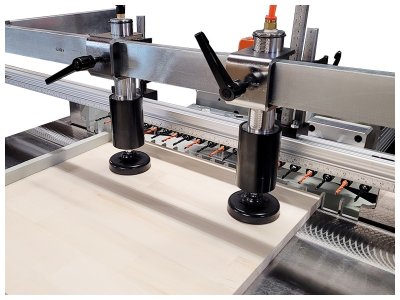
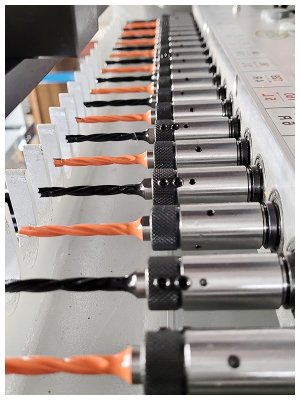
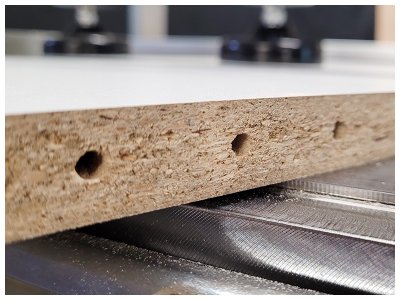
Here are some interesting photos of a Cantek line boring machine in action. What DIY'er would populate a joint with dowels every 32mm? I still feel that unless the dowels are spaced at 32mm distances, a joint reinforced with Dominos is still stronger than a sloppily done dowel joint.

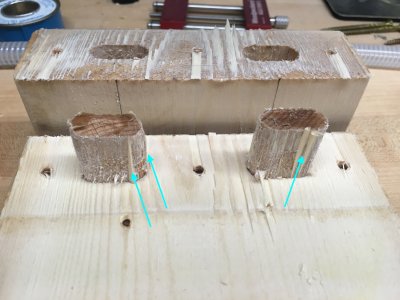
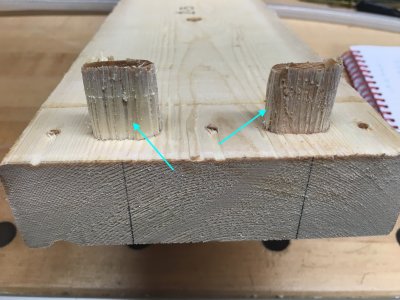
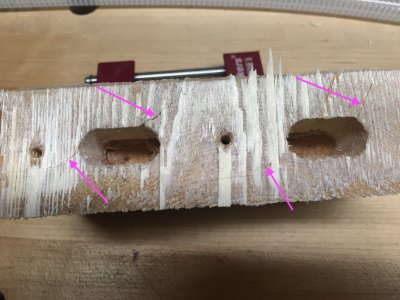
Here are also some photos of a Domino joint in a piece of fir. It took a couple of swings with a 2# sledge hammer to break the joint. Notice wood fibers from the mortise are still attached to both sides of the Dominos. And to separate the joint the fir was cracked in 4 locations. This is in soft fir...hardwoods would be even more difficult to separate.
 

Attachments

  • Cantek-HS21T-004.jpg
    Cantek-HS21T-004.jpg
    157.5 KB · Views: 6
  • Cantek-HS21T-009.jpg
    Cantek-HS21T-009.jpg
    158.1 KB · Views: 5
  • Cantek-HS21T-016.jpg
    Cantek-HS21T-016.jpg
    173.5 KB · Views: 6
  • 3588 mortise rear fibers.JPG
    3588 mortise rear fibers.JPG
    666 KB · Views: 6
  • 3589 mortise front fibers.JPG
    3589 mortise front fibers.JPG
    842.3 KB · Views: 6
  • 3590 cracked.JPG
    3590 cracked.JPG
    817.5 KB · Views: 6
I do .. the only way I ever use dowels.
:cool:
Me too. My templates have holes on 32mm centers and I always drill all of them.

Sometimes I will substitute two of the dowels with a pair of Hafele spreading connectors, in place of clamps. The connectors are not structural so the regular glued dowels are still required. I only use the connectors for larger items that would be difficult to transport (or even move from my basement to the main floor of my house). They don’t seem strong enough to draw a joint together, but they are strong enough to hold it together while the glue dries.

 
Perhaps the idea with the Trinity is that you can bore a set of three dowels every 32mm. This should give it the Ultimate Power in The Universe, right? (<----- Not a serious question)
Yeah. The idea is correct. While DD40 makes "too few holes" for many use cases in a single "side of board" operation, the Trinity would provide enough. So far so good.
The problem is not the idea - which is sound. It is the inadequate execution .. and the dishonest marketing.

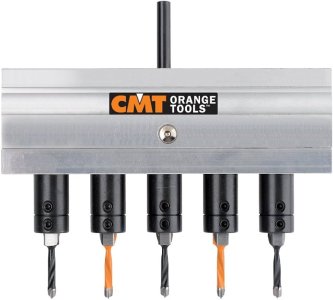
But the CMT boring jig drills 5 holes and is available now.
But .. it has no fence .. and is designed for smaller line-boring machines with powerful spindles.

What the guy *should* have done is not try to reinvent the computer. Take the standard industrial CMT 3-hole jig you noted earlier, add fence and dust extraction and he would be good .. but he did not do that indeed.

Making functional gearboxes is not kid's play.
 
Last edited:
Yeah. The idea is correct. While DD40 makes "too few holes" for many use cases in a single "side of board" operation, the Trinity would provide enough. So far so good.
The problem is not the idea - which is sound. It is the inadequate execution .. and the dishonest marketing.


But .. it has no fence .. and is designed for smaller line-boring machines with powerful spindles.

What the guy *should* have done is not try to reinvent the computer. Take the standard industrial CMT 3-hole jig you noted earlier, add fence and dust extraction and he would be good .. but he did not do that indeed.

Making functional gearboxes is not kid's play.
I think you could use the CMT 5-hole boring jig in a drill press with a fence mounted on the base of the drill press. I’m not sure how you would index it though. Maybe add a dowel pin to the outside edge of the unit thigh would index from the edge and index from the previous hole. In any case, I think it is doable with a drill press. But I don’t need that level of productivity enough to invest in the time or in the money to come up with a workable system.

(My spell checker keeps making dubious “corrections”. It changed “boring jig” to “borking jig”, and it changed “borking” to “nothing”. I had to look up “borking”. If my spell checker is an indication of the direction of A.I., then I worry for our future.)

Borking: to attack or defeat (a nominee or candidate for public office) unfairly through an organized campaign of harsh public criticism or vilification
 
I can't believe I just got to this today and read the whole thing... :D

It's a very interesting discussion.

My two cents on the "Domino hate/it's too expensive/doing it by hand is better" thing is this:

For much of my life I couldn't afford much of anything and was kind of envious of the people who could. Not bitter, just wished I could get some of that cool stuff too. In that situation, buying a Domino is not possible and you need to find an affordable alternative or you just forego the adventure. End of story. I ended up foregoing a lot of adventures. (I'll leave out the psychological analysis of the various possible emotional reactions to such a condition.)

I have been in a pretty good place financially for at least ten years and no longer have anyone judging my purchases. For me now, the Domino is a no brainer. It is fast, accurate, and efficient. I don't have the patience for making mortises with a router, jig, and vacuum. I did that for a while, and it got old fast. It was satisfying in a way, but for me it felt very tedious.

When I feel the need to justify the cost as a hobbiest, I just look at the furniture I have built and figure that when comparing the cost of the Domino to the cost of decent furniture, I have probably broken even, or at least heavily subsidized the cost. But mostly, I just love using it and that is good enough, well plus having a bunch of furniture that has improved my bachelor existence. (The ex has nearly all of what was our communal furniture.)

But I get that some people love cutting mortises and tenons by hand and/or love saving money by investing their time and energy instead of buying high end power tools. And that is just fine. To each his/her own.

By the way, I am also into higher-end electronic drums, and my sense is that they are like Festool tools in that both are unreachable for a lot of people until they get older and have some decent earning power.
 
[…]
When I feel the need to justify the cost as a hobbiest, I just look at the furniture I have built and figure that when comparing the cost of the Domino to the cost of decent furniture, I have probably broken even, or at least heavily subsidized the cost. But mostly, I just love using it and that is good enough, well plus having a bunch of furniture that has improved my bachelor existence. (The ex has nearly all of what was our communal furniture.). […]
Why is it that woodworkers have to justify their hobby’s cost? Do skiers justify their cost? Boaters? People who love travel?

I found a list online of the most popular hobbies in the USA. Of them, only Cooking/Baking has any chance of “earning its keep”. All the others are time/money consumers. (Of course you could justify it the way I used to: “It keeps me out of bars. I would drink myself broke if it was not for my hobbies.”

  • Cooking/Baking – 42%
  • Reading – 37%
  • Pets – 35%
  • Video Gaming – 35%
  • Outdoor Activities – 31%
  • Traveling – 29%
  • Socializing – 27%
  • DIY/Arts & Crafts – 26%
  • Board/Card Games – 24%
  • Gardening/Plants – 24%
  • Cars/Vehicle – 20%
  • Sports/Fitness – 20%
  • Meditation/Wellness – 20%
  • Photography – 20%
  • Tech/Computers – 20%
  • Writing – 19%
  • Making Music – 17%
  • Other – 5%
 
Packard... that's pretty funny. I have told myself and my friends more than once, "Yeah I buy some expensive tools, but hey, I don't play golf, or ski, or travel, or have a sports car..."

But I don't know. Seems like some of us were brought up to believe that spending money on things just because we like is them bad. My parents were kids during the great depression, and never had much money, so that may be part of it.
 
Packard... that's pretty funny. I have told myself and my friends more than once, "Yeah I buy some expensive tools, but hey, I don't play golf, or ski, or travel, or have a sports car..."

But I don't know. Seems like some of us were brought up to believe that spending money on things just because we like is them bad. My parents were kids during the great depression, and never had much money, so that may be part of it.
Well. Spending money on anything not benefiting your mistress IS wrong. Hail Her Holiness!

The thing is. The practical issue with tools is they actually *can* be justified on merit in most cases. This conflicts with Women being "now" creatures. If you spend $5k on a golfing trip, it is past, it does not matter anymore. But a DOMINO, that they can see on the shelf in the garage, that is here, now, insulting and assaulting Her patience with your 'wasteful' behaviour.

Men often, foolishly, attempt to convey the actual rational reasons why they bought this and that. Completely missing that the Mistress "does not care", for she cannot comprehend *).

And herein lies the mistake, or, more precise, the conundrum:
.. the more rational the purchase
.. the more tempting it is to justify it to others
.. the more something is justified, the more such justification is seen a petty attempt at dishonesty /projection, she does this/
.. the more tempting it is to make things for the home of exquisite value
.. the more those things will be seen as zero value for they were not purchased
.. the more resentment will be created for waste of scarce money on 'toys' for an adult child

The only way out
.. never attempt to justify your hobbies to your close ones
.. never ask them for support unless they offer
.. and, most importantly, never let yourself believe they see anything you create, however exquisite, as holding any value whatsoever
.. the justification you like them is enough, expect it will be respected as reason-enough and it will be

That it the only way to reap the benefits of passion for creating things yet not have it destroy you. Be they from wood, from flour, or just of placing colours on a canvas. Anything of value.

Yet. At same. When you create something special. Something for someone. DO make sure to say it was made FOR that someone. That you would have never have found the determination to complete it or even attempt it without knowing how happy it can make them. If you fail at this last point, the person will genuinely believe you are just abusing them as a fake cause to indulge yourself .. trying to "dispose" of things you made for have fun..

/end musings

@Packard
Just a bit of an expansion on your musings .. LOL

*) exceptions of keepers confirming the rule
 
Back
Top