
ReneS
Member
I am making a plaque for a friend who wants to mount a deer head on his wall.
I find making a perfect curve challenging. I am doing okay, but was wondering about my technique with my oscillating spindle sander.
Can anyone let me know whether for larger curves the larger spindle is the better choice?
Also, do you nibble at the high spots and then finish off by running the entire curve along the drum?
Lastly, I have the Festool sander with the right angle guide (I forget the model numbers). That seems to be useful for smoothing out the curve, but I wonder whether it ultimately will introduce flat spots that can't be smoothed out.
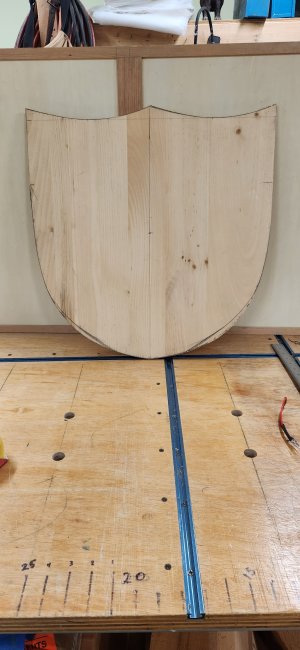
I am currently making a template for the plaque out of pine. Here is a picture.
Edit: It is roughly 21" tall by 20" wide. Also, the pencil lines at the bottom are not what I was following. I decided to move the curve out a bit from those lines.
I find making a perfect curve challenging. I am doing okay, but was wondering about my technique with my oscillating spindle sander.
Can anyone let me know whether for larger curves the larger spindle is the better choice?
Also, do you nibble at the high spots and then finish off by running the entire curve along the drum?
Lastly, I have the Festool sander with the right angle guide (I forget the model numbers). That seems to be useful for smoothing out the curve, but I wonder whether it ultimately will introduce flat spots that can't be smoothed out.
I am currently making a template for the plaque out of pine. Here is a picture.
Edit: It is roughly 21" tall by 20" wide. Also, the pencil lines at the bottom are not what I was following. I decided to move the curve out a bit from those lines.
Last edited:


