Question

Bob Marino

Member
Joined
Jan 16, 2007
Messages
3,003
Ok, let me through this one out to the Group. What are the current thoughts/opinions on the RO90? I had one, but hadn't used it too much, but when I did, it served its purpose. I had a garage fire last year, lost all my tools, so I am looking to have a semblance of a shop now that the garage is rebuilt. I have the ETS 150/3. I don't anticipate doing rough, large board sanding, but there will be times I'll need something more aggressive than the ETS.
 
Firstly, really sorry to hear about the fire, I can only imagine how gutting that would have been.

It sounds like the RO150 might be the better single aggressive option, unless you're likely to mainly do smaller areas/buffing, in which case the RO90 would be more suitable I expect?
 
Bob, very sad to hear about your fire. That's a real bummer!

I bought the RO90 a couple years ago. It doesn't get a whole lot of use, honestly, but when it's the right tool, particularly in tight spaces, it gets pulled out. (To be fair, I don't use the RO150 much either but it's a great tool) You're welcome to come play with it if you want to make the drive. It's been a minute... ;)
 
Thanks guys. Yeah, it was tough, buy luckily it was the garage (and car inside) but the house was not affected and most importantly, no one was heart. Interesting thing, most likely scenario - not conclusive, was that the ct 26 was plugged in - but not on and there could have been some type of short/arc and was enough to light up the nearby cardboard.
 
So glad your house didn’t burn!

I bought the RO90 to beat hell out of small stuff and sculpt chair bottoms, but I have’nt used it at all so far. I’m in the “if you think you’ll need someday and find it on sale, go ahead and buy it”.

Are you sure using more aggressive grits on the ERS 150/3 won’t suffice? Have you tried 3M Cubitron?
 
Sorry to hear about the fire. That's always devastating - even if no one was injured.

I've had my RO90 for about a year but didn't really use it much - until this past couple of weeks as I've been refinishing this courtroom chair. I used it almost exclusively on the chair (with a little ETS 125 action) - especially for stripping the remaining paint and finish after using CitriStrip.

I'm like Michael - more of the "if you think you may need it, it's better to have it" mindset. The RO90 is a great performer.
 
Sorry for the fire...I had one and it sucks. :mad::mad:

But this is pretty cute, I pulled up the receipt for my RO 90 and it says I purchased it from some guy named Bob Marino in 2014 for $332...:ROFLMAO::ROFLMAO::ROFLMAO:

I use mine for sanding narrow pieces on cabinetry and also for buffing out acrylic lenses on headlights. I've also used it to sand/blend in weld beads on metal weldments.
 
I'd pinch to argue the RO90 is one of those tools that have two distinct markets:
- those professionals who can justify it for specialty tasks
- homeowner hobbyists who seek a small yet versatile tool chest and would leverage its versatility

I presume you fit the hobbyist slot here. It can take the role of the ROTEX, the Delta and a polisher, small detail sander all in one nimble tool. The only way I can imagine the RO 90 improved is a cordless version of it. Along with an OSC 18, AGC 18 and the TPC those four would be my "home attendance" tools to have for ad-hoc touches of whatever might need it. Already the ETS EC is a specialist tool in this context.

It is an excellent companion to an ETS EC when seeking a minimal tool chest. It is much better in this role than a monster like the RO 150.
The alternative to an RO 90 is an RO 150 + DTS 400 + 70 mm sanding disc for a drill.

IMO what you will find is that people who have it and use it very rarely are hobbyists with significant tool chests that will often use other, more specialist, tool for a task the RO 90 could have handled.
 
Last edited:
Sorry to hear about the fire, but glad everyone was OK.

I have an RO90 and use it a lot. (For sanding I would be in the homeowner hobbyist camp, and exactly as predicted by Mino my other sander is an ETS EC 150/5)!

I find the RO90 very useful for sanding skirting boards (baseboards), window sills, details around doors etc prior to painting. It is conveniently small and "gets in there" particularly with the delta attachment.

For woodwork I mainly do smaller sized pieces which are well suited to the RO 90. The ETS EC then picks up bigger stuff. The two are a really good combination.

Obviously depends on what you do but I am really glad I have mine and love it.
 
Tough break @Bob Marino , and I'm sorry to hear about your loss.

The RO90 is increasingly a specialty tool for me, and i use it a lot less than when I first bought it. I was initially attracted to it for doing detailed contour sanding as well as stripping for refinishing furniture, and for these applications it is without peer. But i then found all sorts of additional uses with the delta head, especially cleaning up corners and edges after glue ups. Over time though ive changed my protocol on furniture builds, taking a lot more care taping up joints and in general just investing more time in prep so as to minimize the time spent on clean up. As a result, I've more or less eliminated the need for the delta head function of the RO90 in these situations.

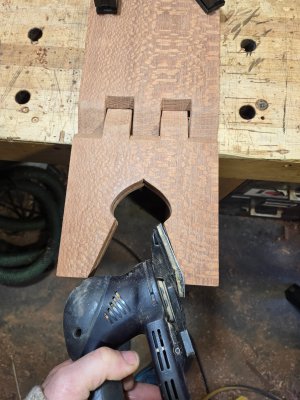
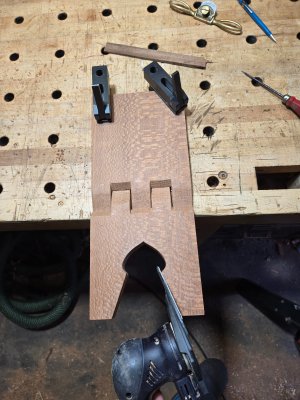
But random situations always pop up where the RO90 is the only tool for the job. Like just yesterday, where I was making a book cradle, and had to sand the edge of the legs i had cut out with a jigsaw. The space was too narrow to fit a sander, even the low profile of the RO90 fitted with the normal pads -- but the extended delta head of the RO90 allowed me to reach the edge and sand it smooth and straight. I've recreated the difference in the attached pictures showing how the extended head permitted full coverage of the edge.

So I'm glad I have the tool in my arsenal, though i could conceivably go without it.

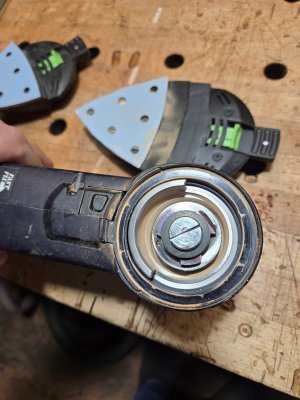
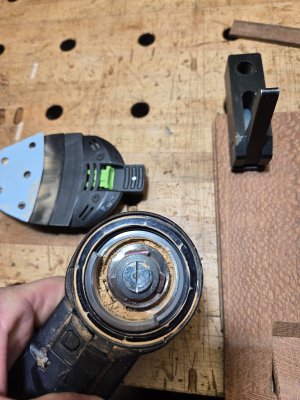
One complaint I've always had about the RO90 is the way dust builds up in the sander head under the pad. I've never measured whether this affects dust collection when it builds up excessively (which actually does not take that long to do), but it seems like this is something that could be easily fixed with a design change.
 

Attachments

  • 20260429_065839.jpg
    20260429_065839.jpg
    2 MB · Views: 6
  • 20260429_070957.jpg
    20260429_070957.jpg
    1.9 MB · Views: 6
  • 20260429_070638.jpg
    20260429_070638.jpg
    1.4 MB · Views: 6
  • 20260429_070700.jpg
    20260429_070700.jpg
    1.6 MB · Views: 6
Bob, I bought my RO 90 through you "way back when", and it has performed admirably. I find that it is my go-to tool for polishing out headlight covers, and it really shines (pun intended) in this as well as doing small furniture repairs. Sorry you have to go through this and hope you come through OK.
 
...
One complaint I've always had about the RO90 is the way dust builds up in the sander head under the pad. I've never measured whether this affects dust collection when it builds up excessively (which actually does not take that long to do), but it seems like this is something that could be easily fixed with a design change.
Dust gathers like this in spaces that do not see sufficient air speed .. and those space are, by definition, the ones not necessary to be there. It may seem counter-intuitive, but you "want" the dust there. Once the dust fills those superfluous cavities, dust collection will marginally improve as turbulent flow is replaced by a /faster/ laminar flow with a smaller pressure loss.

The way to avoid this at design is usually to add material, creating a shape that is more similar to the one with attached dust .. but that adds weight. Just leaving a cavity around empty and relying on generated the dust to fill it up is a technically very elegant solution. Of course, a different situation is clogging of the dust port from fibres .. but this it not the scenario here.

If you are concerned, run the vac at full power once in a while with the sander above the stock to slipstream the air channels. Do not bother with manual cleaning .. if not for aesthetic reasons.
 
Last edited:
@Bob Marino Glad to hear from you again, but sorry it is under these circumstances.

I use my RO 90 on just about every project I do a lot of shaping on edges and such with a carving wheel on a RA grinder. The RO 90 is my go-to tool for smoothing those out and getting to a finish ready surface on those edges and contours. I usually have a foam pad or two under the sandpaper to fit the contours better.

I rely on it so much I actually snagged another of the recon sale for a backup!

Ron
 
Back
Top