Replace outdoor junction box options

Rick Herrick

Member
Joined
Feb 7, 2020
Messages
793
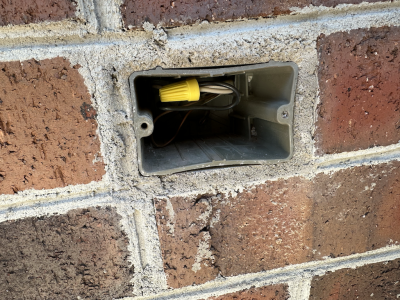
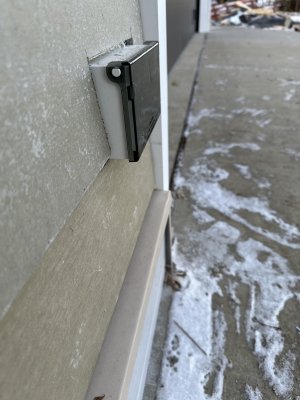
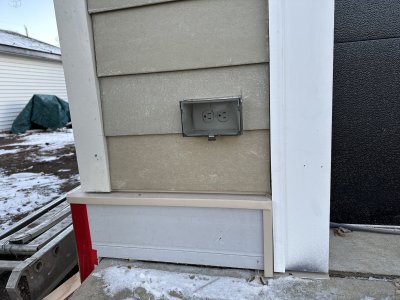
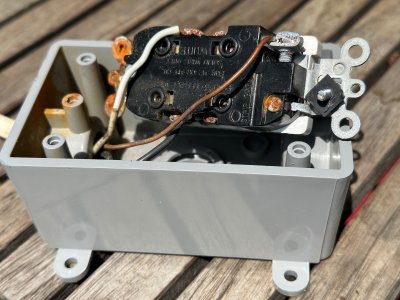
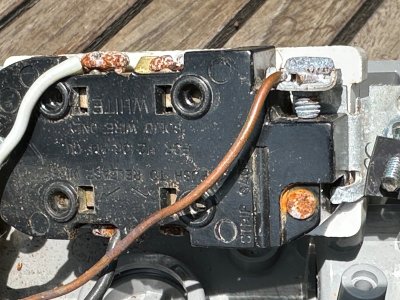
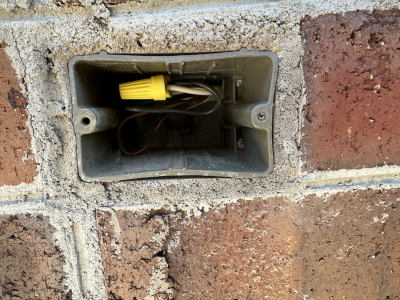
Morning. Moved into a 35 year old house this year and doing some maintenance. Both outdoor outlets are rusted and falling apart. The screws holding the outlet into the junction box had badly rusted screws. I was able to get one out but the other simply snapped leaving a stub in the hole. I haven't used an easy-out in decades and I don't have one handy. Is this hole too small for an easy-out operation? I watched a few YT videos on installing and replacing outlets in brick and it looks like they are mortared in. I would like to salvage this box but it may not be possible. Any thoughts or suggestions? Thank you.
 

Attachments

  • porch outlet 1.png
    porch outlet 1.png
    1.8 MB · Views: 24
  • porch outlet 2.png
    porch outlet 2.png
    1.8 MB · Views: 26
The boxes are plastic so they can be reused. Easy-out don’t come small enough but left hand drill bits do exist.
Wouldn’t bother look for such a bit. Just drill out the snapped screw and use a next size larger stainless screw on that side.
While shopping for the replacement screws look for more weather resistant electrical hardware.
 
I believe that's a #6 screw so you'd use a Hanson EX-1 (5/64) drill bit & extractor. Be careful though as this size of extractor is very easy to break because it's hardened...I've broken several. Also note that it's important to drill the hole directly in the center of the rusted fastener. Any off-center drilling enlarges the hole which may mean you'll have to increase the tapped hole to fit a #8 screw. Also, off-center drilling causes the extractor to bite into the rusted screw AND the metal box itself, thus making the removal of the screw more difficult and possibly leading to extractor breakage. Lastly, if you need to increase the screw size to #8, you may want to consider doing it for both holes to make any future adjustments easier.

For all of the reasons above, If this were my project, I'd consider replacing the metal box with a plastic box, then the rusted/corroded screw issue goes away for ever. :)
 
As mentioned that is definitely a PVC outlet (box), the screw is 6-3. You will not get the screw out of the box with an easy out.

Chip the mortar out, replace the outlet using a PVC outlet.

There are two upgrades you can make, TR/MR GFCI outlets and an in use cover.

Tom
 
As mentioned that is definitely a PVC outlet (box), the screw is 6-3. You will not get the screw out of the box with an easy out.

Chip the mortar out, replace the outlet using a PVC outlet.

There are two upgrades you can make, TR/MR GFCI outlets and an in use cover.

Tom
Thanks Tom. I do believe replacing it for long term. Regarding TR/MR, is that something to do with tamper resistant? This outlet has a GFCI outlet ahead of it on the other side of the wall in the kitchen. The one in the kitchen and this one outside are the only ones on that circuit. Would I still need GFCI outside in this case?
 
FWIW...I've been slowly changing out the existing outside electrical boxes and substituting these Arlington in-wall boxes instead.

They're pretty low profile, basically water proof and any plug-in cords exit the outlet and then bend down to exit the bottom of the in-wall box...pretty slick.

https://www.aifittings.com/media/spec-sheets/DB-SERIES.pdf
 

Attachments

  • 14545.JPG
    14545.JPG
    577 KB · Views: 18
  • 14546.JPG
    14546.JPG
    855 KB · Views: 18
FWIW...I've been slowly changing out the existing outside electrical boxes and substituting these Arlington in-wall boxes instead.

They're pretty low profile, basically water proof and any plug-in cords exit the outlet and then bend down to exit the bottom of the in-wall box...pretty slick.

https://www.aifittings.com/media/spec-sheets/DB-SERIES.pdf
Thanks Cheese, these look pretty good. Did you order from the company? I guess I will go to a local electrical supply and skip the big box store. I am seeing a few of these, even from a bigger company like Hubbell are still including a metal box vs plastic.
 
The first time I ran across these (about 15 years ago) I purchased them from Graybar Electric. The last grouping was purchased 2 years ago on the internet. If you want to examine them in person then a local electrical supply house is probably your best bet. They're offered with clear, smoke and white covers.

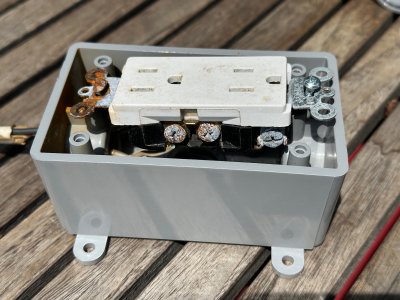
I've pretty much given up on using metal electrical boxes for any outside exposure. I was a big fan of powder coated aluminum boxes and installed 10 of them around the yard for power tools & holiday decorations. After just 5-6 years the powder coating was peeling off and they all looked like hell. They also leaked internally because when the powder coating on the aluminum box edge flakes off and the powder coating on the aluminum cover flakes off, it leaves a gap for moisture to gain entrance to the contents. Here's what a Leviton outlet looks like after 11 years of exposure in a "sealed" aluminum electrical box.
 

Attachments

  • 16301_11yrs.JPG
    16301_11yrs.JPG
    801.1 KB · Views: 16
  • 16302_11 years.JPG
    16302_11 years.JPG
    832.8 KB · Views: 14
  • 16303_11 years.JPG
    16303_11 years.JPG
    821.4 KB · Views: 13
The first time I ran across these (about 15 years ago) I purchased them from Graybar Electric. The last grouping was purchased 2 years ago on the internet. If you want to examine them in person then a local electrical supply house is probably your best bet. They're offered with clear, smoke and white covers.

I've pretty much given up on using metal electrical boxes for any outside exposure. I was a big fan of powder coated aluminum boxes and installed 10 of them around the yard for power tools & holiday decorations. After just 5-6 years the powder coating was peeling off and they all looked like hell. They also leaked internally because when the powder coating on the aluminum box edge flakes off and the powder coating on the aluminum cover flakes off, it leaves a gap for moisture to gain entrance to the contents. Here's what a Leviton outlet looks like after 11 years of exposure in a "sealed" aluminum electrical box.
I guess the water wins almost every time.
 
Wow, did I get lucky today. I thought if I was going to have to remove the existing plastic box I should try to drill out the one screw. I got in about 3/16". I took an awl and lightly tapped it on the metal, trying to break it lose. But it actually pushed back into the whole like it was a bushing of some sort. The more I pushed it in, the side of the junction box pressed inward. I could see mortar on the outside of the box. I got a small old flat blade screw driver and tried to break some of it up. I realize now there is a cavity behind the screw hole to accept the mortar when its pushed in? Once I had enough broken (without the box coming lose), I tested the screw holes with a new GFCI outlet. It went in a bit then seemed to spin so I pushed just a little harder and it bit. I went ahead with that install just so I still have something to use on my porch but I will be looking for a more permanent box/outlet at Graybar. Thanks for the tips.
 
Thanks Tom. I do believe replacing it for long term. Regarding TR/MR, is that something to do with tamper resistant? This outlet has a GFCI outlet ahead of it on the other side of the wall in the kitchen. The one in the kitchen and this one outside are the only ones on that circuit. Would I still need GFCI outside in this case?
Tamper resistant/moisture resistant.

Tom
 
FWIW...I've been slowly changing out the existing outside electrical boxes and substituting these Arlington in-wall boxes instead.

They're pretty low profile, basically water proof and any plug-in cords exit the outlet and then bend down to exit the bottom of the in-wall box...pretty slick.

https://www.aifittings.com/media/spec-sheets/DB-SERIES.pdf
I agree.
Those Arlington boxes are big enough to hide a 12 ounce beer can.
Only thing is the cover will degrade over time if sun shines on it.
Of course, putting one in a brick wall is a bit of work.
 
Tamper resistant/moisture resistant.

Tom
Add to that listing, weather resistant receptacles which Legrand designates as WR and are required as code in outdoor spaces in Minnesota.

As just a general observation, before I became aware of the WR rated GFCI's, I installed a non WR rated unit and had to replace it after 2 years because it failed. About 1-1/2 years later I had to replace the GFCI again. Finally after the 3rd replacement within about 5 years total, I became aware of the local WR requirement and more importantly the WR receptacle availability. It's been just over 2 years now and my fingers are both crossed. :)
 
Last edited:
Back
Top