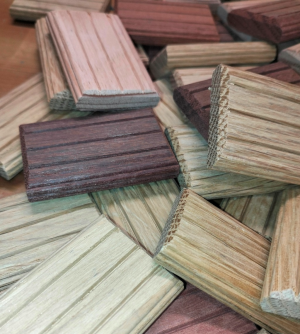
Just my two cents...I don't usually think the sides of a domino offer much. I'll just cut a wider domino with the machine, and then rip the domino square sided. Occasionally I'll take a few passes with a low angle block plane and give the sides a rough chamfer. It's nice to have some extra wiggle room on the sides when gluing up a large number of dominoes, and extra width also gives space for any extra glue. The top and the bottom of a domino are structurally enough for most of my work, small and big—unless I really want perfect alignment—and even then, that's usually just a matter of adjusting while clamping.
I fret the near perfect thickness of the domino. To my mind that's the important factor. In softwoods, I'll do a test, and sometimes leave them just a fraction of a hair thicker for snug alignment. Especially in larger thickness dominoes from the XL.


 agree
agree