Sander for Trim indoors, and Outdoors?

DashZero

Member
Joined
Feb 23, 2017
Messages
137
Currently I have a Mirka Deros 650 6" Paddle Electric Cord sander I use with my Festool CT 26 HEPA. I have been using this to learn to float my drywall and work on getting a smooth no texture finish. I recently replace carpet with LVP floating, and made sure to take al the trim off. There is no quarter round just trim along the baseboards.

I have attempted to use the Mirka to sand the existing gold paint off so I can fill any issues and pain the trim before I nail it back on. I think from all the threads here I should be using an Orbital sander.

After I sand, paint, put the trim back, I will need to sand and paint the facia and soft outside and a back wall of cement board.

Question 1: Could this be done with a RO 90? I like the idea of the new DTSC 200. But it's not out. If the DTSC would do the outside and the inside. I could hold off for it.

Question 2: It looks like I should be using the delta foam pad to sand the trim to not damage the profile an edges, and that seem to fit the DTSC 400. I assume the DTSC 200 will have foam pads as well.

Question 3: Am I correct that the RO 90 is really for flat surfaces, since it don't see a foam pad?

Thank You.

Mario
 
To take a page from the traditional floor finishers books, edgers are typically used around the periphery of the room where the trim/base meets the wood flooring. The usual Clarke or Lagler edger is a rotary driven disc machine using either 7" or 6" discs. It functions in the same manner as a Festool RAS or a RA grinder.
I'd think using a Rotex dual action machine for the same purpose would work well, it'll just take a little longer...but not much if just reapplying a maintenance coat is desired. However, I do think that trying to use an RO 90 for that purpose could be challenging. I'd prefer to use the RO 150 and if absolutely necessary settle on the RO 125...maybe...just maybe. If the floor boards are more than 3" wide, then the RO 90 could prove to be a hot mess as it will not completely cover the piece of wood strip you want to sand and you'll then have to fair in the floor to meet the height of the floor edge.
 
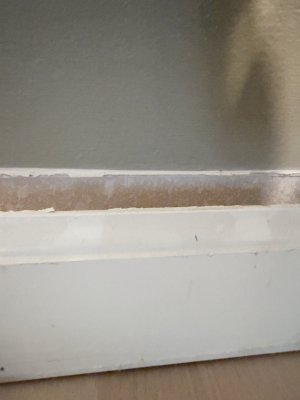
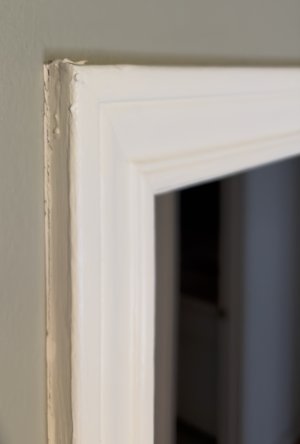
I apologize for not being more clear, The floor is vinyl plank, I'm trying to sand 3 inch baseboard molding , and trim around doors, not the floor itself.
 

Attachments

  • IMG_9176.jpg
    IMG_9176.jpg
    1.5 MB · Views: 18
  • IMG_9177 copy.jpg
    IMG_9177 copy.jpg
    1.3 MB · Views: 18
I take it you are trying to keep the original trim…I see very little help from the “machine” (flat surfaces..yes) soft pads just round over details and there will be a lot of hand sanding -after stripping that old paint-
If the original detail is not really important, the crisp details of new trim will leave more time for other work and make all this go much faster, plus make you smile …next to your super smooth walls
 
Last edited:
Well yes sort of….thats why I was careful not to just say, replace it with new…when you have unique or custom trim and want to save it there is a lot of hand- finessing- stripping, (often several coats in an older house) ,to be done. Trim is often soft wood(s) and sanding can remove/soften crisp details.
So yes…the basic steps..prime, install, fill nail holes, apply finish until happy with the coverage
 
I have a Porter-Cable detail sander. Well-made, but ill-conceived. Almost unusable.

I have found that a decent sanding block and appropriate grit selection can make fast work of the trim like the ones pictured.

I use the Gator-style moulded foam sanding blocks. I have them in three sizes. The original one was a genuine Gator, the rest are Amazon-purchased knock offs. They all work about the same.

Gator sand paper is pretty good, but not cheap. I buy roles of sand paper from Amazon to use with these.

In any case, I think you will find that the job is not so labor intensive if you have the right sanding block and the right grit selection. The sanding blocks are light weight, have no trailing electric cords and will do the job in short order. They will also drop all the dust directly below and very little will remain airborne.

Also, I find hand sanding somewhat addictive. It makes me feel more craftsman-like. But I assume that is a personality quirk possibly unique to me.

The original Gator stuff is available a Lowes and Home Depot.

 
Well yes sort of….thats why I was careful not to just say, replace it with new…when you have unique or custom trim and want to save it there is a lot of hand- finessing- stripping, (often several coats in an older house) ,to be done. Trim is often soft wood(s) and sanding can remove/soften crisp details.
So yes…the basic steps..prime, install, fill nail holes, apply finish until happy with the coverage
it is solid wood about 4 or 5 inch pieces joint not mdf and no fancy profile. SO that leaves for soffit and facia outdoors I should still use an orbital sander correct?
 
I have a Porter-Cable detail sander. Well-made, but ill-conceived. Almost unusable.

I have found that a decent sanding block and appropriate grit selection can make fast work of the trim like the ones pictured.

I use the Gator-style moulded foam sanding blocks. I have them in three sizes. The original one was a genuine Gator, the rest are Amazon-purchased knock offs. They all work about the same.

Gator sand paper is pretty good, but not cheap. I buy roles of sand paper from Amazon to use with these.

In any case, I think you will find that the job is not so labor intensive if you have the right sanding block and the right grit selection. The sanding blocks are light weight, have no trailing electric cords and will do the job in short order. They will also drop all the dust directly below and very little will remain airborne.

Also, I find hand sanding somewhat addictive. It makes me feel more craftsman-like. But I assume that is a personality quirk possibly unique to me.

The original Gator stuff is available a Lowes and Home Depot.


ok thanks ill take a look
 
ok thanks ill take a look
Even if they don’t work for the bulk of this job, they will be useful for difficult to reach spots. And they will see action in many woodworking projects. I think sanding blocks of some sort are essential tools for woodworkers.

I just think the Gator-style blocks are the best of the bunch and the Velcro attachment method is very handy.

The make three sizes: 3.5” x 9”; 2.65” x 5” and 1” x 3.5”. The 2.65” x 5” sees the most use. A kit with samples of sanding paper and the holder is about $12.00.
 
Last edited:
As far as the original trim is concerned, you might go The Difficult Way - see if you can find a used LS130 sander, buy that and get the contour pad for it. This allows you to shape a pad to the exact shape of the trim you need to sand. I say this is The Difficult Way because the LS130 has been discontinued for quite a few years now but they do come up in the used market from time to time.
 
Back
Top